

56
3 Mechanism of Unidirectional Rotation of γ Subunit in F 1 -ATPase
Loosely packed
Closely packed
Moderately packed
State (d)
Moderately packed
Loosely packed
Closely packed
State (c)
State (a) in Fig. 3.22
X
X
: Closely packed interface
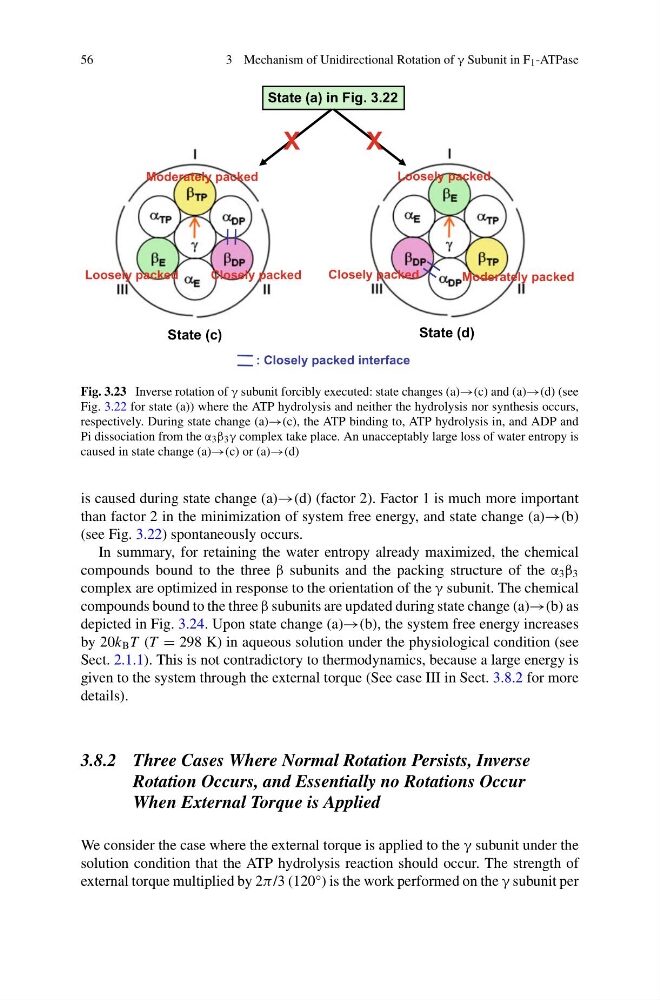
Fig. 3.23 Inverse rotation of γ subunit forcibly executed: state changes (a)→(c) and (a)→(d) (see
Fig. 3.22 for state (a)) where the ATP hydrolysis and neither the hydrolysis nor synthesis occurs,
respectively. During state change (a)→(c), the ATP binding to, ATP hydrolysis in, and ADP and
Pi dissociation from the α 3 β 3 γ complex take place. An unacceptably large loss of water entropy is
caused in state change (a)→(c) or (a)→(d)
is caused during state change (a)→(d) (factor 2). Factor 1 is much more important
than factor 2 in the minimization of system free energy, and state change (a)→(b)
(see Fig. 3.22) spontaneously occurs.
In summary, for retaining the water entropy already maximized, the chemical
compounds bound to the three β subunits and the packing structure of the α 3 β 3
complex are optimized in response to the orientation of the γ subunit. The chemical
compounds bound to the three β subunits are updated during state change (a)→(b) as
depicted in Fig. 3.24. Upon state change (a)→(b), the system free energy increases
by 20k B T (T = 298 K) in aqueous solution under the physiological condition (see
Sect. 2.1.1). This is not contradictory to thermodynamics, because a large energy is
given to the system through the external torque (See case III in Sect. 3.8.2 for more
details).
3.8.2 Three Cases Where Normal Rotation Persists, Inverse
Rotation Occurs, and Essentially no Rotations Occur
When External Torque is Applied
We consider the case where the external torque is applied to the γ subunit under the
solution condition that the ATP hydrolysis reaction should occur. The strength of
external torque multiplied by 2π /3 (120°) is the work performed on the γ subunit per
3 Mechanism of Unidirectional Rotation of γ Subunit in F 1 -ATPase
Loosely packed
Closely packed
Moderately packed
State (d)
Moderately packed
Loosely packed
Closely packed
State (c)
State (a) in Fig. 3.22
X
X
: Closely packed interface
Fig. 3.23 Inverse rotation of γ subunit forcibly executed: state changes (a)→(c) and (a)→(d) (see
Fig. 3.22 for state (a)) where the ATP hydrolysis and neither the hydrolysis nor synthesis occurs,
respectively. During state change (a)→(c), the ATP binding to, ATP hydrolysis in, and ADP and
Pi dissociation from the α 3 β 3 γ complex take place. An unacceptably large loss of water entropy is
caused in state change (a)→(c) or (a)→(d)
is caused during state change (a)→(d) (factor 2). Factor 1 is much more important
than factor 2 in the minimization of system free energy, and state change (a)→(b)
(see Fig. 3.22) spontaneously occurs.
In summary, for retaining the water entropy already maximized, the chemical
compounds bound to the three β subunits and the packing structure of the α 3 β 3
complex are optimized in response to the orientation of the γ subunit. The chemical
compounds bound to the three β subunits are updated during state change (a)→(b) as
depicted in Fig. 3.24. Upon state change (a)→(b), the system free energy increases
by 20k B T (T = 298 K) in aqueous solution under the physiological condition (see
Sect. 2.1.1). This is not contradictory to thermodynamics, because a large energy is
given to the system through the external torque (See case III in Sect. 3.8.2 for more
details).
3.8.2 Three Cases Where Normal Rotation Persists, Inverse
Rotation Occurs, and Essentially no Rotations Occur
When External Torque is Applied
We consider the case where the external torque is applied to the γ subunit under the
solution condition that the ATP hydrolysis reaction should occur. The strength of
external torque multiplied by 2π /3 (120°) is the work performed on the γ subunit per