

52
3 Mechanism of Unidirectional Rotation of γ Subunit in F 1 -ATPase
(i.e., roughly as small as) the decrease in system free energy during one ATP hydrolysis cycle ~−20k B T (T = 298 K), which is physically reasonable. We also find that
the interfaces of α DP −β DP and α E −β E become less efficiently packed (i.e., more
open) after the rotation, which is in agreement with the experimental observations
[30].
3.6 Inverse Rotation Under Solution Condition that ATP
Synthesis Reaction Occurs
3.6.1 State of α 3 β 3 γ Complex Stabilized
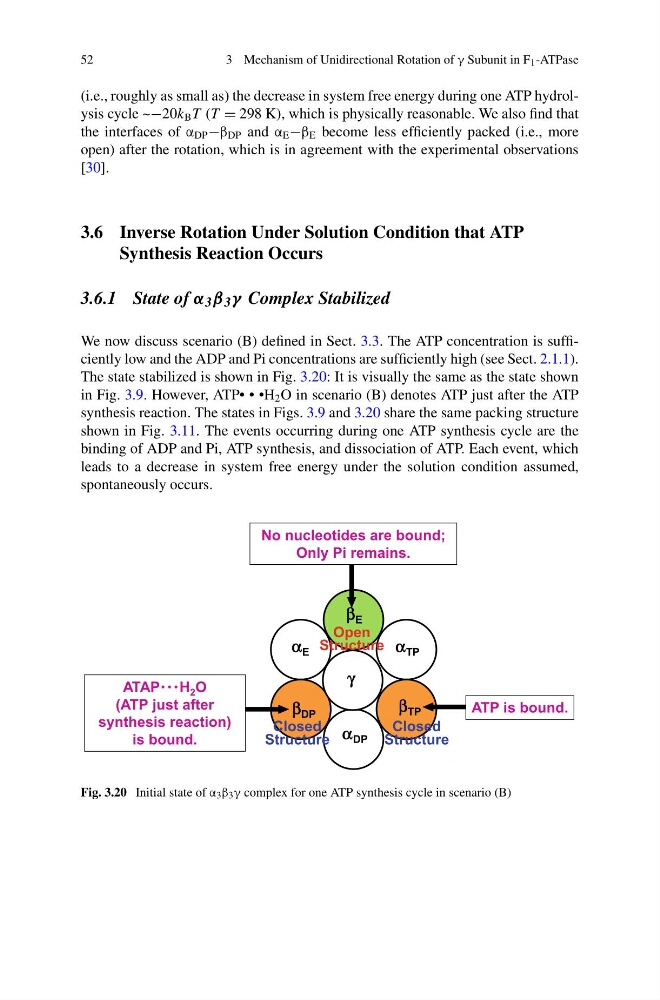
We now discuss scenario (B) defined in Sect. 3.3. The ATP concentration is sufficiently low and the ADP and Pi concentrations are sufficiently high (see Sect. 2.1.1).
The state stabilized is shown in Fig. 3.20: It is visually the same as the state shown
in Fig. 3.9. However, ATP• • •H 2 O in scenario (B) denotes ATP just after the ATP
synthesis reaction. The states in Figs. 3.9 and 3.20 share the same packing structure
shown in Fig. 3.11. The events occurring during one ATP synthesis cycle are the
binding of ADP and Pi, ATP synthesis, and dissociation of ATP. Each event, which
leads to a decrease in system free energy under the solution condition assumed,
spontaneously occurs.
α TP
β DP
β E
α E
α DP
β TP
ATAP H 2 O
(ATP just after
synthesis reaction)
is bound.
γ
No nucleotides are bound;
Only Pi remains.
ATP is bound.
Closed
Structure
Closed
Structure
Open
Structure
Fig. 3.20 Initial state of α 3 β 3 γ complex for one ATP synthesis cycle in scenario (B)
3 Mechanism of Unidirectional Rotation of γ Subunit in F 1 -ATPase
(i.e., roughly as small as) the decrease in system free energy during one ATP hydrolysis cycle ~−20k B T (T = 298 K), which is physically reasonable. We also find that
the interfaces of α DP −β DP and α E −β E become less efficiently packed (i.e., more
open) after the rotation, which is in agreement with the experimental observations
[30].
3.6 Inverse Rotation Under Solution Condition that ATP
Synthesis Reaction Occurs
3.6.1 State of α 3 β 3 γ Complex Stabilized
We now discuss scenario (B) defined in Sect. 3.3. The ATP concentration is sufficiently low and the ADP and Pi concentrations are sufficiently high (see Sect. 2.1.1).
The state stabilized is shown in Fig. 3.20: It is visually the same as the state shown
in Fig. 3.9. However, ATP• • •H 2 O in scenario (B) denotes ATP just after the ATP
synthesis reaction. The states in Figs. 3.9 and 3.20 share the same packing structure
shown in Fig. 3.11. The events occurring during one ATP synthesis cycle are the
binding of ADP and Pi, ATP synthesis, and dissociation of ATP. Each event, which
leads to a decrease in system free energy under the solution condition assumed,
spontaneously occurs.
α TP
β DP
β E
α E
α DP
β TP
ATAP H 2 O
(ATP just after
synthesis reaction)
is bound.
γ
No nucleotides are bound;
Only Pi remains.
ATP is bound.
Closed
Structure
Closed
Structure
Open
Structure
Fig. 3.20 Initial state of α 3 β 3 γ complex for one ATP synthesis cycle in scenario (B)