

46
3 Mechanism of Unidirectional Rotation of γ Subunit in F 1 -ATPase
Looser
Closer
Dissociation of
Pi from β E
ATP binding
to β’ E
Closed (β DP )
↓
Half-open (β DP
HO )
Half-open (β DP
HO )
↓
Open (β E )
Looser
ATP hydrolysis
in β DP
Dissociation of
ADP from β DP
HO
40 o
rotation
80 o
rotation
Loose
Close
Moderate
Closer
Closer
Closer
Loose
Close
Moderate
ATP ATP(ATP H 2 O)
ATP(ATP H 2 O)
ATP H 2 O
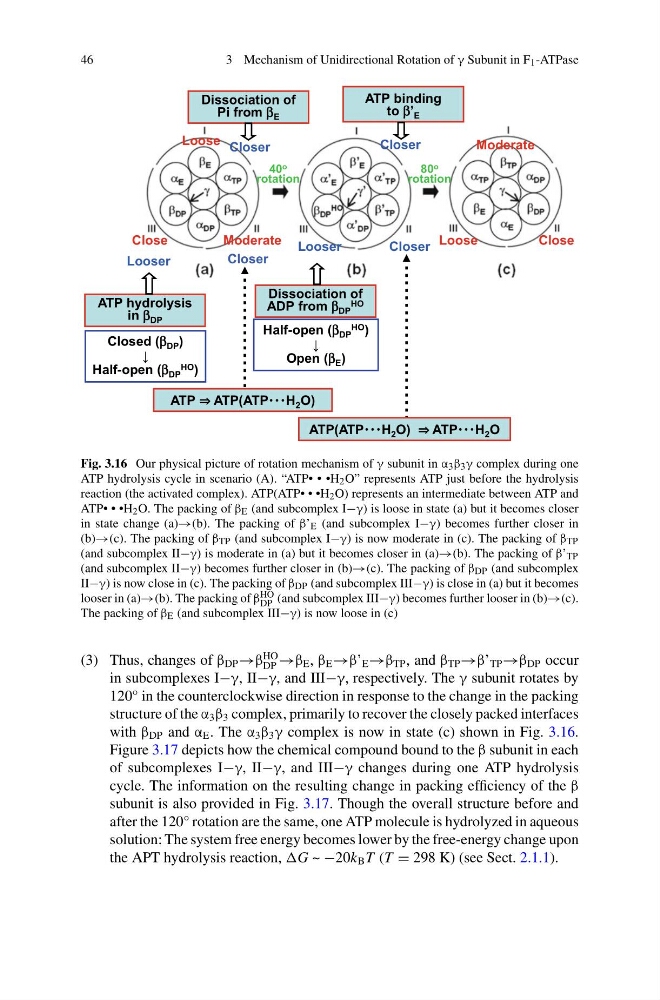
Fig. 3.16 Our physical picture of rotation mechanism of γ subunit in α 3 β 3 γ complex during one
ATP hydrolysis cycle in scenario (A). “ATP• • •H 2 O” represents ATP just before the hydrolysis
reaction (the activated complex). ATP(ATP• • •H 2 O) represents an intermediate between ATP and
ATP• • •H 2 O. The packing of β E (and subcomplex I−γ) is loose in state (a) but it becomes closer
in state change (a)→(b). The packing of β’ E (and subcomplex I−γ) becomes further closer in
(b)→(c). The packing of β TP (and subcomplex I−γ) is now moderate in (c). The packing of β TP
(and subcomplex II−γ) is moderate in (a) but it becomes closer in (a)→(b). The packing of β’ TP
(and subcomplex II−γ) becomes further closer in (b)→(c). The packing of β DP (and subcomplex
II−γ) is now close in (c). The packing of β DP (and subcomplex III−γ) is close in (a) but it becomes
looser in (a)→(b). The packing of β HO
DP (and subcomplex III−γ) becomes further looser in (b)→(c).
The packing of β E (and subcomplex III−γ) is now loose in (c)
(3) Thus, changes of β DP →β
HO
DP →β E , β E →β’ E →β TP , and β TP →β’ TP →β DP occur
in subcomplexes I−γ, II−γ, and III−γ, respectively. The γ subunit rotates by
120° in the counterclockwise direction in response to the change in the packing
structure of the α 3 β 3 complex, primarily to recover the closely packed interfaces
with β DP and α E . The α 3 β 3 γ complex is now in state (c) shown in Fig. 3.16.
Figure 3.17 depicts how the chemical compound bound to the β subunit in each
of subcomplexes I−γ, II−γ, and III−γ changes during one ATP hydrolysis
cycle. The information on the resulting change in packing efficiency of the β
subunit is also provided in Fig. 3.17. Though the overall structure before and
after the 120° rotation are the same, one ATP molecule is hydrolyzed in aqueous
solution: The system free energy becomes lower by the free-energy change upon
the APT hydrolysis reaction, ~ −20k B T (T = 298 K) (see Sect. 2.1.1).
3 Mechanism of Unidirectional Rotation of γ Subunit in F 1 -ATPase
Looser
Closer
Dissociation of
Pi from β E
ATP binding
to β’ E
Closed (β DP )
↓
Half-open (β DP
HO )
Half-open (β DP
HO )
↓
Open (β E )
Looser
ATP hydrolysis
in β DP
Dissociation of
ADP from β DP
HO
40 o
rotation
80 o
rotation
Loose
Close
Moderate
Closer
Closer
Closer
Loose
Close
Moderate
ATP ATP(ATP H 2 O)
ATP(ATP H 2 O)
ATP H 2 O
Fig. 3.16 Our physical picture of rotation mechanism of γ subunit in α 3 β 3 γ complex during one
ATP hydrolysis cycle in scenario (A). “ATP• • •H 2 O” represents ATP just before the hydrolysis
reaction (the activated complex). ATP(ATP• • •H 2 O) represents an intermediate between ATP and
ATP• • •H 2 O. The packing of β E (and subcomplex I−γ) is loose in state (a) but it becomes closer
in state change (a)→(b). The packing of β’ E (and subcomplex I−γ) becomes further closer in
(b)→(c). The packing of β TP (and subcomplex I−γ) is now moderate in (c). The packing of β TP
(and subcomplex II−γ) is moderate in (a) but it becomes closer in (a)→(b). The packing of β’ TP
(and subcomplex II−γ) becomes further closer in (b)→(c). The packing of β DP (and subcomplex
II−γ) is now close in (c). The packing of β DP (and subcomplex III−γ) is close in (a) but it becomes
looser in (a)→(b). The packing of β HO
DP (and subcomplex III−γ) becomes further looser in (b)→(c).
The packing of β E (and subcomplex III−γ) is now loose in (c)
(3) Thus, changes of β DP →β
HO
DP →β E , β E →β’ E →β TP , and β TP →β’ TP →β DP occur
in subcomplexes I−γ, II−γ, and III−γ, respectively. The γ subunit rotates by
120° in the counterclockwise direction in response to the change in the packing
structure of the α 3 β 3 complex, primarily to recover the closely packed interfaces
with β DP and α E . The α 3 β 3 γ complex is now in state (c) shown in Fig. 3.16.
Figure 3.17 depicts how the chemical compound bound to the β subunit in each
of subcomplexes I−γ, II−γ, and III−γ changes during one ATP hydrolysis
cycle. The information on the resulting change in packing efficiency of the β
subunit is also provided in Fig. 3.17. Though the overall structure before and
after the 120° rotation are the same, one ATP molecule is hydrolyzed in aqueous
solution: The system free energy becomes lower by the free-energy change upon
the APT hydrolysis reaction, ~ −20k B T (T = 298 K) (see Sect. 2.1.1).