

3.3 Theoretical Analyses on Packing Structure …
41
β DP
γ
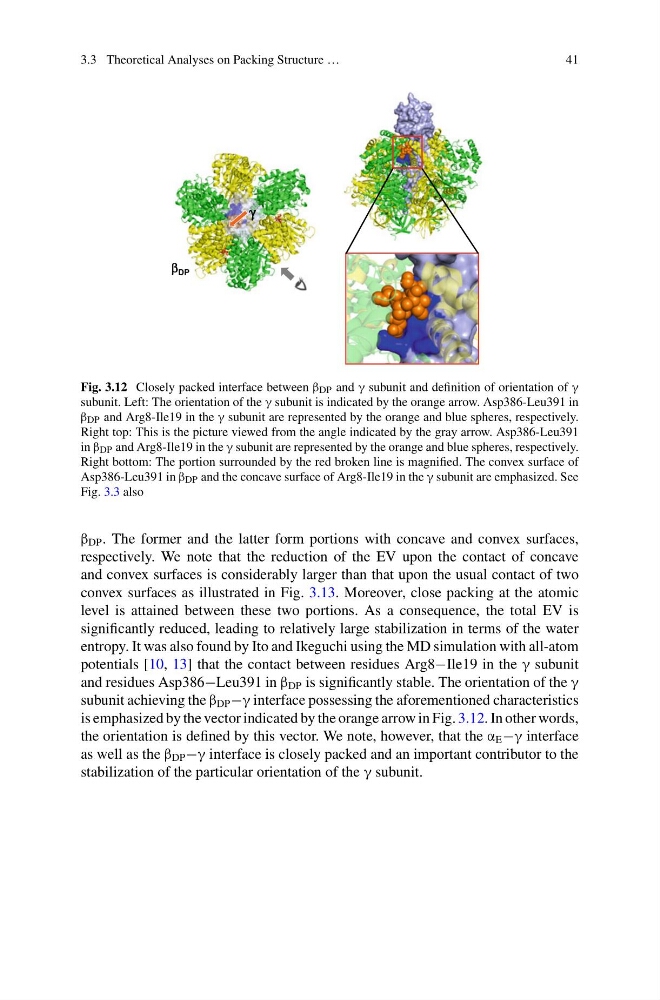
Fig. 3.12 Closely packed interface between β DP and γ subunit and definition of orientation of γ
subunit. Left: The orientation of the γ subunit is indicated by the orange arrow. Asp386-Leu391 in
β DP and Arg8-Ile19 in the γ subunit are represented by the orange and blue spheres, respectively.
Right top: This is the picture viewed from the angle indicated by the gray arrow. Asp386-Leu391
in β DP and Arg8-Ile19 in the γ subunit are represented by the orange and blue spheres, respectively.
Right bottom: The portion surrounded by the red broken line is magnified. The convex surface of
Asp386-Leu391 in β DP and the concave surface of Arg8-Ile19 in the γ subunit are emphasized. See
Fig. 3.3 also
β DP . The former and the latter form portions with concave and convex surfaces,
respectively. We note that the reduction of the EV upon the contact of concave
and convex surfaces is considerably larger than that upon the usual contact of two
convex surfaces as illustrated in Fig. 3.13. Moreover, close packing at the atomic
level is attained between these two portions. As a consequence, the total EV is
significantly reduced, leading to relatively large stabilization in terms of the water
entropy. It was also found by Ito and Ikeguchi using the MD simulation with all-atom
potentials [10, 13] that the contact between residues Arg8−Ile19 in the γ subunit
and residues Asp386−Leu391 in β DP is significantly stable. The orientation of the γ
subunit achieving the β DP −γ interface possessing the aforementioned characteristics
is emphasized by the vector indicated by the orange arrow in Fig. 3.12. In other words,
the orientation is defined by this vector. We note, however, that the α E −γ interface
as well as the β DP −γ interface is closely packed and an important contributor to the
stabilization of the particular orientation of the γ subunit.
41
β DP
γ
Fig. 3.12 Closely packed interface between β DP and γ subunit and definition of orientation of γ
subunit. Left: The orientation of the γ subunit is indicated by the orange arrow. Asp386-Leu391 in
β DP and Arg8-Ile19 in the γ subunit are represented by the orange and blue spheres, respectively.
Right top: This is the picture viewed from the angle indicated by the gray arrow. Asp386-Leu391
in β DP and Arg8-Ile19 in the γ subunit are represented by the orange and blue spheres, respectively.
Right bottom: The portion surrounded by the red broken line is magnified. The convex surface of
Asp386-Leu391 in β DP and the concave surface of Arg8-Ile19 in the γ subunit are emphasized. See
Fig. 3.3 also
β DP . The former and the latter form portions with concave and convex surfaces,
respectively. We note that the reduction of the EV upon the contact of concave
and convex surfaces is considerably larger than that upon the usual contact of two
convex surfaces as illustrated in Fig. 3.13. Moreover, close packing at the atomic
level is attained between these two portions. As a consequence, the total EV is
significantly reduced, leading to relatively large stabilization in terms of the water
entropy. It was also found by Ito and Ikeguchi using the MD simulation with all-atom
potentials [10, 13] that the contact between residues Arg8−Ile19 in the γ subunit
and residues Asp386−Leu391 in β DP is significantly stable. The orientation of the γ
subunit achieving the β DP −γ interface possessing the aforementioned characteristics
is emphasized by the vector indicated by the orange arrow in Fig. 3.12. In other words,
the orientation is defined by this vector. We note, however, that the α E −γ interface
as well as the β DP −γ interface is closely packed and an important contributor to the
stabilization of the particular orientation of the γ subunit.