

22
2 A New View on Mechanism of Functional Expression …
Yeast Frataxin
Vacant Space
(Valley)
Tail
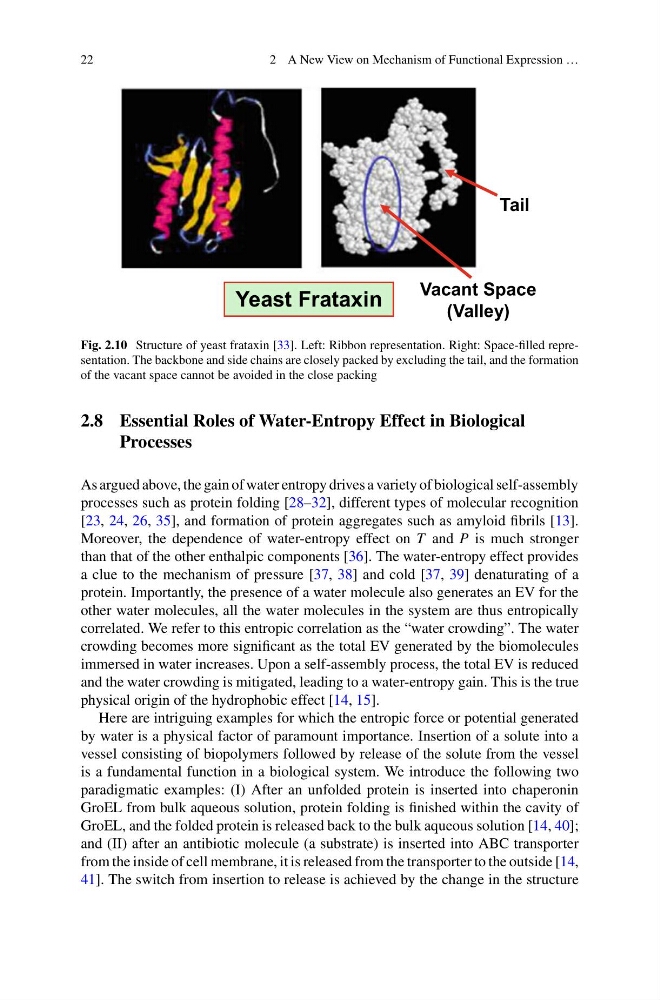
Fig. 2.10 Structure of yeast frataxin [33]. Left: Ribbon representation. Right: Space-filled representation. The backbone and side chains are closely packed by excluding the tail, and the formation
of the vacant space cannot be avoided in the close packing
2.8 Essential Roles of Water-Entropy Effect in Biological
Processes
As argued above, the gain of water entropy drives a variety of biological self-assembly
processes such as protein folding [28–32], different types of molecular recognition
[23, 24, 26, 35], and formation of protein aggregates such as amyloid fibrils [13].
Moreover, the dependence of water-entropy effect on T and P is much stronger
than that of the other enthalpic components [36]. The water-entropy effect provides
a clue to the mechanism of pressure [37, 38] and cold [37, 39] denaturating of a
protein. Importantly, the presence of a water molecule also generates an EV for the
other water molecules, all the water molecules in the system are thus entropically
correlated. We refer to this entropic correlation as the “water crowding”. The water
crowding becomes more significant as the total EV generated by the biomolecules
immersed in water increases. Upon a self-assembly process, the total EV is reduced
and the water crowding is mitigated, leading to a water-entropy gain. This is the true
physical origin of the hydrophobic effect [14, 15].
Here are intriguing examples for which the entropic force or potential generated
by water is a physical factor of paramount importance. Insertion of a solute into a
vessel consisting of biopolymers followed by release of the solute from the vessel
is a fundamental function in a biological system. We introduce the following two
paradigmatic examples: (I) After an unfolded protein is inserted into chaperonin
GroEL from bulk aqueous solution, protein folding is finished within the cavity of
GroEL, and the folded protein is released back to the bulk aqueous solution [14, 40];
and (II) after an antibiotic molecule (a substrate) is inserted into ABC transporter
from the inside of cell membrane, it is released from the transporter to the outside [14,
41]. The switch from insertion to release is achieved by the change in the structure
2 A New View on Mechanism of Functional Expression …
Yeast Frataxin
Vacant Space
(Valley)
Tail
Fig. 2.10 Structure of yeast frataxin [33]. Left: Ribbon representation. Right: Space-filled representation. The backbone and side chains are closely packed by excluding the tail, and the formation
of the vacant space cannot be avoided in the close packing
2.8 Essential Roles of Water-Entropy Effect in Biological
Processes
As argued above, the gain of water entropy drives a variety of biological self-assembly
processes such as protein folding [28–32], different types of molecular recognition
[23, 24, 26, 35], and formation of protein aggregates such as amyloid fibrils [13].
Moreover, the dependence of water-entropy effect on T and P is much stronger
than that of the other enthalpic components [36]. The water-entropy effect provides
a clue to the mechanism of pressure [37, 38] and cold [37, 39] denaturating of a
protein. Importantly, the presence of a water molecule also generates an EV for the
other water molecules, all the water molecules in the system are thus entropically
correlated. We refer to this entropic correlation as the “water crowding”. The water
crowding becomes more significant as the total EV generated by the biomolecules
immersed in water increases. Upon a self-assembly process, the total EV is reduced
and the water crowding is mitigated, leading to a water-entropy gain. This is the true
physical origin of the hydrophobic effect [14, 15].
Here are intriguing examples for which the entropic force or potential generated
by water is a physical factor of paramount importance. Insertion of a solute into a
vessel consisting of biopolymers followed by release of the solute from the vessel
is a fundamental function in a biological system. We introduce the following two
paradigmatic examples: (I) After an unfolded protein is inserted into chaperonin
GroEL from bulk aqueous solution, protein folding is finished within the cavity of
GroEL, and the folded protein is released back to the bulk aqueous solution [14, 40];
and (II) after an antibiotic molecule (a substrate) is inserted into ABC transporter
from the inside of cell membrane, it is released from the transporter to the outside [14,
41]. The switch from insertion to release is achieved by the change in the structure