

2.7 Translational, Configurational Entropy …
21
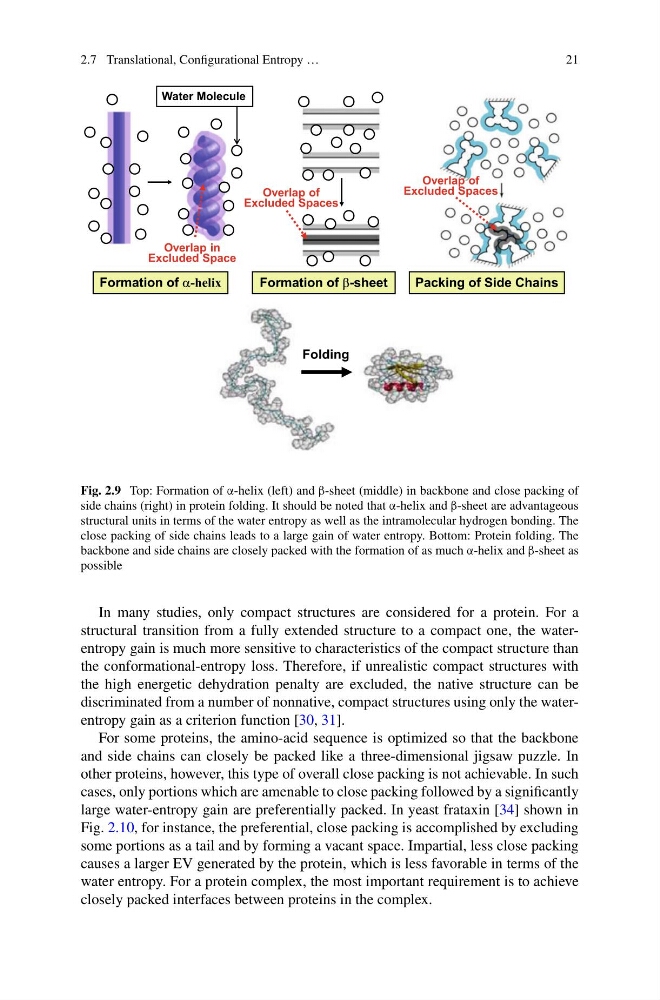
Fig. 2.9 Top: Formation of α-helix (left) and β-sheet (middle) in backbone and close packing of
side chains (right) in protein folding. It should be noted that α-helix and β-sheet are advantageous
structural units in terms of the water entropy as well as the intramolecular hydrogen bonding. The
close packing of side chains leads to a large gain of water entropy. Bottom: Protein folding. The
backbone and side chains are closely packed with the formation of as much α-helix and β-sheet as
possible
In many studies, only compact structures are considered for a protein. For a
structural transition from a fully extended structure to a compact one, the waterentropy gain is much more sensitive to characteristics of the compact structure than
the conformational-entropy loss. Therefore, if unrealistic compact structures with
the high energetic dehydration penalty are excluded, the native structure can be
discriminated from a number of nonnative, compact structures using only the waterentropy gain as a criterion function [30, 31].
For some proteins, the amino-acid sequence is optimized so that the backbone
and side chains can closely be packed like a three-dimensional jigsaw puzzle. In
other proteins, however, this type of overall close packing is not achievable. In such
cases, only portions which are amenable to close packing followed by a significantly
large water-entropy gain are preferentially packed. In yeast frataxin [34] shown in
Fig. 2.10, for instance, the preferential, close packing is accomplished by excluding
some portions as a tail and by forming a vacant space. Impartial, less close packing
causes a larger EV generated by the protein, which is less favorable in terms of the
water entropy. For a protein complex, the most important requirement is to achieve
closely packed interfaces between proteins in the complex.
21
Fig. 2.9 Top: Formation of α-helix (left) and β-sheet (middle) in backbone and close packing of
side chains (right) in protein folding. It should be noted that α-helix and β-sheet are advantageous
structural units in terms of the water entropy as well as the intramolecular hydrogen bonding. The
close packing of side chains leads to a large gain of water entropy. Bottom: Protein folding. The
backbone and side chains are closely packed with the formation of as much α-helix and β-sheet as
possible
In many studies, only compact structures are considered for a protein. For a
structural transition from a fully extended structure to a compact one, the waterentropy gain is much more sensitive to characteristics of the compact structure than
the conformational-entropy loss. Therefore, if unrealistic compact structures with
the high energetic dehydration penalty are excluded, the native structure can be
discriminated from a number of nonnative, compact structures using only the waterentropy gain as a criterion function [30, 31].
For some proteins, the amino-acid sequence is optimized so that the backbone
and side chains can closely be packed like a three-dimensional jigsaw puzzle. In
other proteins, however, this type of overall close packing is not achievable. In such
cases, only portions which are amenable to close packing followed by a significantly
large water-entropy gain are preferentially packed. In yeast frataxin [34] shown in
Fig. 2.10, for instance, the preferential, close packing is accomplished by excluding
some portions as a tail and by forming a vacant space. Impartial, less close packing
causes a larger EV generated by the protein, which is less favorable in terms of the
water entropy. For a protein complex, the most important requirement is to achieve
closely packed interfaces between proteins in the complex.