

17 Introduction to Evidence-Based Robust Optimisation
551
that leads to the robust optimisation problem [47]:
max d∈D Bel(f (d, u) ≤ ν)
min ν∈R ν
(17.26)
Problem (17.26) can be extended to include constraints in three different forms:
max d∈D Bel(f (d, u) ≤ ν)
min ν∈R ν
s.t.
C(d, u) ≤ ν c
(17.27)
max d∈D Bel(f (d, u) ≤ ν)
min ν∈R ν
s.t.
Bel(C(d, u) ≤ ν c ) > 1 −
(17.28)
max d∈D Bel(f (d, u) ≤ ν f )
max d∈D Bel(C(d, u) ≤ ν c )
min ν f ∈R ν f
min ν c ∈R nc ν c
(17.29)
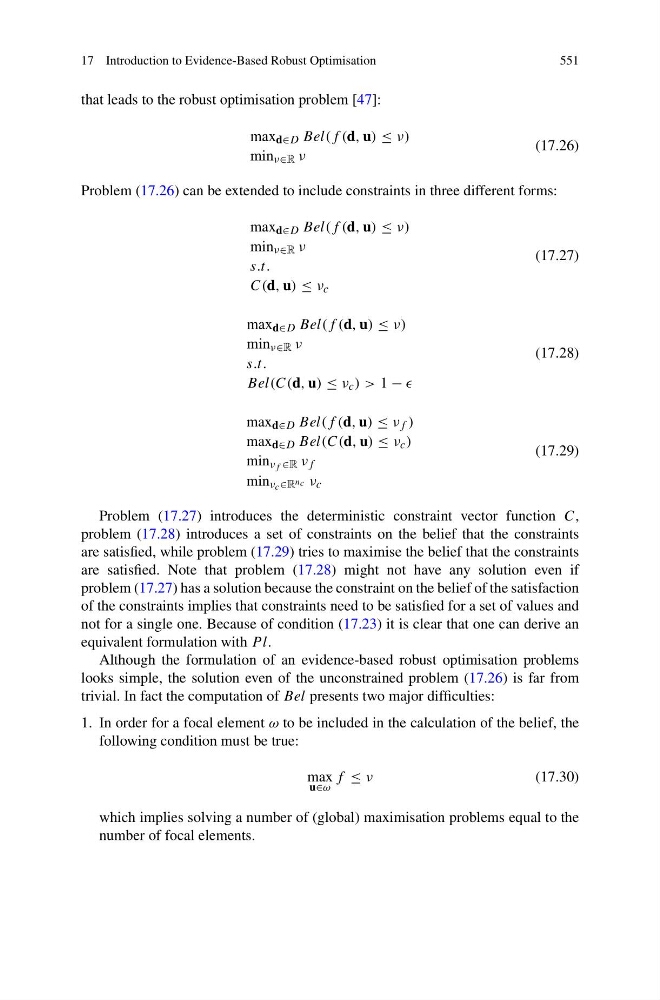
Problem (17.27) introduces the deterministic constraint vector function C,
problem (17.28) introduces a set of constraints on the belief that the constraints
are satisfied, while problem (17.29) tries to maximise the belief that the constraints
are satisfied. Note that problem (17.28) might not have any solution even if
problem (17.27) has a solution because the constraint on the belief of the satisfaction
of the constraints implies that constraints need to be satisfied for a set of values and
not for a single one. Because of condition (17.23) it is clear that one can derive an
equivalent formulation with P l.
Although the formulation of an evidence-based robust optimisation problems
looks simple, the solution even of the unconstrained problem (17.26) is far from
trivial. In fact the computation of Bel presents two major difficulties:
1. In order for a focal element ω to be included in the calculation of the belief, the
following condition must be true:
max
u∈ω
f ≤ ν
(17.30)
which implies solving a number of (global) maximisation problems equal to the
number of focal elements.