

548
G. Filippi and M. Vasile
17.2.1 Frame of Discernment, Power Set and Evidence
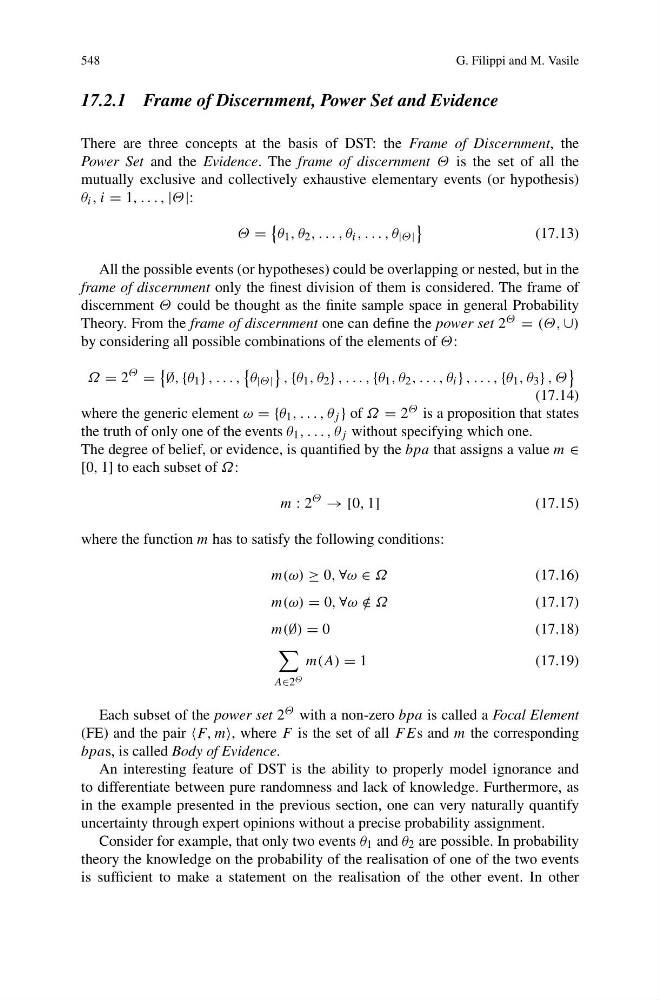
There are three concepts at the basis of DST: the Frame of Discernment, the
Power Set and the Evidence. The frame of discernment Θ is the set of all the
mutually exclusive and collectively exhaustive elementary events (or hypothesis)
θ i , i = 1, . . . , |Θ|:
Θ =
θ 1 , θ 2 , . . . , θ i , . . . , θ |Θ|
(17.13)
All the possible events (or hypotheses) could be overlapping or nested, but in the
frame of discernment only the finest division of them is considered. The frame of
discernment Θ could be thought as the finite sample space in general Probability
Theory. From the frame of discernment one can define the power set 2 Θ = (Θ, ∪)
by considering all possible combinations of the elements of Θ:
Ω = 2
Θ
=
∅, {θ 1 } , . . . ,
θ |Θ|
, {θ 1 , θ 2 } , . . . , {θ 1 , θ 2 , . . . , θ i } , . . . , {θ 1 , θ 3 } , Θ
(17.14)
where the generic element ω = {θ 1 , . . . , θ j } of Ω = 2 Θ is a proposition that states
the truth of only one of the events θ 1 , . . . , θ j without specifying which one.
The degree of belief, or evidence, is quantified by the bpa that assigns a value m ∈
[0, 1] to each subset of Ω:
m : 2
Θ
→ [0, 1]
(17.15)
where the function m has to satisfy the following conditions:
m(ω) ≥ 0, ∀ω ∈ Ω
(17.16)
m(ω) = 0, ∀ω /
∈ Ω
(17.17)
m(∅) = 0
(17.18)
A∈2 Θ
m(A) = 1
(17.19)
Each subset of the power set 2 Θ with a non-zero bpa is called a Focal Element
(FE) and the pair F, m, where F is the set of all F Es and m the corresponding
bpas, is called Body of Evidence.
An interesting feature of DST is the ability to properly model ignorance and
to differentiate between pure randomness and lack of knowledge. Furthermore, as
in the example presented in the previous section, one can very naturally quantify
uncertainty through expert opinions without a precise probability assignment.
Consider for example, that only two events θ 1 and θ 2 are possible. In probability
theory the knowledge on the probability of the realisation of one of the two events
is sufficient to make a statement on the realisation of the other event. In other