

17 Introduction to Evidence-Based Robust Optimisation
547
original work [18]. DST belongs to the class of Imprecise Probabilities Theories
that generalise the classical concept of probability by considering the different
nature and manifestations of uncertainty. DST allows one to treat both aleatory and
epistemic uncertainty with partial information and lack of knowledge. A discussion
on the main advantages and disadvantages of DST can be found in [46] and will
not be presented in this chapter. On the contrary, this chapter is only concerned with
the computation of robust and reliable solutions once uncertainty is quantified with
DST.
The central idea of DST can be understood with the following example. Imagine
that a spacecraft S, initially in orbit around the Earth, falls down in a not precise
zone of Europe. The defence commission recruits a group of m experts, E m =
{E 1 , E 2 , . . . , E m }, to predict where the spacecraft will fall. Imagine that a subset
of them, E n ⊂ E m , believes that S will fall in some crash area L i ∀i | E i ∈ E n
and the others E m−n believe that the S will fall in the ocean L j = ∅ ∀j | E j ∈
E m−n . The question posed by the commission is: “What is evidence in support that
S will fall in the specific land-area A?” Each expert, considering all the available
information and their knowledge, gives one of these three possible answers: (i) the
whole crash area is included in A (L i ⊂ A), (ii) S could fall in A (L i ∩ A = ∅)
or (iii) is not possible for the S to fall in A (L i ∩ A = ∅). Imagine that q experts
in E m agree with (ii) and in particular k of them answer (i), where q ≥ k ∈ E m .
The commission can then reconstruct the belief that S will fall inside A,
k
m , and the
plausibility,
q
m , that S might fall inside A. In this case the commission assumes that
all experts are equally credible, i.e. that the evidence they provide has equal weight.
If m − n experts do not believe there is a dangerous situation, belief and plausibility
became: Bel =
k
n and P l =
q
n . If some experts are recognised to be more reliable
than others, the commission can use a set of weights, ω 1 , ω 2 , . . . , ω n , to assign more
or less belief to the statement of each expert. In this case the cumulative belief and
plausibility values become
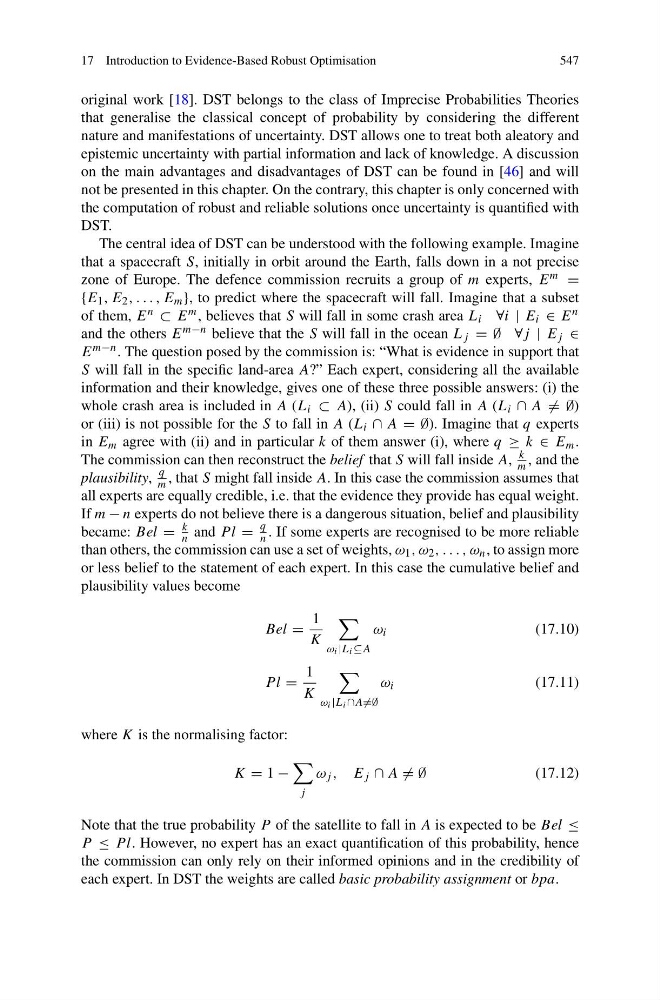
Bel =
1
K
ω i |L i ⊆A
ω i
(17.10)
P l =
1
K
ω i |L i ∩A =∅
ω i
(17.11)
where K is the normalising factor:
K = 1 −
j
ω j , E j ∩ A = ∅
(17.12)
Note that the true probability P of the satellite to fall in A is expected to be Bel ≤
P ≤ P l. However, no expert has an exact quantification of this probability, hence
the commission can only rely on their informed opinions and in the credibility of
each expert. In DST the weights are called basic probability assignment or bpa.