

536
A. del Val et al.
• Non-smooth solutions in physical space imposing a shock-capturing numerical
scheme.
• Sparse experimental data making more difficult a probabilistic treatment of
the uncertainties while urging the numerical methods to be more refined in the
solutions.
16.5.1 Current Margin Policies: Where Are We?
Models, particularly in aerosciences and material response, have largely undefined
uncertainty levels for many problems (limited validation). Without well-defined
uncertainty levels, it is difficult to assess the system risk and to trade risk with other
subsystems. The result is typically (but not automatically) overdesign.
Safety factors for entry vehicles rank among the highest ones in engineering
systems with an average value of 2. In atmospheric entry systems, the most critical
design parameter, concerning the high heat loads encountered, is the thermal
protection system thickness which directly relates to the vehicle weight. Under these
premises, an over-estimation of the protection material thickness leads to higher
constraints on payload weights or in a much more expensive vehicle to fly.
The opposite side of the spectrum is the underestimation of safety margins and
the exposure of the crew to fatal disaster or to the robotic mission to a catastrophic
end.
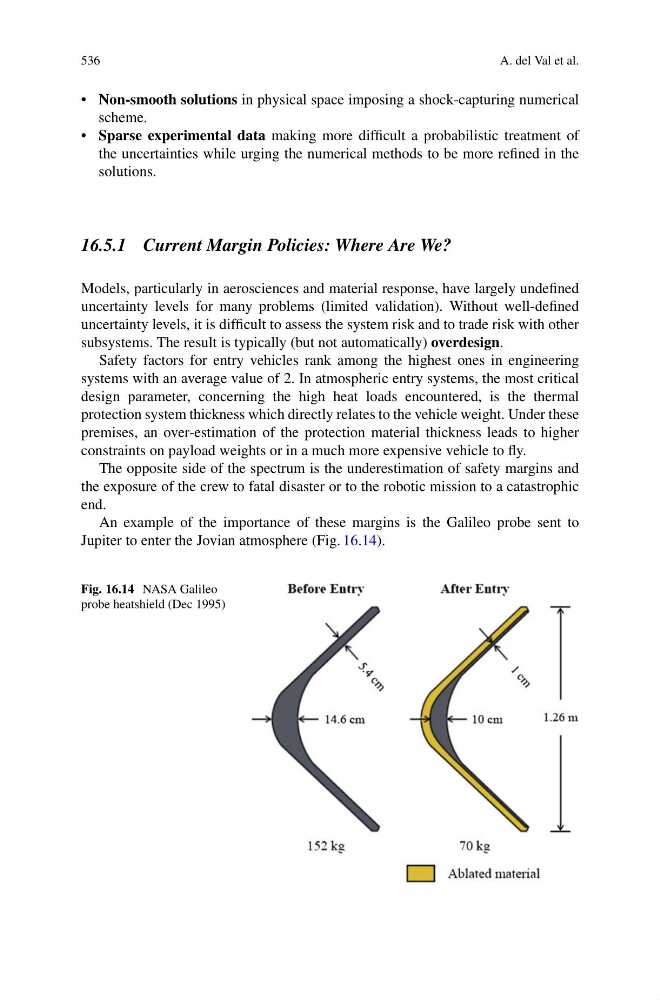
An example of the importance of these margins is the Galileo probe sent to
Jupiter to enter the Jovian atmosphere (Fig. 16.14).
Fig. 16.14 NASA Galileo
probe heatshield (Dec 1995)