

16 Uncertainty Treatment Applications: High-Enthalpy Flow Ground Testing
525
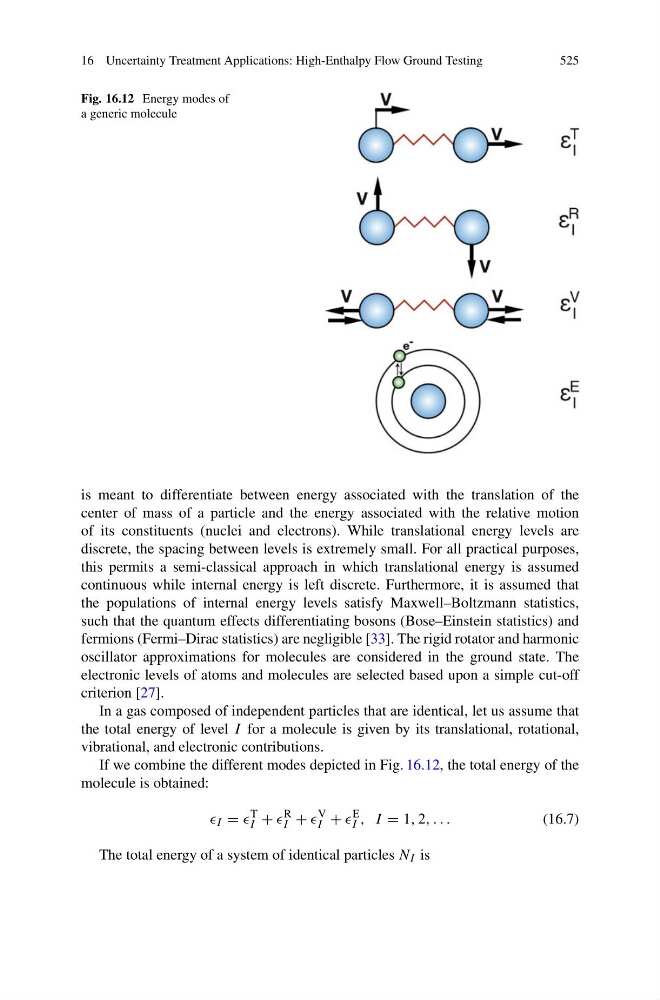
Fig. 16.12 Energy modes of
a generic molecule
is meant to differentiate between energy associated with the translation of the
center of mass of a particle and the energy associated with the relative motion
of its constituents (nuclei and electrons). While translational energy levels are
discrete, the spacing between levels is extremely small. For all practical purposes,
this permits a semi-classical approach in which translational energy is assumed
continuous while internal energy is left discrete. Furthermore, it is assumed that
the populations of internal energy levels satisfy Maxwell–Boltzmann statistics,
such that the quantum effects differentiating bosons (Bose–Einstein statistics) and
fermions (Fermi–Dirac statistics) are negligible [33]. The rigid rotator and harmonic
oscillator approximations for molecules are considered in the ground state. The
electronic levels of atoms and molecules are selected based upon a simple cut-off
criterion [27].
In a gas composed of independent particles that are identical, let us assume that
the total energy of level I for a molecule is given by its translational, rotational,
vibrational, and electronic contributions.
If we combine the different modes depicted in Fig. 16.12, the total energy of the
molecule is obtained:
I =
T
I +
R
I +
V
I +
E
I , I = 1, 2, . . .
(16.7)
The total energy of a system of identical particles N I is