

16 Uncertainty Treatment Applications: High-Enthalpy Flow Ground Testing
513
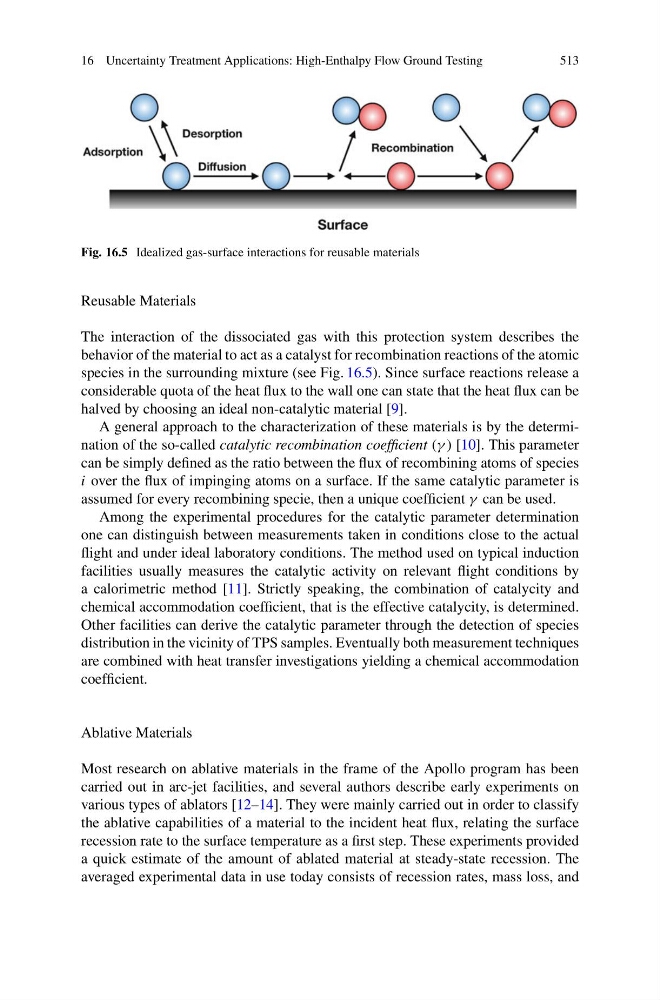
Fig. 16.5 Idealized gas-surface interactions for reusable materials
Reusable Materials
The interaction of the dissociated gas with this protection system describes the
behavior of the material to act as a catalyst for recombination reactions of the atomic
species in the surrounding mixture (see Fig. 16.5). Since surface reactions release a
considerable quota of the heat flux to the wall one can state that the heat flux can be
halved by choosing an ideal non-catalytic material [9].
A general approach to the characterization of these materials is by the determination of the so-called catalytic recombination coefficient (γ ) [10]. This parameter
can be simply defined as the ratio between the flux of recombining atoms of species
i over the flux of impinging atoms on a surface. If the same catalytic parameter is
assumed for every recombining specie, then a unique coefficient γ can be used.
Among the experimental procedures for the catalytic parameter determination
one can distinguish between measurements taken in conditions close to the actual
flight and under ideal laboratory conditions. The method used on typical induction
facilities usually measures the catalytic activity on relevant flight conditions by
a calorimetric method [11]. Strictly speaking, the combination of catalycity and
chemical accommodation coefficient, that is the effective catalycity, is determined.
Other facilities can derive the catalytic parameter through the detection of species
distribution in the vicinity of TPS samples. Eventually both measurement techniques
are combined with heat transfer investigations yielding a chemical accommodation
coefficient.
Ablative Materials
Most research on ablative materials in the frame of the Apollo program has been
carried out in arc-jet facilities, and several authors describe early experiments on
various types of ablators [12–14]. They were mainly carried out in order to classify
the ablative capabilities of a material to the incident heat flux, relating the surface
recession rate to the surface temperature as a first step. These experiments provided
a quick estimate of the amount of ablated material at steady-state recession. The
averaged experimental data in use today consists of recession rates, mass loss, and