

15 In-flight Icing: Modeling, Prediction, and Uncertainty
495
[103]. They are commonly deployed near the stagnation point on the leading edges,
stabilizers, and propeller wings. The boots are normally oriented spanwise [104],
although they can be deployed chord-wise or in certain critical surfaces. De-icing
boot IPS consist of a set of sudden inflatable rubber boots positioned in the protected
surfaces which are cyclically inflated and deflated according to the protection needs.
They are de-icing systems because they remove an already formed layer of ice
from the surfaces where they are implemented. Depending on the type of aircraft,
boots are inflated with bleed air from the engines or an additional pneumatic system
is included for that purpose [104]. Following the rupture of the ice, aerodynamic
forces completely remove the ice from the surface [105]. The boots are made out of
rubber and they require a supply of vacuum to avoid self-inflation. To improve the
performance of these systems, chemical solutions that reduce the ice adhesion to the
boot can be sprayed over the rubber boots.
Their activation time is critical. The more ice is accumulated in the surface, the
more effective the system is. However, a compromise in performance and safety
is to be found. In addition, late activation was claimed to cause the Comair flight
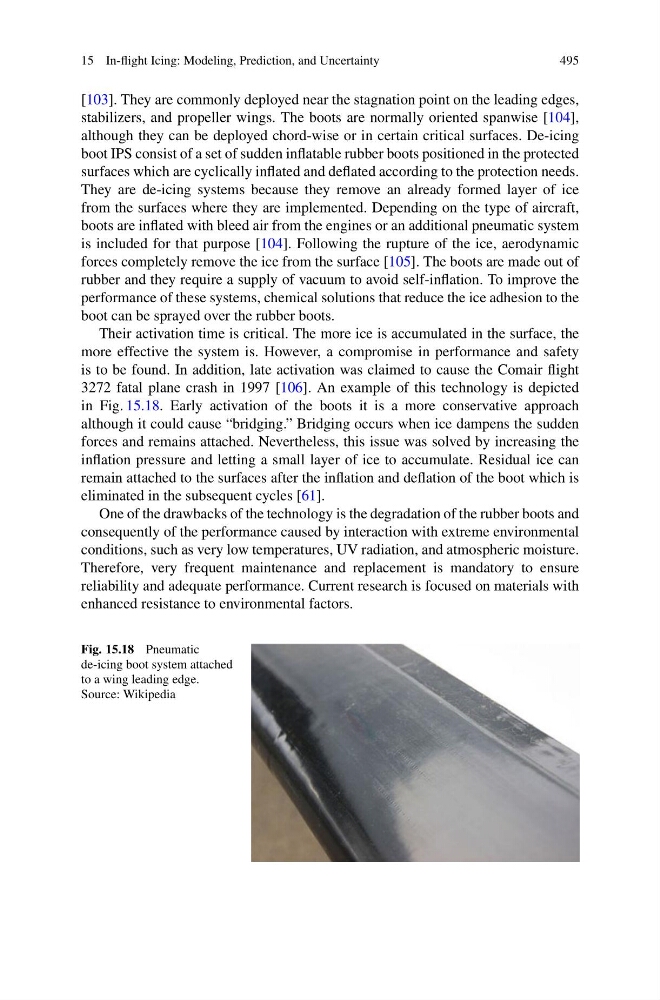
3272 fatal plane crash in 1997 [106]. An example of this technology is depicted
in Fig. 15.18. Early activation of the boots it is a more conservative approach
although it could cause “bridging.” Bridging occurs when ice dampens the sudden
forces and remains attached. Nevertheless, this issue was solved by increasing the
inflation pressure and letting a small layer of ice to accumulate. Residual ice can
remain attached to the surfaces after the inflation and deflation of the boot which is
eliminated in the subsequent cycles [61].
One of the drawbacks of the technology is the degradation of the rubber boots and
consequently of the performance caused by interaction with extreme environmental
conditions, such as very low temperatures, UV radiation, and atmospheric moisture.
Therefore, very frequent maintenance and replacement is mandatory to ensure
reliability and adequate performance. Current research is focused on materials with
enhanced resistance to environmental factors.
Fig. 15.18 Pneumatic
de-icing boot system attached
to a wing leading edge.
Source: Wikipedia
495
[103]. They are commonly deployed near the stagnation point on the leading edges,
stabilizers, and propeller wings. The boots are normally oriented spanwise [104],
although they can be deployed chord-wise or in certain critical surfaces. De-icing
boot IPS consist of a set of sudden inflatable rubber boots positioned in the protected
surfaces which are cyclically inflated and deflated according to the protection needs.
They are de-icing systems because they remove an already formed layer of ice
from the surfaces where they are implemented. Depending on the type of aircraft,
boots are inflated with bleed air from the engines or an additional pneumatic system
is included for that purpose [104]. Following the rupture of the ice, aerodynamic
forces completely remove the ice from the surface [105]. The boots are made out of
rubber and they require a supply of vacuum to avoid self-inflation. To improve the
performance of these systems, chemical solutions that reduce the ice adhesion to the
boot can be sprayed over the rubber boots.
Their activation time is critical. The more ice is accumulated in the surface, the
more effective the system is. However, a compromise in performance and safety
is to be found. In addition, late activation was claimed to cause the Comair flight
3272 fatal plane crash in 1997 [106]. An example of this technology is depicted
in Fig. 15.18. Early activation of the boots it is a more conservative approach
although it could cause “bridging.” Bridging occurs when ice dampens the sudden
forces and remains attached. Nevertheless, this issue was solved by increasing the
inflation pressure and letting a small layer of ice to accumulate. Residual ice can
remain attached to the surfaces after the inflation and deflation of the boot which is
eliminated in the subsequent cycles [61].
One of the drawbacks of the technology is the degradation of the rubber boots and
consequently of the performance caused by interaction with extreme environmental
conditions, such as very low temperatures, UV radiation, and atmospheric moisture.
Therefore, very frequent maintenance and replacement is mandatory to ensure
reliability and adequate performance. Current research is focused on materials with
enhanced resistance to environmental factors.
Fig. 15.18 Pneumatic
de-icing boot system attached
to a wing leading edge.
Source: Wikipedia