

486
B. Arizmendi et al.
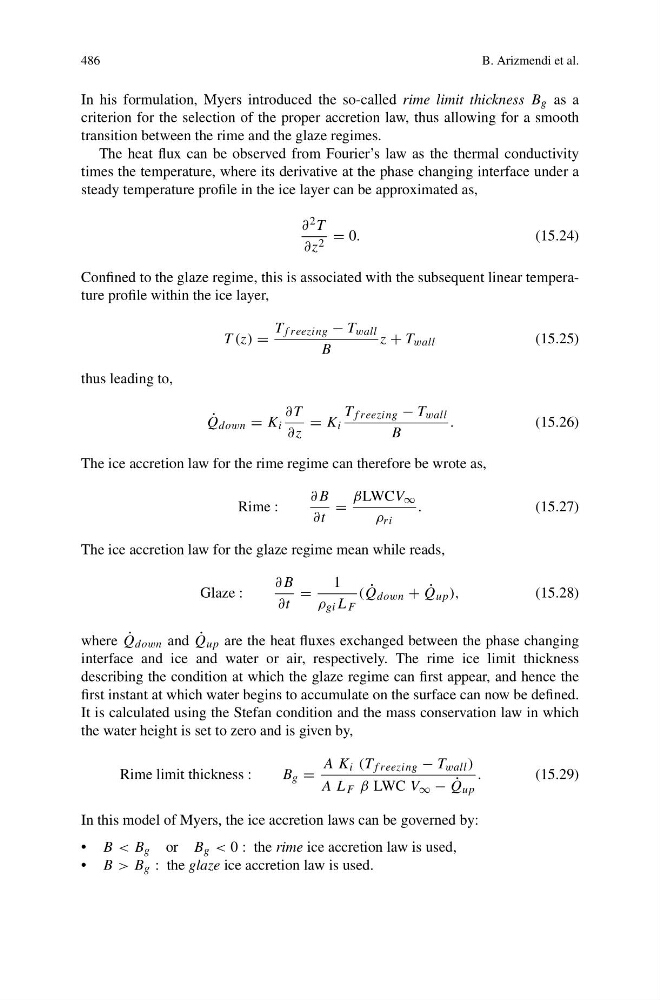
In his formulation, Myers introduced the so-called rime limit thickness B g as a
criterion for the selection of the proper accretion law, thus allowing for a smooth
transition between the rime and the glaze regimes.
The heat flux can be observed from Fourier’s law as the thermal conductivity
times the temperature, where its derivative at the phase changing interface under a
steady temperature profile in the ice layer can be approximated as,
∂ 2 T
∂z 2 = 0.
(15.24)
Confined to the glaze regime, this is associated with the subsequent linear temperature profile within the ice layer,
T (z) =
T f reezing − T wall
B
z + T wall
(15.25)
thus leading to,
˙
Q down = K i
∂T
∂z
= K i
T f reezing − T wall
B
.
(15.26)
The ice accretion law for the rime regime can therefore be wrote as,
Rime :
∂B
∂t
=
βLWCV ∞
ρ ri
.
(15.27)
The ice accretion law for the glaze regime mean while reads,
Glaze :
∂B
∂t
=
1
ρ gi L F
( ˙
Q down + ˙
Q up ),
(15.28)
where ˙
Q down and ˙
Q up are the heat fluxes exchanged between the phase changing
interface and ice and water or air, respectively. The rime ice limit thickness
describing the condition at which the glaze regime can first appear, and hence the
first instant at which water begins to accumulate on the surface can now be defined.
It is calculated using the Stefan condition and the mass conservation law in which
the water height is set to zero and is given by,
Rime limit thickness :
B g =
A K i (T f reezing − T wall )
A L F β LWC V ∞ − ˙
Q up
.
(15.29)
In this model of Myers, the ice accretion laws can be governed by:
• B < B g or B g < 0 : the rime ice accretion law is used,
• B > B g : the glaze ice accretion law is used.
B. Arizmendi et al.
In his formulation, Myers introduced the so-called rime limit thickness B g as a
criterion for the selection of the proper accretion law, thus allowing for a smooth
transition between the rime and the glaze regimes.
The heat flux can be observed from Fourier’s law as the thermal conductivity
times the temperature, where its derivative at the phase changing interface under a
steady temperature profile in the ice layer can be approximated as,
∂ 2 T
∂z 2 = 0.
(15.24)
Confined to the glaze regime, this is associated with the subsequent linear temperature profile within the ice layer,
T (z) =
T f reezing − T wall
B
z + T wall
(15.25)
thus leading to,
˙
Q down = K i
∂T
∂z
= K i
T f reezing − T wall
B
.
(15.26)
The ice accretion law for the rime regime can therefore be wrote as,
Rime :
∂B
∂t
=
βLWCV ∞
ρ ri
.
(15.27)
The ice accretion law for the glaze regime mean while reads,
Glaze :
∂B
∂t
=
1
ρ gi L F
( ˙
Q down + ˙
Q up ),
(15.28)
where ˙
Q down and ˙
Q up are the heat fluxes exchanged between the phase changing
interface and ice and water or air, respectively. The rime ice limit thickness
describing the condition at which the glaze regime can first appear, and hence the
first instant at which water begins to accumulate on the surface can now be defined.
It is calculated using the Stefan condition and the mass conservation law in which
the water height is set to zero and is given by,
Rime limit thickness :
B g =
A K i (T f reezing − T wall )
A L F β LWC V ∞ − ˙
Q up
.
(15.29)
In this model of Myers, the ice accretion laws can be governed by:
• B < B g or B g < 0 : the rime ice accretion law is used,
• B > B g : the glaze ice accretion law is used.