

440
C. Sabater
14.4.1 Problem Definition
The deterministic and uncertain optimization problems are introduced below. The
formulations are based on previous studies focused on the robust design of an airfoil
at cruise conditions [2, 7].
14.4.1.1 Deterministic Optimization
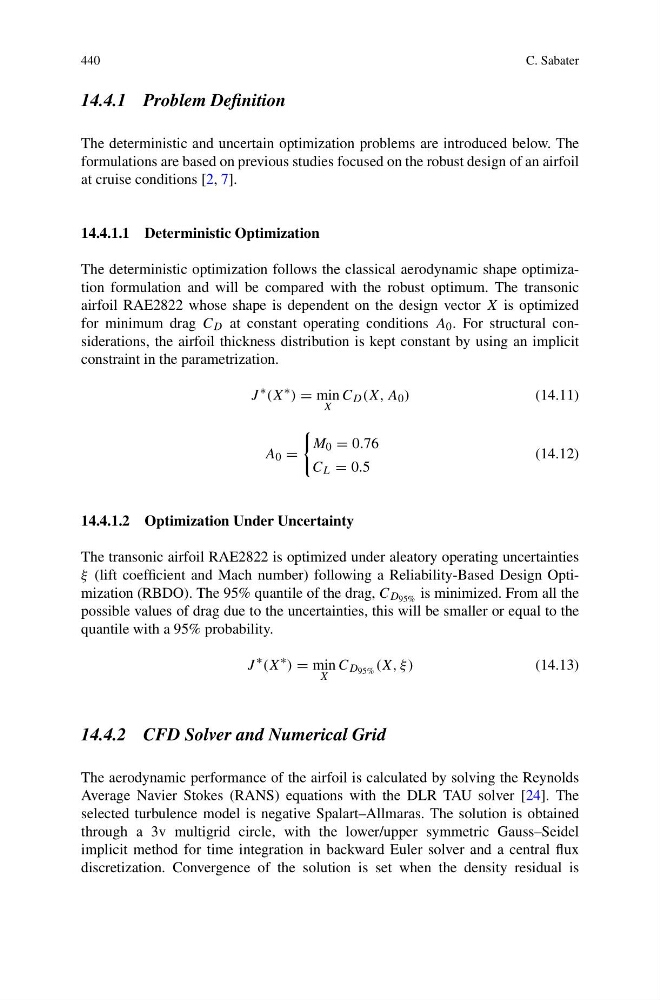
The deterministic optimization follows the classical aerodynamic shape optimization formulation and will be compared with the robust optimum. The transonic
airfoil RAE2822 whose shape is dependent on the design vector X is optimized
for minimum drag C D at constant operating conditions A 0 . For structural considerations, the airfoil thickness distribution is kept constant by using an implicit
constraint in the parametrization.
J
∗ (X
∗ ) = min
X
C D (X, A 0 )
(14.11)
A 0 =
M 0 = 0.76
C L = 0.5
(14.12)
14.4.1.2 Optimization Under Uncertainty
The transonic airfoil RAE2822 is optimized under aleatory operating uncertainties
ξ (lift coefficient and Mach number) following a Reliability-Based Design Optimization (RBDO). The 95% quantile of the drag, C D 95% is minimized. From all the
possible values of drag due to the uncertainties, this will be smaller or equal to the
quantile with a 95% probability.
J
∗ (X
∗ ) = min
X
C D 95% (X, ξ )
(14.13)
14.4.2 CFD Solver and Numerical Grid
The aerodynamic performance of the airfoil is calculated by solving the Reynolds
Average Navier Stokes (RANS) equations with the DLR TAU solver [24]. The
selected turbulence model is negative Spalart–Allmaras. The solution is obtained
through a 3v multigrid circle, with the lower/upper symmetric Gauss–Seidel
implicit method for time integration in backward Euler solver and a central flux
discretization. Convergence of the solution is set when the density residual is
C. Sabater
14.4.1 Problem Definition
The deterministic and uncertain optimization problems are introduced below. The
formulations are based on previous studies focused on the robust design of an airfoil
at cruise conditions [2, 7].
14.4.1.1 Deterministic Optimization
The deterministic optimization follows the classical aerodynamic shape optimization formulation and will be compared with the robust optimum. The transonic
airfoil RAE2822 whose shape is dependent on the design vector X is optimized
for minimum drag C D at constant operating conditions A 0 . For structural considerations, the airfoil thickness distribution is kept constant by using an implicit
constraint in the parametrization.
J
∗ (X
∗ ) = min
X
C D (X, A 0 )
(14.11)
A 0 =
M 0 = 0.76
C L = 0.5
(14.12)
14.4.1.2 Optimization Under Uncertainty
The transonic airfoil RAE2822 is optimized under aleatory operating uncertainties
ξ (lift coefficient and Mach number) following a Reliability-Based Design Optimization (RBDO). The 95% quantile of the drag, C D 95% is minimized. From all the
possible values of drag due to the uncertainties, this will be smaller or equal to the
quantile with a 95% probability.
J
∗ (X
∗ ) = min
X
C D 95% (X, ξ )
(14.13)
14.4.2 CFD Solver and Numerical Grid
The aerodynamic performance of the airfoil is calculated by solving the Reynolds
Average Navier Stokes (RANS) equations with the DLR TAU solver [24]. The
selected turbulence model is negative Spalart–Allmaras. The solution is obtained
through a 3v multigrid circle, with the lower/upper symmetric Gauss–Seidel
implicit method for time integration in backward Euler solver and a central flux
discretization. Convergence of the solution is set when the density residual is