

434
C. Sabater
14.2.4.3 Definition of Objective Function (II) Reliability Based
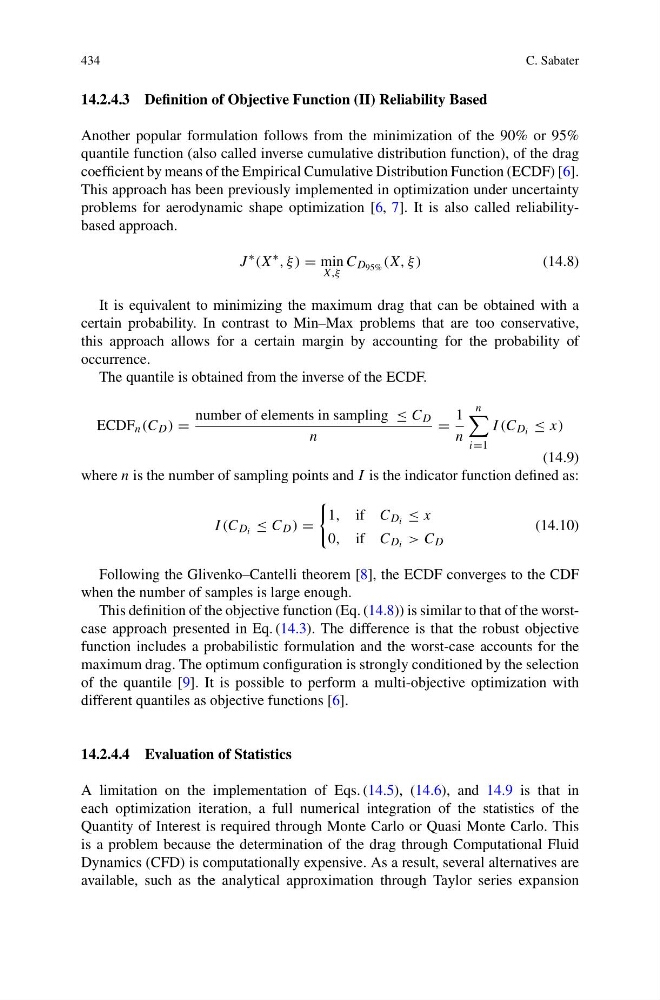
Another popular formulation follows from the minimization of the 90% or 95%
quantile function (also called inverse cumulative distribution function), of the drag
coefficient by means of the Empirical Cumulative Distribution Function (ECDF) [6].
This approach has been previously implemented in optimization under uncertainty
problems for aerodynamic shape optimization [6, 7]. It is also called reliabilitybased approach.
J
∗ (X
∗ , ξ) = min
X,ξ
C D 95% (X, ξ )
(14.8)
It is equivalent to minimizing the maximum drag that can be obtained with a
certain probability. In contrast to Min–Max problems that are too conservative,
this approach allows for a certain margin by accounting for the probability of
occurrence.
The quantile is obtained from the inverse of the ECDF.
ECDF n (C D ) =
number of elements in sampling ≤ C D
n
=
1
n
n
i=1
I (C D i ≤ x)
(14.9)
where n is the number of sampling points and I is the indicator function defined as:
I (C D i ≤ C D ) =
1, if C D i ≤ x
0, if C D i > C D
(14.10)
Following the Glivenko–Cantelli theorem [8], the ECDF converges to the CDF
when the number of samples is large enough.
This definition of the objective function (Eq. (14.8)) is similar to that of the worstcase approach presented in Eq. (14.3). The difference is that the robust objective
function includes a probabilistic formulation and the worst-case accounts for the
maximum drag. The optimum configuration is strongly conditioned by the selection
of the quantile [9]. It is possible to perform a multi-objective optimization with
different quantiles as objective functions [6].
14.2.4.4 Evaluation of Statistics
A limitation on the implementation of Eqs. (14.5), (14.6), and 14.9 is that in
each optimization iteration, a full numerical integration of the statistics of the
Quantity of Interest is required through Monte Carlo or Quasi Monte Carlo. This
is a problem because the determination of the drag through Computational Fluid
Dynamics (CFD) is computationally expensive. As a result, several alternatives are
available, such as the analytical approximation through Taylor series expansion
C. Sabater
14.2.4.3 Definition of Objective Function (II) Reliability Based
Another popular formulation follows from the minimization of the 90% or 95%
quantile function (also called inverse cumulative distribution function), of the drag
coefficient by means of the Empirical Cumulative Distribution Function (ECDF) [6].
This approach has been previously implemented in optimization under uncertainty
problems for aerodynamic shape optimization [6, 7]. It is also called reliabilitybased approach.
J
∗ (X
∗ , ξ) = min
X,ξ
C D 95% (X, ξ )
(14.8)
It is equivalent to minimizing the maximum drag that can be obtained with a
certain probability. In contrast to Min–Max problems that are too conservative,
this approach allows for a certain margin by accounting for the probability of
occurrence.
The quantile is obtained from the inverse of the ECDF.
ECDF n (C D ) =
number of elements in sampling ≤ C D
n
=
1
n
n
i=1
I (C D i ≤ x)
(14.9)
where n is the number of sampling points and I is the indicator function defined as:
I (C D i ≤ C D ) =
1, if C D i ≤ x
0, if C D i > C D
(14.10)
Following the Glivenko–Cantelli theorem [8], the ECDF converges to the CDF
when the number of samples is large enough.
This definition of the objective function (Eq. (14.8)) is similar to that of the worstcase approach presented in Eq. (14.3). The difference is that the robust objective
function includes a probabilistic formulation and the worst-case accounts for the
maximum drag. The optimum configuration is strongly conditioned by the selection
of the quantile [9]. It is possible to perform a multi-objective optimization with
different quantiles as objective functions [6].
14.2.4.4 Evaluation of Statistics
A limitation on the implementation of Eqs. (14.5), (14.6), and 14.9 is that in
each optimization iteration, a full numerical integration of the statistics of the
Quantity of Interest is required through Monte Carlo or Quasi Monte Carlo. This
is a problem because the determination of the drag through Computational Fluid
Dynamics (CFD) is computationally expensive. As a result, several alternatives are
available, such as the analytical approximation through Taylor series expansion