

408
P. Z. Korondi et al.
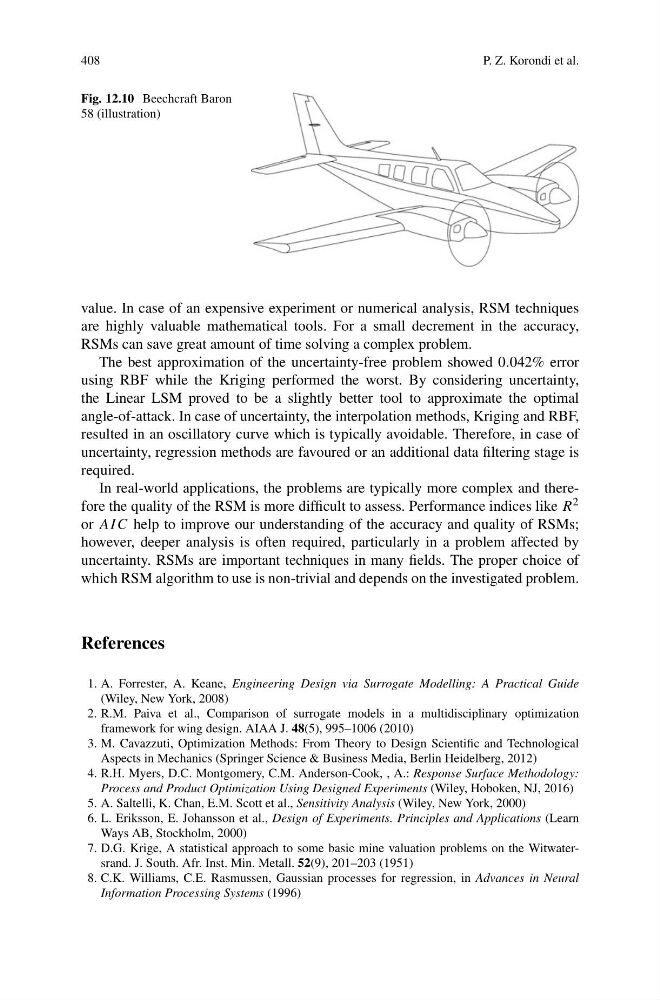
Fig. 12.10 Beechcraft Baron
58 (illustration)
value. In case of an expensive experiment or numerical analysis, RSM techniques
are highly valuable mathematical tools. For a small decrement in the accuracy,
RSMs can save great amount of time solving a complex problem.
The best approximation of the uncertainty-free problem showed 0.042% error
using RBF while the Kriging performed the worst. By considering uncertainty,
the Linear LSM proved to be a slightly better tool to approximate the optimal
angle-of-attack. In case of uncertainty, the interpolation methods, Kriging and RBF,
resulted in an oscillatory curve which is typically avoidable. Therefore, in case of
uncertainty, regression methods are favoured or an additional data filtering stage is
required.
In real-world applications, the problems are typically more complex and therefore the quality of the RSM is more difficult to assess. Performance indices like R 2
or AI C help to improve our understanding of the accuracy and quality of RSMs;
however, deeper analysis is often required, particularly in a problem affected by
uncertainty. RSMs are important techniques in many fields. The proper choice of
which RSM algorithm to use is non-trivial and depends on the investigated problem.
References
1. A. Forrester, A. Keane, Engineering Design via Surrogate Modelling: A Practical Guide
(Wiley, New York, 2008)
2. R.M. Paiva et al., Comparison of surrogate models in a multidisciplinary optimization
framework for wing design. AIAA J. 48(5), 995–1006 (2010)
3. M. Cavazzuti, Optimization Methods: From Theory to Design Scientific and Technological
Aspects in Mechanics (Springer Science & Business Media, Berlin Heidelberg, 2012)
4. R.H. Myers, D.C. Montgomery, C.M. Anderson-Cook, , A.: Response Surface Methodology:
Process and Product Optimization Using Designed Experiments (Wiley, Hoboken, NJ, 2016)
5. A. Saltelli, K. Chan, E.M. Scott et al., Sensitivity Analysis (Wiley, New York, 2000)
6. L. Eriksson, E. Johansson et al., Design of Experiments. Principles and Applications (Learn
Ways AB, Stockholm, 2000)
7. D.G. Krige, A statistical approach to some basic mine valuation problems on the Witwatersrand. J. South. Afr. Inst. Min. Metall. 52(9), 201–203 (1951)
8. C.K. Williams, C.E. Rasmussen, Gaussian processes for regression, in Advances in Neural
Information Processing Systems (1996)
P. Z. Korondi et al.
Fig. 12.10 Beechcraft Baron
58 (illustration)
value. In case of an expensive experiment or numerical analysis, RSM techniques
are highly valuable mathematical tools. For a small decrement in the accuracy,
RSMs can save great amount of time solving a complex problem.
The best approximation of the uncertainty-free problem showed 0.042% error
using RBF while the Kriging performed the worst. By considering uncertainty,
the Linear LSM proved to be a slightly better tool to approximate the optimal
angle-of-attack. In case of uncertainty, the interpolation methods, Kriging and RBF,
resulted in an oscillatory curve which is typically avoidable. Therefore, in case of
uncertainty, regression methods are favoured or an additional data filtering stage is
required.
In real-world applications, the problems are typically more complex and therefore the quality of the RSM is more difficult to assess. Performance indices like R 2
or AI C help to improve our understanding of the accuracy and quality of RSMs;
however, deeper analysis is often required, particularly in a problem affected by
uncertainty. RSMs are important techniques in many fields. The proper choice of
which RSM algorithm to use is non-trivial and depends on the investigated problem.
References
1. A. Forrester, A. Keane, Engineering Design via Surrogate Modelling: A Practical Guide
(Wiley, New York, 2008)
2. R.M. Paiva et al., Comparison of surrogate models in a multidisciplinary optimization
framework for wing design. AIAA J. 48(5), 995–1006 (2010)
3. M. Cavazzuti, Optimization Methods: From Theory to Design Scientific and Technological
Aspects in Mechanics (Springer Science & Business Media, Berlin Heidelberg, 2012)
4. R.H. Myers, D.C. Montgomery, C.M. Anderson-Cook, , A.: Response Surface Methodology:
Process and Product Optimization Using Designed Experiments (Wiley, Hoboken, NJ, 2016)
5. A. Saltelli, K. Chan, E.M. Scott et al., Sensitivity Analysis (Wiley, New York, 2000)
6. L. Eriksson, E. Johansson et al., Design of Experiments. Principles and Applications (Learn
Ways AB, Stockholm, 2000)
7. D.G. Krige, A statistical approach to some basic mine valuation problems on the Witwatersrand. J. South. Afr. Inst. Min. Metall. 52(9), 201–203 (1951)
8. C.K. Williams, C.E. Rasmussen, Gaussian processes for regression, in Advances in Neural
Information Processing Systems (1996)