

12 Response Surface Methodology
401
12.4 Wing Structure Design Using Response Surface Models
12.4.1 Design Problem
A radically simplified wing design optimisation problem is introduced in this section
to show the use of RSMs in optimisation.
The chosen optimisation problem aims at finding the optimal angle-of-attack (α)
which maximise the ratio of the lift C L and drag C D coefficients of a Beechcraft
Baron 58 aircraft [12]. The optimisation problem is formulated as:
max
α
C L (α)
C D (α)
s.t. 0 ≤ α ≤ 10 [ ◦ ] .
(12.33)
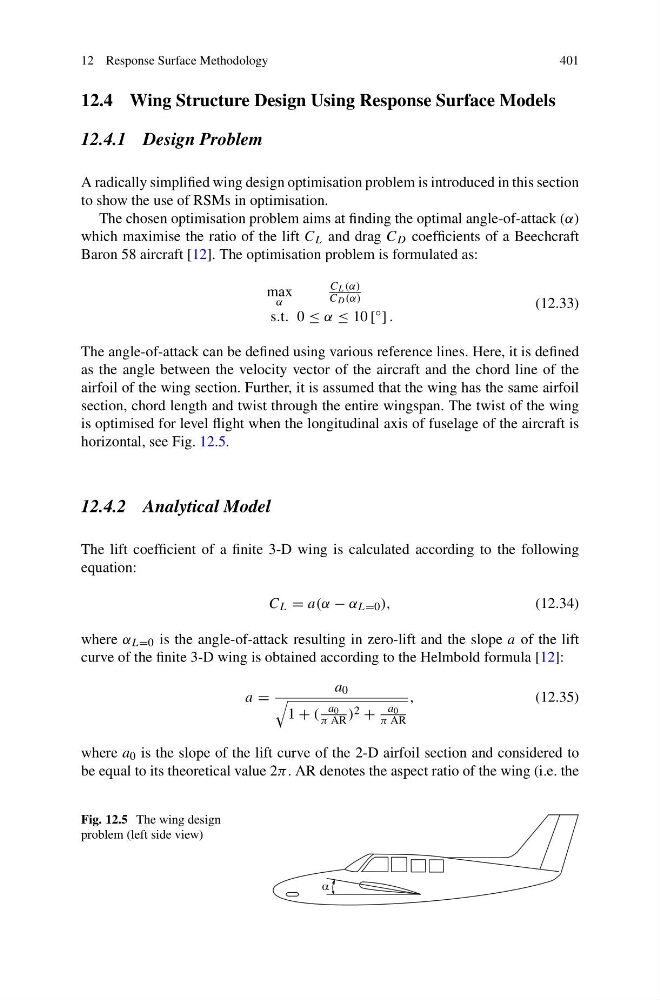
The angle-of-attack can be defined using various reference lines. Here, it is defined
as the angle between the velocity vector of the aircraft and the chord line of the
airfoil of the wing section. Further, it is assumed that the wing has the same airfoil
section, chord length and twist through the entire wingspan. The twist of the wing
is optimised for level flight when the longitudinal axis of fuselage of the aircraft is
horizontal, see Fig. 12.5.
12.4.2 Analytical Model
The lift coefficient of a finite 3-D wing is calculated according to the following
equation:
C L = a(α − α L=0 ),
(12.34)
where α L=0 is the angle-of-attack resulting in zero-lift and the slope a of the lift
curve of the finite 3-D wing is obtained according to the Helmbold formula [12]:
a =
a 0
1 + (
a 0
π AR ) 2 +
a 0
π AR
,
(12.35)
where a 0 is the slope of the lift curve of the 2-D airfoil section and considered to
be equal to its theoretical value 2π . AR denotes the aspect ratio of the wing (i.e. the
Fig. 12.5 The wing design
problem (left side view)
D
401
12.4 Wing Structure Design Using Response Surface Models
12.4.1 Design Problem
A radically simplified wing design optimisation problem is introduced in this section
to show the use of RSMs in optimisation.
The chosen optimisation problem aims at finding the optimal angle-of-attack (α)
which maximise the ratio of the lift C L and drag C D coefficients of a Beechcraft
Baron 58 aircraft [12]. The optimisation problem is formulated as:
max
α
C L (α)
C D (α)
s.t. 0 ≤ α ≤ 10 [ ◦ ] .
(12.33)
The angle-of-attack can be defined using various reference lines. Here, it is defined
as the angle between the velocity vector of the aircraft and the chord line of the
airfoil of the wing section. Further, it is assumed that the wing has the same airfoil
section, chord length and twist through the entire wingspan. The twist of the wing
is optimised for level flight when the longitudinal axis of fuselage of the aircraft is
horizontal, see Fig. 12.5.
12.4.2 Analytical Model
The lift coefficient of a finite 3-D wing is calculated according to the following
equation:
C L = a(α − α L=0 ),
(12.34)
where α L=0 is the angle-of-attack resulting in zero-lift and the slope a of the lift
curve of the finite 3-D wing is obtained according to the Helmbold formula [12]:
a =
a 0
1 + (
a 0
π AR ) 2 +
a 0
π AR
,
(12.35)
where a 0 is the slope of the lift curve of the 2-D airfoil section and considered to
be equal to its theoretical value 2π . AR denotes the aspect ratio of the wing (i.e. the
Fig. 12.5 The wing design
problem (left side view)
D