

314
M. Antoniou and P. Korošec
1.6
1.8
2
2.2
2.4
2.6
2.8
x
1.6
1.8
2
2.2
2.4
2.6
2.8
y
Linear Bilevel Optimisation Example
A
D
C
B
-20
-19
-18
-17
-16
-15
-14
-13
-12
-11
-10
x-8 y
-x-y<=-4
-x+y<=0
3x+y<=10
-3x+2y>=-3
Feasible Area
Inducible Region
min f(y) = y
min F(x,y)
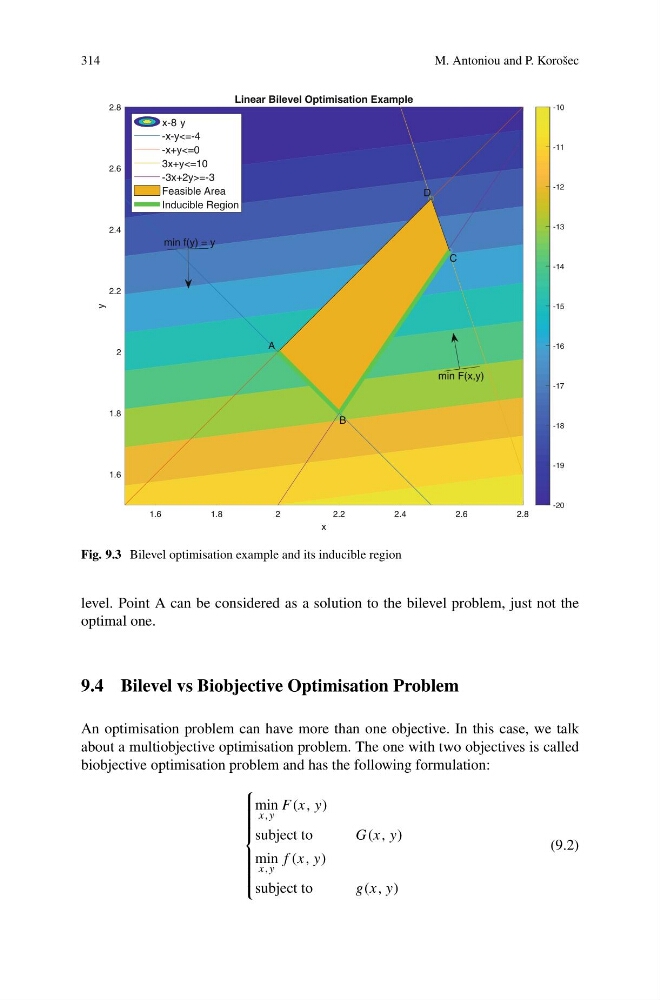
Fig. 9.3 Bilevel optimisation example and its inducible region
level. Point A can be considered as a solution to the bilevel problem, just not the
optimal one.
9.4 Bilevel vs Biobjective Optimisation Problem
An optimisation problem can have more than one objective. In this case, we talk
about a multiobjective optimisation problem. The one with two objectives is called
biobjective optimisation problem and has the following formulation:
⎧
⎪ ⎪ ⎪ ⎪ ⎪ ⎪ ⎨
⎪ ⎪ ⎪ ⎪ ⎪ ⎪ ⎩
min
x,y
F (x, y)
subject to
G(x, y)
min
x,y
f (x, y)
subject to
g(x, y)
(9.2)
M. Antoniou and P. Korošec
1.6
1.8
2
2.2
2.4
2.6
2.8
x
1.6
1.8
2
2.2
2.4
2.6
2.8
y
Linear Bilevel Optimisation Example
A
D
C
B
-20
-19
-18
-17
-16
-15
-14
-13
-12
-11
-10
x-8 y
-x-y<=-4
-x+y<=0
3x+y<=10
-3x+2y>=-3
Feasible Area
Inducible Region
min f(y) = y
min F(x,y)
Fig. 9.3 Bilevel optimisation example and its inducible region
level. Point A can be considered as a solution to the bilevel problem, just not the
optimal one.
9.4 Bilevel vs Biobjective Optimisation Problem
An optimisation problem can have more than one objective. In this case, we talk
about a multiobjective optimisation problem. The one with two objectives is called
biobjective optimisation problem and has the following formulation:
⎧
⎪ ⎪ ⎪ ⎪ ⎪ ⎪ ⎨
⎪ ⎪ ⎪ ⎪ ⎪ ⎪ ⎩
min
x,y
F (x, y)
subject to
G(x, y)
min
x,y
f (x, y)
subject to
g(x, y)
(9.2)