

312
M. Antoniou and P. Korošec
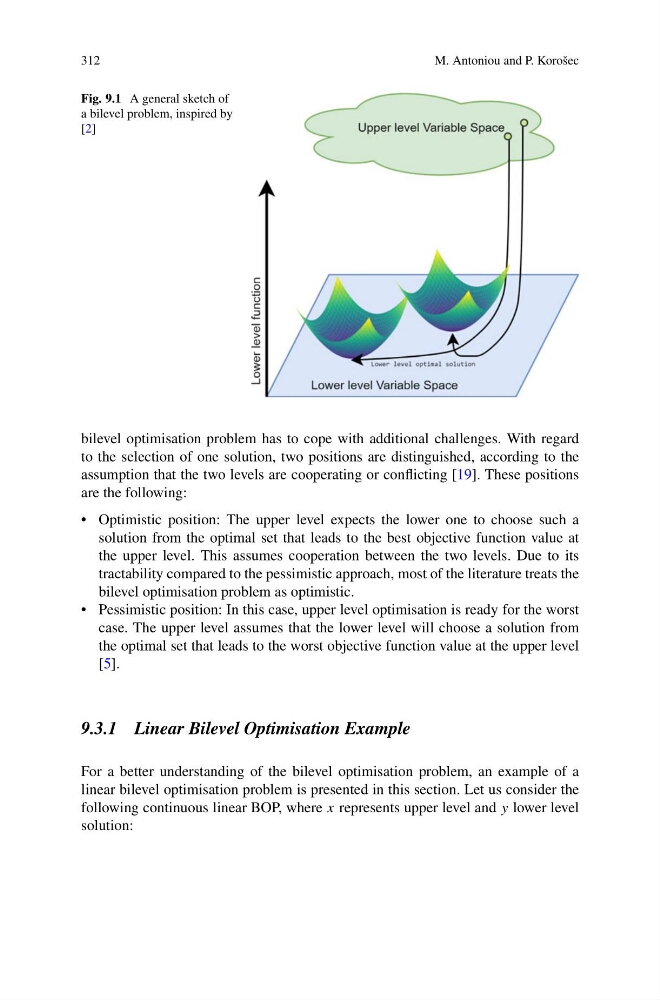
Fig. 9.1 A general sketch of
a bilevel problem, inspired by
[2]
bilevel optimisation problem has to cope with additional challenges. With regard
to the selection of one solution, two positions are distinguished, according to the
assumption that the two levels are cooperating or conflicting [19]. These positions
are the following:
• Optimistic position: The upper level expects the lower one to choose such a
solution from the optimal set that leads to the best objective function value at
the upper level. This assumes cooperation between the two levels. Due to its
tractability compared to the pessimistic approach, most of the literature treats the
bilevel optimisation problem as optimistic.
• Pessimistic position: In this case, upper level optimisation is ready for the worst
case. The upper level assumes that the lower level will choose a solution from
the optimal set that leads to the worst objective function value at the upper level
[5].
9.3.1 Linear Bilevel Optimisation Example
For a better understanding of the bilevel optimisation problem, an example of a
linear bilevel optimisation problem is presented in this section. Let us consider the
following continuous linear BOP, where x represents upper level and y lower level
solution:
M. Antoniou and P. Korošec
Fig. 9.1 A general sketch of
a bilevel problem, inspired by
[2]
bilevel optimisation problem has to cope with additional challenges. With regard
to the selection of one solution, two positions are distinguished, according to the
assumption that the two levels are cooperating or conflicting [19]. These positions
are the following:
• Optimistic position: The upper level expects the lower one to choose such a
solution from the optimal set that leads to the best objective function value at
the upper level. This assumes cooperation between the two levels. Due to its
tractability compared to the pessimistic approach, most of the literature treats the
bilevel optimisation problem as optimistic.
• Pessimistic position: In this case, upper level optimisation is ready for the worst
case. The upper level assumes that the lower level will choose a solution from
the optimal set that leads to the worst objective function value at the upper level
[5].
9.3.1 Linear Bilevel Optimisation Example
For a better understanding of the bilevel optimisation problem, an example of a
linear bilevel optimisation problem is presented in this section. Let us consider the
following continuous linear BOP, where x represents upper level and y lower level
solution: