

8 An Introduction to Many-Objective Evolutionary Optimization
273
Algorithm 1 Evolutionary algorithm
t = 0
P (t) ← Initial population of size μ
Evaluate P (t)
while Stopping criteria not fulfilled do
while |P (t)| < λ do
P (t) ← variation P (t)
Evaluate P (t)
P (t + 1) ← selection from Q ∪ P (t)
t = t + 1
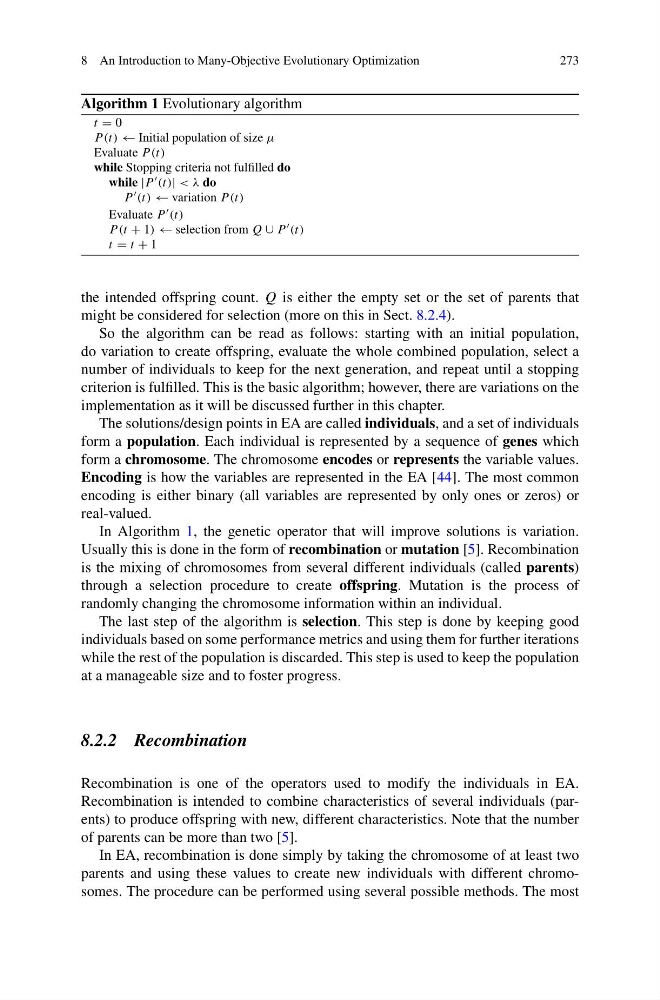
the intended offspring count. Q is either the empty set or the set of parents that
might be considered for selection (more on this in Sect. 8.2.4).
So the algorithm can be read as follows: starting with an initial population,
do variation to create offspring, evaluate the whole combined population, select a
number of individuals to keep for the next generation, and repeat until a stopping
criterion is fulfilled. This is the basic algorithm; however, there are variations on the
implementation as it will be discussed further in this chapter.
The solutions/design points in EA are called individuals, and a set of individuals
form a population. Each individual is represented by a sequence of genes which
form a chromosome. The chromosome encodes or represents the variable values.
Encoding is how the variables are represented in the EA [44]. The most common
encoding is either binary (all variables are represented by only ones or zeros) or
real-valued.
In Algorithm 1, the genetic operator that will improve solutions is variation.
Usually this is done in the form of recombination or mutation [5]. Recombination
is the mixing of chromosomes from several different individuals (called parents)
through a selection procedure to create offspring. Mutation is the process of
randomly changing the chromosome information within an individual.
The last step of the algorithm is selection. This step is done by keeping good
individuals based on some performance metrics and using them for further iterations
while the rest of the population is discarded. This step is used to keep the population
at a manageable size and to foster progress.
8.2.2 Recombination
Recombination is one of the operators used to modify the individuals in EA.
Recombination is intended to combine characteristics of several individuals (parents) to produce offspring with new, different characteristics. Note that the number
of parents can be more than two [5].
In EA, recombination is done simply by taking the chromosome of at least two
parents and using these values to create new individuals with different chromosomes. The procedure can be performed using several possible methods. The most
273
Algorithm 1 Evolutionary algorithm
t = 0
P (t) ← Initial population of size μ
Evaluate P (t)
while Stopping criteria not fulfilled do
while |P (t)| < λ do
P (t) ← variation P (t)
Evaluate P (t)
P (t + 1) ← selection from Q ∪ P (t)
t = t + 1
the intended offspring count. Q is either the empty set or the set of parents that
might be considered for selection (more on this in Sect. 8.2.4).
So the algorithm can be read as follows: starting with an initial population,
do variation to create offspring, evaluate the whole combined population, select a
number of individuals to keep for the next generation, and repeat until a stopping
criterion is fulfilled. This is the basic algorithm; however, there are variations on the
implementation as it will be discussed further in this chapter.
The solutions/design points in EA are called individuals, and a set of individuals
form a population. Each individual is represented by a sequence of genes which
form a chromosome. The chromosome encodes or represents the variable values.
Encoding is how the variables are represented in the EA [44]. The most common
encoding is either binary (all variables are represented by only ones or zeros) or
real-valued.
In Algorithm 1, the genetic operator that will improve solutions is variation.
Usually this is done in the form of recombination or mutation [5]. Recombination
is the mixing of chromosomes from several different individuals (called parents)
through a selection procedure to create offspring. Mutation is the process of
randomly changing the chromosome information within an individual.
The last step of the algorithm is selection. This step is done by keeping good
individuals based on some performance metrics and using them for further iterations
while the rest of the population is discarded. This step is used to keep the population
at a manageable size and to foster progress.
8.2.2 Recombination
Recombination is one of the operators used to modify the individuals in EA.
Recombination is intended to combine characteristics of several individuals (parents) to produce offspring with new, different characteristics. Note that the number
of parents can be more than two [5].
In EA, recombination is done simply by taking the chromosome of at least two
parents and using these values to create new individuals with different chromosomes. The procedure can be performed using several possible methods. The most