

244
A. Riccardi et al.
intersection of the best strategy of each player is a Nash equilibrium, in the sense
that no player can deviate unilaterally from this point for further improvement of
the proper objective.
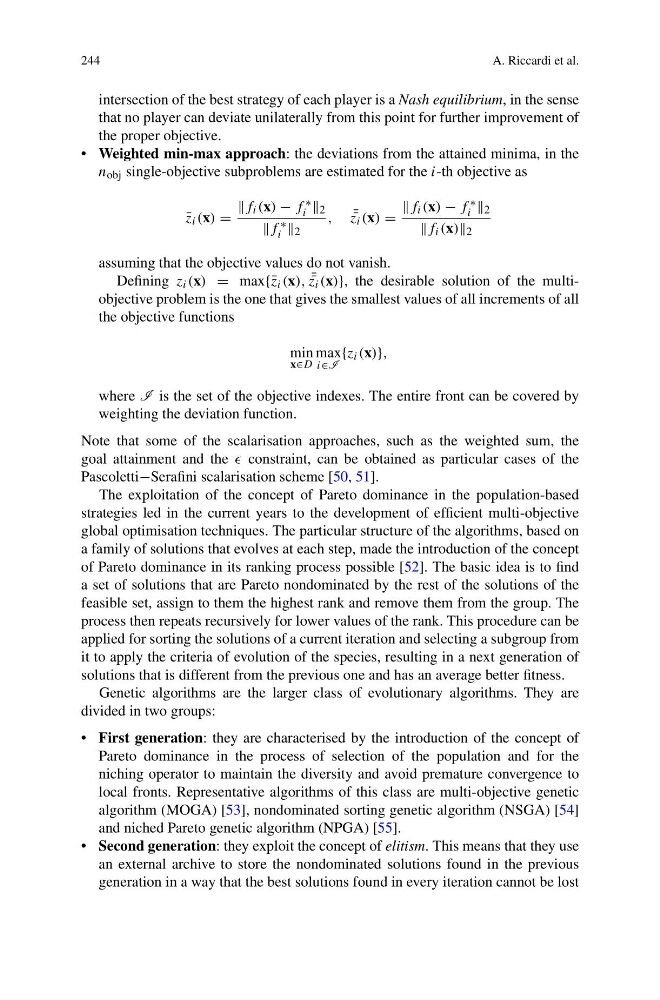
• Weighted min-max approach: the deviations from the attained minima, in the
n obj single-objective subproblems are estimated for the i-th objective as
¯
z i (x) =
f i (x) − f ∗
i 2
f ∗
i 2
, ¯ ¯
z i (x) =
f i (x) − f ∗
i 2
f i (x) 2
assuming that the objective values do not vanish.
Defining z i (x) = max{¯ z i (x), ¯ ¯
z i (x)}, the desirable solution of the multiobjective problem is the one that gives the smallest values of all increments of all
the objective functions
min
x∈D
max
i∈I
{z i (x)},
where I is the set of the objective indexes. The entire front can be covered by
weighting the deviation function.
Note that some of the scalarisation approaches, such as the weighted sum, the
goal attainment and the constraint, can be obtained as particular cases of the
Pascoletti−Serafini scalarisation scheme [50, 51].
The exploitation of the concept of Pareto dominance in the population-based
strategies led in the current years to the development of efficient multi-objective
global optimisation techniques. The particular structure of the algorithms, based on
a family of solutions that evolves at each step, made the introduction of the concept
of Pareto dominance in its ranking process possible [52]. The basic idea is to find
a set of solutions that are Pareto nondominated by the rest of the solutions of the
feasible set, assign to them the highest rank and remove them from the group. The
process then repeats recursively for lower values of the rank. This procedure can be
applied for sorting the solutions of a current iteration and selecting a subgroup from
it to apply the criteria of evolution of the species, resulting in a next generation of
solutions that is different from the previous one and has an average better fitness.
Genetic algorithms are the larger class of evolutionary algorithms. They are
divided in two groups:
• First generation: they are characterised by the introduction of the concept of
Pareto dominance in the process of selection of the population and for the
niching operator to maintain the diversity and avoid premature convergence to
local fronts. Representative algorithms of this class are multi-objective genetic
algorithm (MOGA) [53], nondominated sorting genetic algorithm (NSGA) [54]
and niched Pareto genetic algorithm (NPGA) [55].
• Second generation: they exploit the concept of elitism. This means that they use
an external archive to store the nondominated solutions found in the previous
generation in a way that the best solutions found in every iteration cannot be lost
A. Riccardi et al.
intersection of the best strategy of each player is a Nash equilibrium, in the sense
that no player can deviate unilaterally from this point for further improvement of
the proper objective.
• Weighted min-max approach: the deviations from the attained minima, in the
n obj single-objective subproblems are estimated for the i-th objective as
¯
z i (x) =
f i (x) − f ∗
i 2
f ∗
i 2
, ¯ ¯
z i (x) =
f i (x) − f ∗
i 2
f i (x) 2
assuming that the objective values do not vanish.
Defining z i (x) = max{¯ z i (x), ¯ ¯
z i (x)}, the desirable solution of the multiobjective problem is the one that gives the smallest values of all increments of all
the objective functions
min
x∈D
max
i∈I
{z i (x)},
where I is the set of the objective indexes. The entire front can be covered by
weighting the deviation function.
Note that some of the scalarisation approaches, such as the weighted sum, the
goal attainment and the constraint, can be obtained as particular cases of the
Pascoletti−Serafini scalarisation scheme [50, 51].
The exploitation of the concept of Pareto dominance in the population-based
strategies led in the current years to the development of efficient multi-objective
global optimisation techniques. The particular structure of the algorithms, based on
a family of solutions that evolves at each step, made the introduction of the concept
of Pareto dominance in its ranking process possible [52]. The basic idea is to find
a set of solutions that are Pareto nondominated by the rest of the solutions of the
feasible set, assign to them the highest rank and remove them from the group. The
process then repeats recursively for lower values of the rank. This procedure can be
applied for sorting the solutions of a current iteration and selecting a subgroup from
it to apply the criteria of evolution of the species, resulting in a next generation of
solutions that is different from the previous one and has an average better fitness.
Genetic algorithms are the larger class of evolutionary algorithms. They are
divided in two groups:
• First generation: they are characterised by the introduction of the concept of
Pareto dominance in the process of selection of the population and for the
niching operator to maintain the diversity and avoid premature convergence to
local fronts. Representative algorithms of this class are multi-objective genetic
algorithm (MOGA) [53], nondominated sorting genetic algorithm (NSGA) [54]
and niched Pareto genetic algorithm (NPGA) [55].
• Second generation: they exploit the concept of elitism. This means that they use
an external archive to store the nondominated solutions found in the previous
generation in a way that the best solutions found in every iteration cannot be lost