

14
J. F. Reis et al.
that U is normally distributed is found to be valuable. Indeed, by linearity of
Gaussian random variables, this assumption implies that η i (θ ) are jointly standard
and normally distributed. Since they are uncorrelated, they are also independent,
and to stress this we introduce the notation ξ i for jointly normal independent
random variables. Hereinafter, we will refer to ξ := (ξ 1 , . . . , ξ N KL ) ∈ Ξ as the
germ. Therefore, the probability space Ξ is the space of all jointly, normally and
independent N KL -dimensional random variables. In this perspective, the truncated
KL expansion of a normally distributed stochastic process reads,
ˆ
U(x, ξ ) :=
N KL
i≥1
λ i u(x) i ξ i ≈ U(x, ξ).
(1.14)
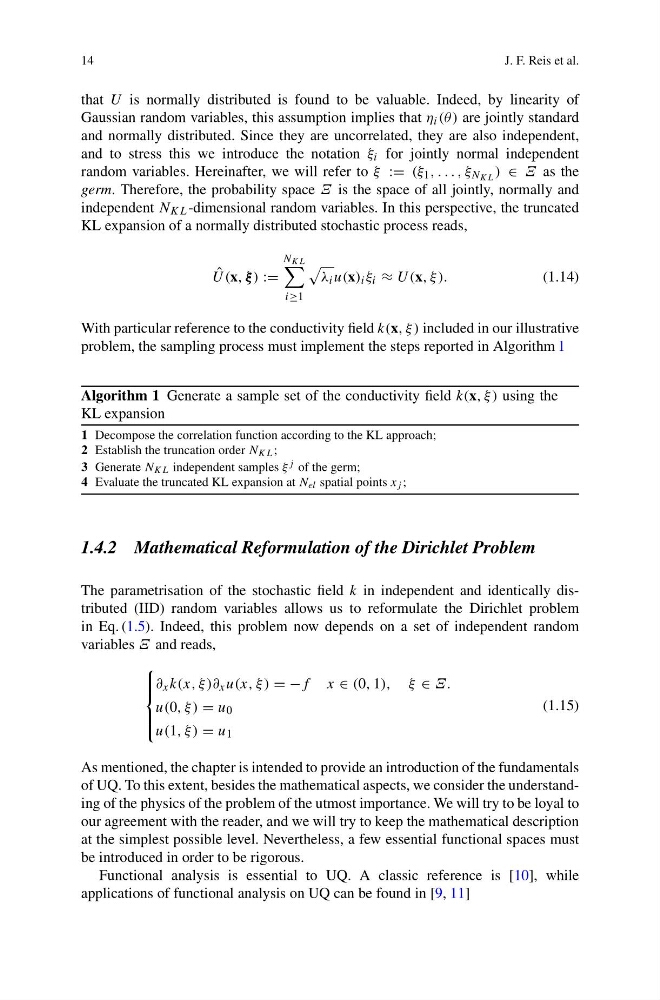
With particular reference to the conductivity field k(x, ξ) included in our illustrative
problem, the sampling process must implement the steps reported in Algorithm 1
Algorithm 1 Generate a sample set of the conductivity field k(x, ξ) using the
KL expansion
1 Decompose the correlation function according to the KL approach;
2 Establish the truncation order N KL ;
3 Generate N KL independent samples ξ j of the germ;
4 Evaluate the truncated KL expansion at N el spatial points x j ;
1.4.2 Mathematical Reformulation of the Dirichlet Problem
The parametrisation of the stochastic field k in independent and identically distributed (IID) random variables allows us to reformulate the Dirichlet problem
in Eq. (1.5). Indeed, this problem now depends on a set of independent random
variables Ξ and reads,
⎧
⎪ ⎪ ⎨
⎪ ⎪ ⎩
∂ x k(x, ξ )∂ x u(x, ξ ) = −f x ∈ (0, 1), ξ ∈ Ξ.
u(0, ξ) = u 0
u(1, ξ) = u 1
(1.15)
As mentioned, the chapter is intended to provide an introduction of the fundamentals
of UQ. To this extent, besides the mathematical aspects, we consider the understanding of the physics of the problem of the utmost importance. We will try to be loyal to
our agreement with the reader, and we will try to keep the mathematical description
at the simplest possible level. Nevertheless, a few essential functional spaces must
be introduced in order to be rigorous.
Functional analysis is essential to UQ. A classic reference is [10], while
applications of functional analysis on UQ can be found in [9, 11]
J. F. Reis et al.
that U is normally distributed is found to be valuable. Indeed, by linearity of
Gaussian random variables, this assumption implies that η i (θ ) are jointly standard
and normally distributed. Since they are uncorrelated, they are also independent,
and to stress this we introduce the notation ξ i for jointly normal independent
random variables. Hereinafter, we will refer to ξ := (ξ 1 , . . . , ξ N KL ) ∈ Ξ as the
germ. Therefore, the probability space Ξ is the space of all jointly, normally and
independent N KL -dimensional random variables. In this perspective, the truncated
KL expansion of a normally distributed stochastic process reads,
ˆ
U(x, ξ ) :=
N KL
i≥1
λ i u(x) i ξ i ≈ U(x, ξ).
(1.14)
With particular reference to the conductivity field k(x, ξ) included in our illustrative
problem, the sampling process must implement the steps reported in Algorithm 1
Algorithm 1 Generate a sample set of the conductivity field k(x, ξ) using the
KL expansion
1 Decompose the correlation function according to the KL approach;
2 Establish the truncation order N KL ;
3 Generate N KL independent samples ξ j of the germ;
4 Evaluate the truncated KL expansion at N el spatial points x j ;
1.4.2 Mathematical Reformulation of the Dirichlet Problem
The parametrisation of the stochastic field k in independent and identically distributed (IID) random variables allows us to reformulate the Dirichlet problem
in Eq. (1.5). Indeed, this problem now depends on a set of independent random
variables Ξ and reads,
⎧
⎪ ⎪ ⎨
⎪ ⎪ ⎩
∂ x k(x, ξ )∂ x u(x, ξ ) = −f x ∈ (0, 1), ξ ∈ Ξ.
u(0, ξ) = u 0
u(1, ξ) = u 1
(1.15)
As mentioned, the chapter is intended to provide an introduction of the fundamentals
of UQ. To this extent, besides the mathematical aspects, we consider the understanding of the physics of the problem of the utmost importance. We will try to be loyal to
our agreement with the reader, and we will try to keep the mathematical description
at the simplest possible level. Nevertheless, a few essential functional spaces must
be introduced in order to be rigorous.
Functional analysis is essential to UQ. A classic reference is [10], while
applications of functional analysis on UQ can be found in [9, 11]