

152
T. Krak
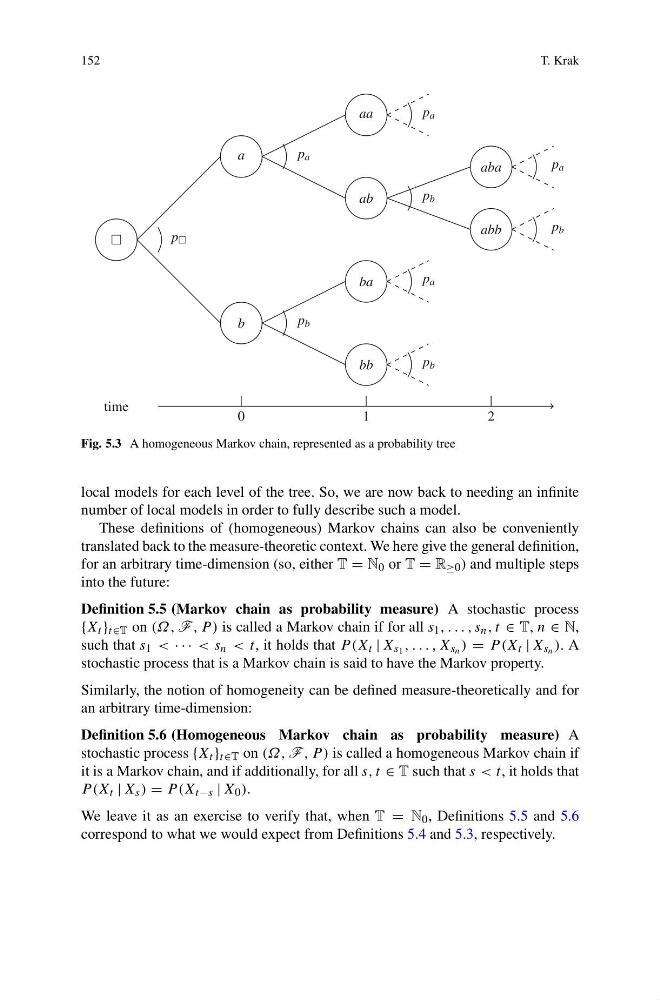
Fig. 5.3 A homogeneous Markov chain, represented as a probability tree
local models for each level of the tree. So, we are now back to needing an infinite
number of local models in order to fully describe such a model.
These definitions of (homogeneous) Markov chains can also be conveniently
translated back to the measure-theoretic context. We here give the general definition,
for an arbitrary time-dimension (so, either T = N 0 or T = R ≥0 ) and multiple steps
into the future:
Definition 5.5 (Markov chain as probability measure) A stochastic process
{X t } t∈T on (Ω, F , P ) is called a Markov chain if for all s 1 , . . . , s n , t ∈ T, n ∈ N,
such that s 1 < · · · < s n < t, it holds that P (X t | X s 1 , . . . , X s n ) = P (X t | X s n ). A
stochastic process that is a Markov chain is said to have the Markov property.
Similarly, the notion of homogeneity can be defined measure-theoretically and for
an arbitrary time-dimension:
Definition 5.6 (Homogeneous Markov chain as probability measure) A
stochastic process {X t } t∈T on (Ω, F , P ) is called a homogeneous Markov chain if
it is a Markov chain, and if additionally, for all s, t ∈ T such that s < t, it holds that
P (X t | X s ) = P (X t−s | X 0 ).
We leave it as an exercise to verify that, when T = N 0 , Definitions 5.5 and 5.6
correspond to what we would expect from Definitions 5.4 and 5.3, respectively.
T. Krak
Fig. 5.3 A homogeneous Markov chain, represented as a probability tree
local models for each level of the tree. So, we are now back to needing an infinite
number of local models in order to fully describe such a model.
These definitions of (homogeneous) Markov chains can also be conveniently
translated back to the measure-theoretic context. We here give the general definition,
for an arbitrary time-dimension (so, either T = N 0 or T = R ≥0 ) and multiple steps
into the future:
Definition 5.5 (Markov chain as probability measure) A stochastic process
{X t } t∈T on (Ω, F , P ) is called a Markov chain if for all s 1 , . . . , s n , t ∈ T, n ∈ N,
such that s 1 < · · · < s n < t, it holds that P (X t | X s 1 , . . . , X s n ) = P (X t | X s n ). A
stochastic process that is a Markov chain is said to have the Markov property.
Similarly, the notion of homogeneity can be defined measure-theoretically and for
an arbitrary time-dimension:
Definition 5.6 (Homogeneous Markov chain as probability measure) A
stochastic process {X t } t∈T on (Ω, F , P ) is called a homogeneous Markov chain if
it is a Markov chain, and if additionally, for all s, t ∈ T such that s < t, it holds that
P (X t | X s ) = P (X t−s | X 0 ).
We leave it as an exercise to verify that, when T = N 0 , Definitions 5.5 and 5.6
correspond to what we would expect from Definitions 5.4 and 5.3, respectively.