

4 Reliability Theory
133
made the computation possible in the time of the publication of his paper. Then,
instead of using the observed covariate vectors, an arbitrary value was permitted. In
the simplest case, all covariates may be assumed
x =
0, which would completely
nullify the covariate contribution into the failure rate function, thus enabling us to
infer it entirely separately. Cox himself has used
x being the mean of the covariates
of the relevant risk set in order to minimise the variance of the non-parametric
estimator he used.
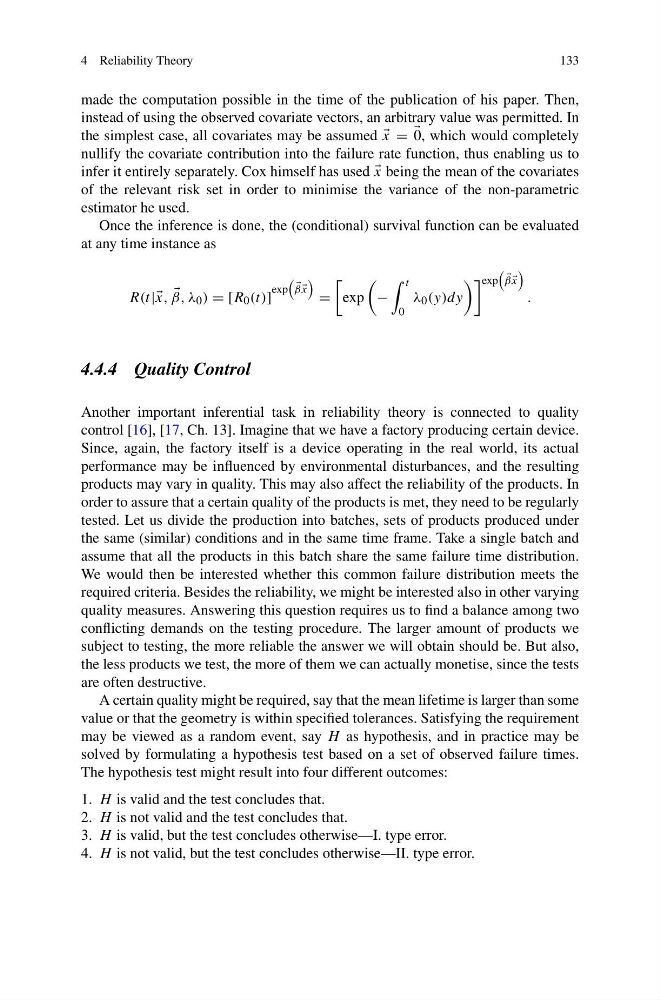
Once the inference is done, the (conditional) survival function can be evaluated
at any time instance as
R(t|| x,
β, λ 0 ) = [R 0 (t)]
exp
β
x
=
exp
−
t
0
λ 0 (y)dy
exp
β
x
.
4.4.4 Quality Control
Another important inferential task in reliability theory is connected to quality
control [16], [17, Ch. 13]. Imagine that we have a factory producing certain device.
Since, again, the factory itself is a device operating in the real world, its actual
performance may be influenced by environmental disturbances, and the resulting
products may vary in quality. This may also affect the reliability of the products. In
order to assure that a certain quality of the products is met, they need to be regularly
tested. Let us divide the production into batches, sets of products produced under
the same (similar) conditions and in the same time frame. Take a single batch and
assume that all the products in this batch share the same failure time distribution.
We would then be interested whether this common failure distribution meets the
required criteria. Besides the reliability, we might be interested also in other varying
quality measures. Answering this question requires us to find a balance among two
conflicting demands on the testing procedure. The larger amount of products we
subject to testing, the more reliable the answer we will obtain should be. But also,
the less products we test, the more of them we can actually monetise, since the tests
are often destructive.
A certain quality might be required, say that the mean lifetime is larger than some
value or that the geometry is within specified tolerances. Satisfying the requirement
may be viewed as a random event, say H as hypothesis, and in practice may be
solved by formulating a hypothesis test based on a set of observed failure times.
The hypothesis test might result into four different outcomes:
1. H is valid and the test concludes that.
2. H is not valid and the test concludes that.
3. H is valid, but the test concludes otherwise—I. type error.
4. H is not valid, but the test concludes otherwise—II. type error.
133
made the computation possible in the time of the publication of his paper. Then,
instead of using the observed covariate vectors, an arbitrary value was permitted. In
the simplest case, all covariates may be assumed
x =
0, which would completely
nullify the covariate contribution into the failure rate function, thus enabling us to
infer it entirely separately. Cox himself has used
x being the mean of the covariates
of the relevant risk set in order to minimise the variance of the non-parametric
estimator he used.
Once the inference is done, the (conditional) survival function can be evaluated
at any time instance as
R(t|| x,
β, λ 0 ) = [R 0 (t)]
exp
β
x
=
exp
−
t
0
λ 0 (y)dy
exp
β
x
.
4.4.4 Quality Control
Another important inferential task in reliability theory is connected to quality
control [16], [17, Ch. 13]. Imagine that we have a factory producing certain device.
Since, again, the factory itself is a device operating in the real world, its actual
performance may be influenced by environmental disturbances, and the resulting
products may vary in quality. This may also affect the reliability of the products. In
order to assure that a certain quality of the products is met, they need to be regularly
tested. Let us divide the production into batches, sets of products produced under
the same (similar) conditions and in the same time frame. Take a single batch and
assume that all the products in this batch share the same failure time distribution.
We would then be interested whether this common failure distribution meets the
required criteria. Besides the reliability, we might be interested also in other varying
quality measures. Answering this question requires us to find a balance among two
conflicting demands on the testing procedure. The larger amount of products we
subject to testing, the more reliable the answer we will obtain should be. But also,
the less products we test, the more of them we can actually monetise, since the tests
are often destructive.
A certain quality might be required, say that the mean lifetime is larger than some
value or that the geometry is within specified tolerances. Satisfying the requirement
may be viewed as a random event, say H as hypothesis, and in practice may be
solved by formulating a hypothesis test based on a set of observed failure times.
The hypothesis test might result into four different outcomes:
1. H is valid and the test concludes that.
2. H is not valid and the test concludes that.
3. H is valid, but the test concludes otherwise—I. type error.
4. H is not valid, but the test concludes otherwise—II. type error.