

128
D. Krpelík et al.
possible systematic bias caused by omitting part of the information [14, Sec. 8.4],
[21, Sec. 5.4]. Such data may originate either due to the experimental design, i.e.
we terminate the experiment when a pre-specified time T lim has passed or when
a certain pre-specified number of failures k lim has been observed or because of
random influences, e.g. failures due to a different cause than the one analysed or
losing the track of the statistical unit (common to clinical studies).
In reliability theory, a common type of censoring is so-called right censoring,
where we have terminated the experiment before all the devices have failed. Here,
we can combine the censoring times with knowledge that the (not manifested) TTF
is greater than the censoring time. In order to construct a (precise) likelihood which
could be used by standard statistical procedures, an additional assumption needs to
be made. The one usually used is that of a random censoring mechanism which
states that the censoring time is stochastically independent of the failure time. One
may imagine how such an assumption might be violated, for example, in medical
survival studies, where the approaching failure may make the patient to reconsider
his participation in the study. We would need to propose different censoring models
based on the nature of the observations.
Let us assume that we have a set of independent statistical units and have
observed a collection of failure times {t 1 , . . . , t n } and also a collection of right
censoring times {c 1 , . . . , c e }. The censoring times denote the supremum time for
which we know the unit has not yet failed, but the exact time of failure is not known.
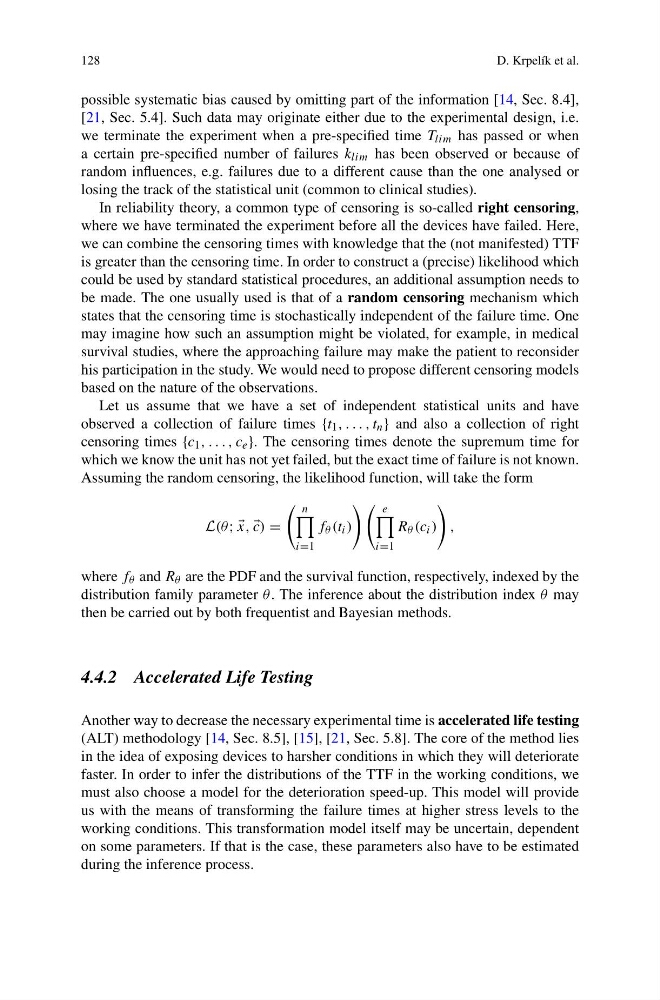
Assuming the random censoring, the likelihood function, will take the form
L(θ ; ;
x,
c) =
n
i=1
f θ (t i )
e
i=1
R θ (c i )
,
where f θ and R θ are the PDF and the survival function, respectively, indexed by the
distribution family parameter θ . The inference about the distribution index θ may
then be carried out by both frequentist and Bayesian methods.
4.4.2 Accelerated Life Testing
Another way to decrease the necessary experimental time is accelerated life testing
(ALT) methodology [14, Sec. 8.5], [15], [21, Sec. 5.8]. The core of the method lies
in the idea of exposing devices to harsher conditions in which they will deteriorate
faster. In order to infer the distributions of the TTF in the working conditions, we
must also choose a model for the deterioration speed-up. This model will provide
us with the means of transforming the failure times at higher stress levels to the
working conditions. This transformation model itself may be uncertain, dependent
on some parameters. If that is the case, these parameters also have to be estimated
during the inference process.
D. Krpelík et al.
possible systematic bias caused by omitting part of the information [14, Sec. 8.4],
[21, Sec. 5.4]. Such data may originate either due to the experimental design, i.e.
we terminate the experiment when a pre-specified time T lim has passed or when
a certain pre-specified number of failures k lim has been observed or because of
random influences, e.g. failures due to a different cause than the one analysed or
losing the track of the statistical unit (common to clinical studies).
In reliability theory, a common type of censoring is so-called right censoring,
where we have terminated the experiment before all the devices have failed. Here,
we can combine the censoring times with knowledge that the (not manifested) TTF
is greater than the censoring time. In order to construct a (precise) likelihood which
could be used by standard statistical procedures, an additional assumption needs to
be made. The one usually used is that of a random censoring mechanism which
states that the censoring time is stochastically independent of the failure time. One
may imagine how such an assumption might be violated, for example, in medical
survival studies, where the approaching failure may make the patient to reconsider
his participation in the study. We would need to propose different censoring models
based on the nature of the observations.
Let us assume that we have a set of independent statistical units and have
observed a collection of failure times {t 1 , . . . , t n } and also a collection of right
censoring times {c 1 , . . . , c e }. The censoring times denote the supremum time for
which we know the unit has not yet failed, but the exact time of failure is not known.
Assuming the random censoring, the likelihood function, will take the form
L(θ ; ;
x,
c) =
n
i=1
f θ (t i )
e
i=1
R θ (c i )
,
where f θ and R θ are the PDF and the survival function, respectively, indexed by the
distribution family parameter θ . The inference about the distribution index θ may
then be carried out by both frequentist and Bayesian methods.
4.4.2 Accelerated Life Testing
Another way to decrease the necessary experimental time is accelerated life testing
(ALT) methodology [14, Sec. 8.5], [15], [21, Sec. 5.8]. The core of the method lies
in the idea of exposing devices to harsher conditions in which they will deteriorate
faster. In order to infer the distributions of the TTF in the working conditions, we
must also choose a model for the deterioration speed-up. This model will provide
us with the means of transforming the failure times at higher stress levels to the
working conditions. This transformation model itself may be uncertain, dependent
on some parameters. If that is the case, these parameters also have to be estimated
during the inference process.