

126
D. Krpelík et al.
signatures implies stochastic orderings of system TTF [20]. This enables us to
define system optimisation problems as problems of finding systems with optimal
signatures, although not each signature correspond to a physical system.
4.3.4.2 Survival Signature
An extension to system signatures may be made for systems consisting of multiple
types of components. In this scenario, we assume that the TTFs of components of
the same type are exchangeable (i.i.d. implies exchangeability). This allows us to
model more scenarios than the system signature (e.g. network system with both
switch-boards and transmission ducts). The scenario in which the TTF of each of
the components is different is also included as an extreme case.
Let us assume that we have a system with K distinct component types and denote
G j the set of components of type j and M j the number of components of type j in
the system. We can introduce a natural decomposition of {0, 1} N into D
l , where
l ∈
⊗ K
i=1 {0, 1, . . . , M i } is a multi-index, and D
l := {{ x ∈ Ω X : ∀j :
i∈G j
x i = l j }.
This corresponds to a decomposition into disjoint sets D
l where for each component
type j exactly l j components are functioning. The probability P (S|D i ) may be
viewed, due to the exchangeability assumption, as the probability of success in a
Bernoulli trial (the number of favourable events divided by the number of all the
possible events) and may be derived from the structure function as
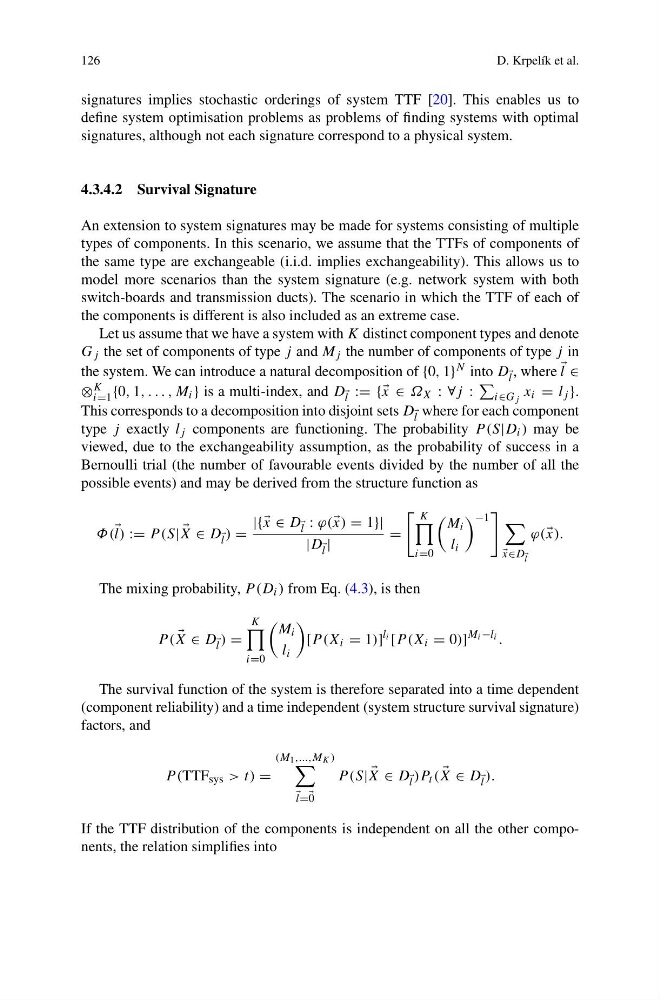
Φ(
l) := P (S|
X ∈ D
l ) =
|{{ x ∈ D
l : ϕ( x) = 1}|
|D
l |
=
K
i=0
M i
l i
−1
x∈D
l
ϕ( x).
The mixing probability, P (D i ) from Eq. (4.3), is then
P (
X ∈ D
l ) =
K
i=0
M i
l i
[P (X i = 1)]
l i [P (X i = 0)]
M i −l i .
The survival function of the system is therefore separated into a time dependent
(component reliability) and a time independent (system structure survival signature)
factors, and
P (TTF sys > t) =
(M 1 ,...,M K )
l=
0
P (S|
X ∈ D
l )P t (
X ∈ D
l ).
If the TTF distribution of the components is independent on all the other components, the relation simplifies into
D. Krpelík et al.
signatures implies stochastic orderings of system TTF [20]. This enables us to
define system optimisation problems as problems of finding systems with optimal
signatures, although not each signature correspond to a physical system.
4.3.4.2 Survival Signature
An extension to system signatures may be made for systems consisting of multiple
types of components. In this scenario, we assume that the TTFs of components of
the same type are exchangeable (i.i.d. implies exchangeability). This allows us to
model more scenarios than the system signature (e.g. network system with both
switch-boards and transmission ducts). The scenario in which the TTF of each of
the components is different is also included as an extreme case.
Let us assume that we have a system with K distinct component types and denote
G j the set of components of type j and M j the number of components of type j in
the system. We can introduce a natural decomposition of {0, 1} N into D
l , where
l ∈
⊗ K
i=1 {0, 1, . . . , M i } is a multi-index, and D
l := {{ x ∈ Ω X : ∀j :
i∈G j
x i = l j }.
This corresponds to a decomposition into disjoint sets D
l where for each component
type j exactly l j components are functioning. The probability P (S|D i ) may be
viewed, due to the exchangeability assumption, as the probability of success in a
Bernoulli trial (the number of favourable events divided by the number of all the
possible events) and may be derived from the structure function as
Φ(
l) := P (S|
X ∈ D
l ) =
|{{ x ∈ D
l : ϕ( x) = 1}|
|D
l |
=
K
i=0
M i
l i
−1
x∈D
l
ϕ( x).
The mixing probability, P (D i ) from Eq. (4.3), is then
P (
X ∈ D
l ) =
K
i=0
M i
l i
[P (X i = 1)]
l i [P (X i = 0)]
M i −l i .
The survival function of the system is therefore separated into a time dependent
(component reliability) and a time independent (system structure survival signature)
factors, and
P (TTF sys > t) =
(M 1 ,...,M K )
l=
0
P (S|
X ∈ D
l )P t (
X ∈ D
l ).
If the TTF distribution of the components is independent on all the other components, the relation simplifies into