

124
D. Krpelík et al.
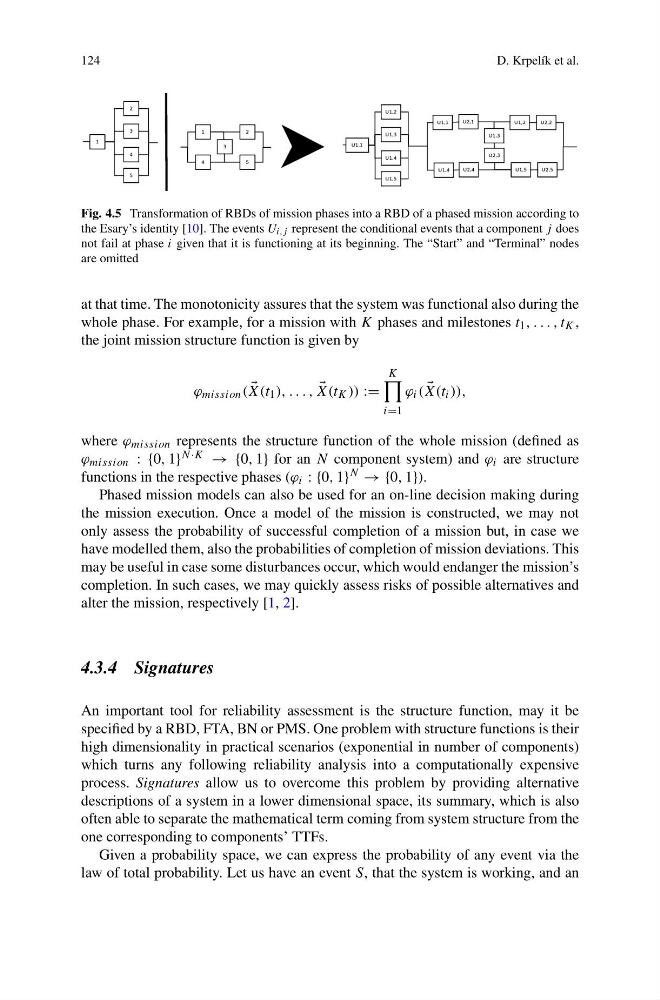
Fig. 4.5 Transformation of RBDs of mission phases into a RBD of a phased mission according to
the Esary’s identity [10]. The events U i,j represent the conditional events that a component j does
not fail at phase i given that it is functioning at its beginning. The “Start” and “Terminal” nodes
are omitted
at that time. The monotonicity assures that the system was functional also during the
whole phase. For example, for a mission with K phases and milestones t 1 , . . . , t K ,
the joint mission structure function is given by
ϕ mission (
X(t 1 ), . . . ,
X(t K )) :=
K
i=1
ϕ i (
X(t i )),
where ϕ mission represents the structure function of the whole mission (defined as
ϕ mission : {0, 1} N ·K → {0, 1} for an N component system) and ϕ i are structure
functions in the respective phases (ϕ i : {0, 1} N → {0, 1}).
Phased mission models can also be used for an on-line decision making during
the mission execution. Once a model of the mission is constructed, we may not
only assess the probability of successful completion of a mission but, in case we
have modelled them, also the probabilities of completion of mission deviations. This
may be useful in case some disturbances occur, which would endanger the mission’s
completion. In such cases, we may quickly assess risks of possible alternatives and
alter the mission, respectively [1, 2].
4.3.4 Signatures
An important tool for reliability assessment is the structure function, may it be
specified by a RBD, FTA, BN or PMS. One problem with structure functions is their
high dimensionality in practical scenarios (exponential in number of components)
which turns any following reliability analysis into a computationally expensive
process. Signatures allow us to overcome this problem by providing alternative
descriptions of a system in a lower dimensional space, its summary, which is also
often able to separate the mathematical term coming from system structure from the
one corresponding to components’ TTFs.
Given a probability space, we can express the probability of any event via the
law of total probability. Let us have an event S, that the system is working, and an
D. Krpelík et al.
Fig. 4.5 Transformation of RBDs of mission phases into a RBD of a phased mission according to
the Esary’s identity [10]. The events U i,j represent the conditional events that a component j does
not fail at phase i given that it is functioning at its beginning. The “Start” and “Terminal” nodes
are omitted
at that time. The monotonicity assures that the system was functional also during the
whole phase. For example, for a mission with K phases and milestones t 1 , . . . , t K ,
the joint mission structure function is given by
ϕ mission (
X(t 1 ), . . . ,
X(t K )) :=
K
i=1
ϕ i (
X(t i )),
where ϕ mission represents the structure function of the whole mission (defined as
ϕ mission : {0, 1} N ·K → {0, 1} for an N component system) and ϕ i are structure
functions in the respective phases (ϕ i : {0, 1} N → {0, 1}).
Phased mission models can also be used for an on-line decision making during
the mission execution. Once a model of the mission is constructed, we may not
only assess the probability of successful completion of a mission but, in case we
have modelled them, also the probabilities of completion of mission deviations. This
may be useful in case some disturbances occur, which would endanger the mission’s
completion. In such cases, we may quickly assess risks of possible alternatives and
alter the mission, respectively [1, 2].
4.3.4 Signatures
An important tool for reliability assessment is the structure function, may it be
specified by a RBD, FTA, BN or PMS. One problem with structure functions is their
high dimensionality in practical scenarios (exponential in number of components)
which turns any following reliability analysis into a computationally expensive
process. Signatures allow us to overcome this problem by providing alternative
descriptions of a system in a lower dimensional space, its summary, which is also
often able to separate the mathematical term coming from system structure from the
one corresponding to components’ TTFs.
Given a probability space, we can express the probability of any event via the
law of total probability. Let us have an event S, that the system is working, and an