

4 Reliability Theory
123
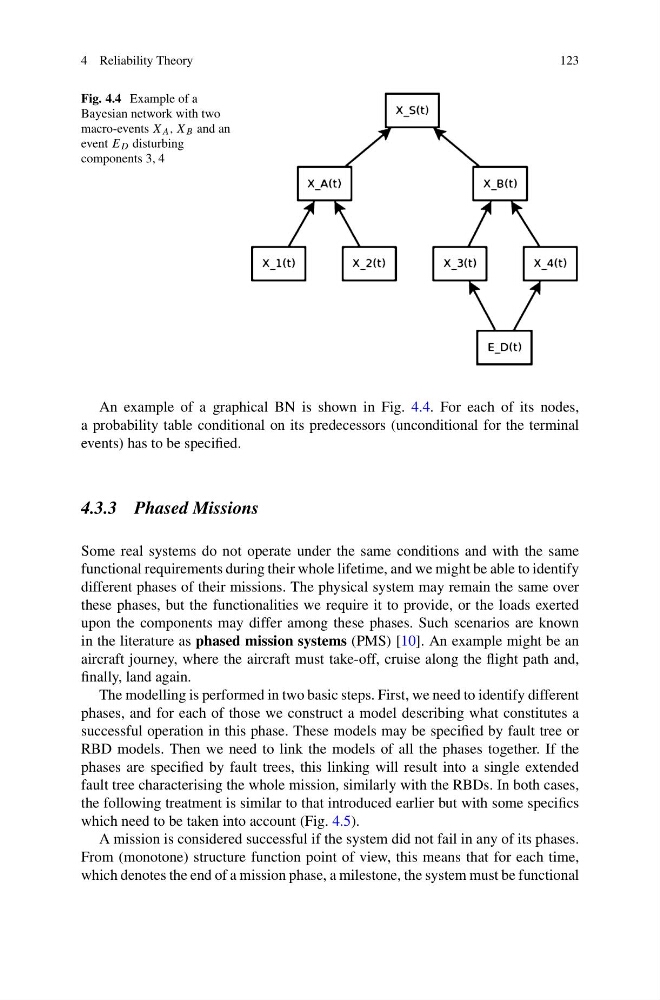
Fig. 4.4 Example of a
Bayesian network with two
macro-events X A , X B and an
event E D disturbing
components 3, 4
An example of a graphical BN is shown in Fig. 4.4. For each of its nodes,
a probability table conditional on its predecessors (unconditional for the terminal
events) has to be specified.
4.3.3 Phased Missions
Some real systems do not operate under the same conditions and with the same
functional requirements during their whole lifetime, and we might be able to identify
different phases of their missions. The physical system may remain the same over
these phases, but the functionalities we require it to provide, or the loads exerted
upon the components may differ among these phases. Such scenarios are known
in the literature as phased mission systems (PMS) [10]. An example might be an
aircraft journey, where the aircraft must take-off, cruise along the flight path and,
finally, land again.
The modelling is performed in two basic steps. First, we need to identify different
phases, and for each of those we construct a model describing what constitutes a
successful operation in this phase. These models may be specified by fault tree or
RBD models. Then we need to link the models of all the phases together. If the
phases are specified by fault trees, this linking will result into a single extended
fault tree characterising the whole mission, similarly with the RBDs. In both cases,
the following treatment is similar to that introduced earlier but with some specifics
which need to be taken into account (Fig. 4.5).
A mission is considered successful if the system did not fail in any of its phases.
From (monotone) structure function point of view, this means that for each time,
which denotes the end of a mission phase, a milestone, the system must be functional
123
Fig. 4.4 Example of a
Bayesian network with two
macro-events X A , X B and an
event E D disturbing
components 3, 4
An example of a graphical BN is shown in Fig. 4.4. For each of its nodes,
a probability table conditional on its predecessors (unconditional for the terminal
events) has to be specified.
4.3.3 Phased Missions
Some real systems do not operate under the same conditions and with the same
functional requirements during their whole lifetime, and we might be able to identify
different phases of their missions. The physical system may remain the same over
these phases, but the functionalities we require it to provide, or the loads exerted
upon the components may differ among these phases. Such scenarios are known
in the literature as phased mission systems (PMS) [10]. An example might be an
aircraft journey, where the aircraft must take-off, cruise along the flight path and,
finally, land again.
The modelling is performed in two basic steps. First, we need to identify different
phases, and for each of those we construct a model describing what constitutes a
successful operation in this phase. These models may be specified by fault tree or
RBD models. Then we need to link the models of all the phases together. If the
phases are specified by fault trees, this linking will result into a single extended
fault tree characterising the whole mission, similarly with the RBDs. In both cases,
the following treatment is similar to that introduced earlier but with some specifics
which need to be taken into account (Fig. 4.5).
A mission is considered successful if the system did not fail in any of its phases.
From (monotone) structure function point of view, this means that for each time,
which denotes the end of a mission phase, a milestone, the system must be functional