

4 Reliability Theory
121
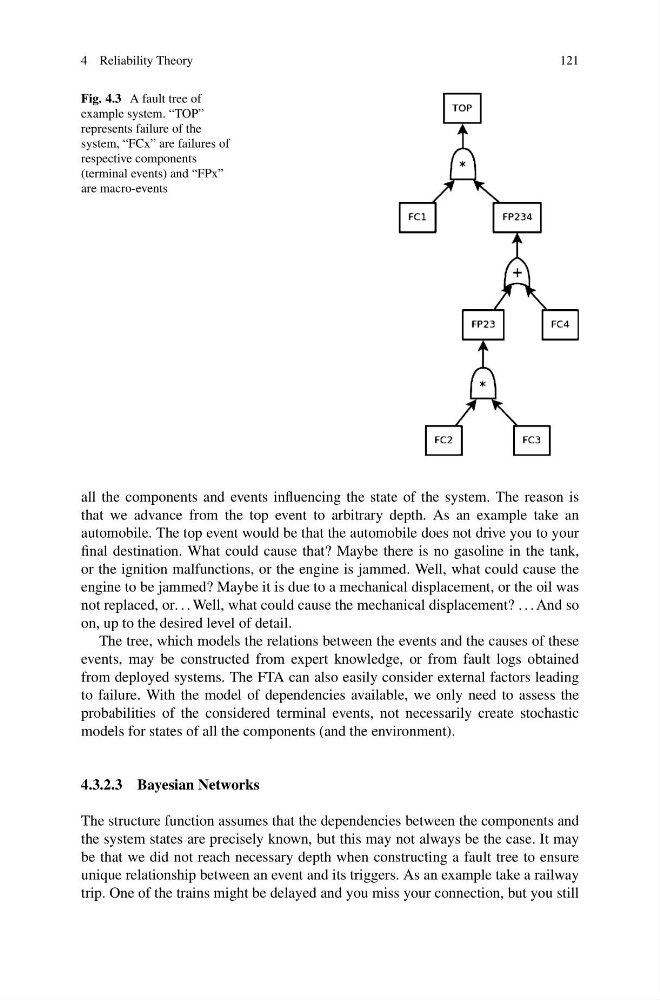
Fig. 4.3 A fault tree of
example system. “TOP”
represents failure of the
system, “FCx” are failures of
respective components
(terminal events) and “FPx”
are macro-events
all the components and events influencing the state of the system. The reason is
that we advance from the top event to arbitrary depth. As an example take an
automobile. The top event would be that the automobile does not drive you to your
final destination. What could cause that? Maybe there is no gasoline in the tank,
or the ignition malfunctions, or the engine is jammed. Well, what could cause the
engine to be jammed? Maybe it is due to a mechanical displacement, or the oil was
not replaced, or. . . Well, what could cause the mechanical displacement? . . . And so
on, up to the desired level of detail.
The tree, which models the relations between the events and the causes of these
events, may be constructed from expert knowledge, or from fault logs obtained
from deployed systems. The FTA can also easily consider external factors leading
to failure. With the model of dependencies available, we only need to assess the
probabilities of the considered terminal events, not necessarily create stochastic
models for states of all the components (and the environment).
4.3.2.3 Bayesian Networks
The structure function assumes that the dependencies between the components and
the system states are precisely known, but this may not always be the case. It may
be that we did not reach necessary depth when constructing a fault tree to ensure
unique relationship between an event and its triggers. As an example take a railway
trip. One of the trains might be delayed and you miss your connection, but you still
121
Fig. 4.3 A fault tree of
example system. “TOP”
represents failure of the
system, “FCx” are failures of
respective components
(terminal events) and “FPx”
are macro-events
all the components and events influencing the state of the system. The reason is
that we advance from the top event to arbitrary depth. As an example take an
automobile. The top event would be that the automobile does not drive you to your
final destination. What could cause that? Maybe there is no gasoline in the tank,
or the ignition malfunctions, or the engine is jammed. Well, what could cause the
engine to be jammed? Maybe it is due to a mechanical displacement, or the oil was
not replaced, or. . . Well, what could cause the mechanical displacement? . . . And so
on, up to the desired level of detail.
The tree, which models the relations between the events and the causes of these
events, may be constructed from expert knowledge, or from fault logs obtained
from deployed systems. The FTA can also easily consider external factors leading
to failure. With the model of dependencies available, we only need to assess the
probabilities of the considered terminal events, not necessarily create stochastic
models for states of all the components (and the environment).
4.3.2.3 Bayesian Networks
The structure function assumes that the dependencies between the components and
the system states are precisely known, but this may not always be the case. It may
be that we did not reach necessary depth when constructing a fault tree to ensure
unique relationship between an event and its triggers. As an example take a railway
trip. One of the trains might be delayed and you miss your connection, but you still