

1 Introduction to Spectral Methods for Uncertainty Quantification
5
We start by introducing the deterministic model of the heat diffusion problem,
providing a brief discussion about the boundary conditions and about the exact
solution. Then, we evaluate potential sources of uncertainty, and we introduce the
stochastic form of the heat diffusion equation. We close this section by pointing
out some of the classical questions addressed by UQ techniques. We will answer to
some of these questions along the rest of the chapter. Although this all process is
focused on the simple illustrative problem, the same questions and procedures can
be applied to more complex and general problems.
1.2.1 The Deterministic Heat Diffusion Equation
In the following section, we discuss the heat diffusion problem through a solid
continuum. To keep it as simple as possible, we consider the propagation of heat
across a straight beam, or, in other words, we consider a one-dimensional problem.
Assuming that we have a metal rod, our problem consists in modelling the
distribution of the temperature u(x). The one-dimensional heat diffusion problem
reads
ρ (x) C p (x)∂ t u(x, t) − ∂ x k(x)∂ x u(x, t) = ˙
q(x, t),
(1.1)
where x ∈ (0, 1) and t ∈ (0, +∞). In Eq. (1.1), ρ represents the density of
the matter; C p is the specific heat capacity, and k is the thermal conductivity.
These are properties of the matter, and the three of them are always positive
(k, ρ, C p ∈ R + ). These properties may be a function of space, and thus they vary
along the beam, or they may be homogeneous. In general, their value can be inferred
through experiments or predicted exploiting semi-empirical models. The ˙
q term in
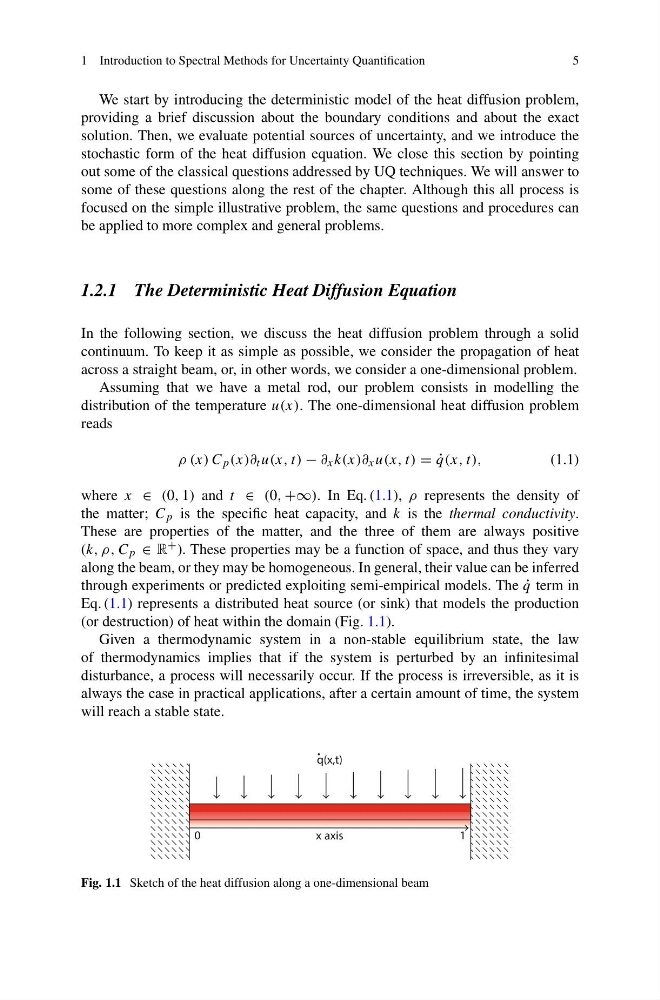
Eq. (1.1) represents a distributed heat source (or sink) that models the production
(or destruction) of heat within the domain (Fig. 1.1).
Given a thermodynamic system in a non-stable equilibrium state, the law
of thermodynamics implies that if the system is perturbed by an infinitesimal
disturbance, a process will necessarily occur. If the process is irreversible, as it is
always the case in practical applications, after a certain amount of time, the system
will reach a stable state.
Fig. 1.1 Sketch of the heat diffusion along a one-dimensional beam
5
We start by introducing the deterministic model of the heat diffusion problem,
providing a brief discussion about the boundary conditions and about the exact
solution. Then, we evaluate potential sources of uncertainty, and we introduce the
stochastic form of the heat diffusion equation. We close this section by pointing
out some of the classical questions addressed by UQ techniques. We will answer to
some of these questions along the rest of the chapter. Although this all process is
focused on the simple illustrative problem, the same questions and procedures can
be applied to more complex and general problems.
1.2.1 The Deterministic Heat Diffusion Equation
In the following section, we discuss the heat diffusion problem through a solid
continuum. To keep it as simple as possible, we consider the propagation of heat
across a straight beam, or, in other words, we consider a one-dimensional problem.
Assuming that we have a metal rod, our problem consists in modelling the
distribution of the temperature u(x). The one-dimensional heat diffusion problem
reads
ρ (x) C p (x)∂ t u(x, t) − ∂ x k(x)∂ x u(x, t) = ˙
q(x, t),
(1.1)
where x ∈ (0, 1) and t ∈ (0, +∞). In Eq. (1.1), ρ represents the density of
the matter; C p is the specific heat capacity, and k is the thermal conductivity.
These are properties of the matter, and the three of them are always positive
(k, ρ, C p ∈ R + ). These properties may be a function of space, and thus they vary
along the beam, or they may be homogeneous. In general, their value can be inferred
through experiments or predicted exploiting semi-empirical models. The ˙
q term in
Eq. (1.1) represents a distributed heat source (or sink) that models the production
(or destruction) of heat within the domain (Fig. 1.1).
Given a thermodynamic system in a non-stable equilibrium state, the law
of thermodynamics implies that if the system is perturbed by an infinitesimal
disturbance, a process will necessarily occur. If the process is irreversible, as it is
always the case in practical applications, after a certain amount of time, the system
will reach a stable state.
Fig. 1.1 Sketch of the heat diffusion along a one-dimensional beam