

610
M. Huda et al.
40.3.2 Electricity Market Assumption
The power system must be kept in balance, being produced and consumed in equal
amounts at all times (Zhao et al. 2018). This condition is ensured on the electricity market by trading in one-hour cycles that has been implemented in developed
countries with demand response (Aziz et al. 2018).
However, the load fluctuation must be covered by a high ramp-rate power generator to return the frequency to its normal value (50.00 Hz) (PT PLN (Persero). PLN
Statsistics. 2017). In addition, the peak load basically occurs twice in a day, caused
by high demand from several sectors, including industrial (noon peak) and residential
(night peak) activities. As the primary regulation, governor-free regulation is adopted
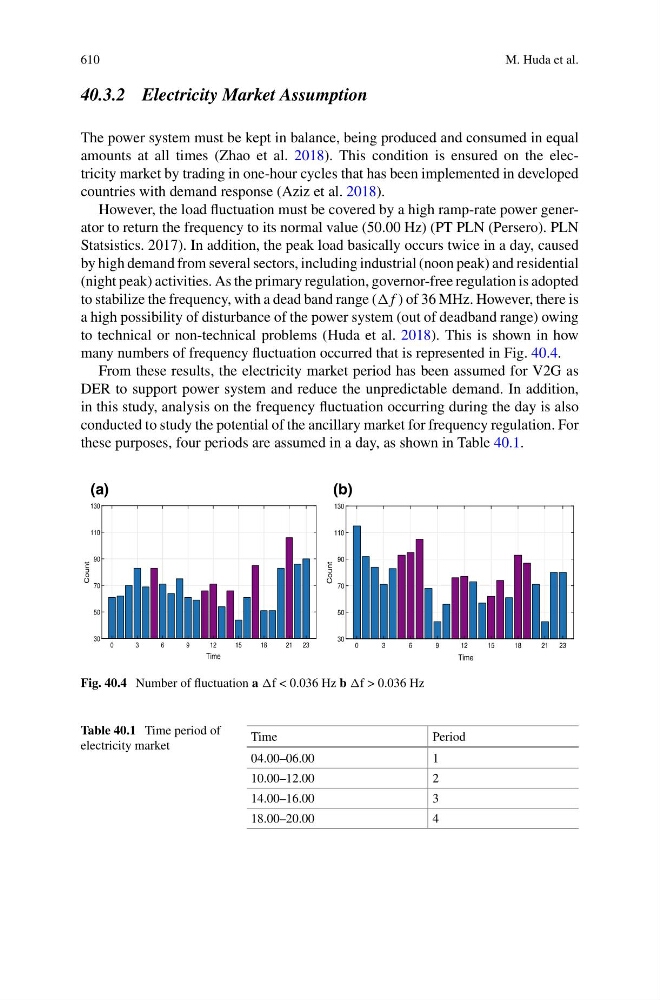
to stabilize the frequency, with a dead band range ( f ) of 36 MHz. However, there is
a high possibility of disturbance of the power system (out of deadband range) owing
to technical or non-technical problems (Huda et al. 2018). This is shown in how
many numbers of frequency fluctuation occurred that is represented in Fig. 40.4.
From these results, the electricity market period has been assumed for V2G as
DER to support power system and reduce the unpredictable demand. In addition,
in this study, analysis on the frequency fluctuation occurring during the day is also
conducted to study the potential of the ancillary market for frequency regulation. For
these purposes, four periods are assumed in a day, as shown in Table 40.1.
(a)
(b)
Fig. 40.4 Number of fluctuation a f < 0.036 Hz b f > 0.036 Hz
Table 40.1 Time period of
electricity market
Time
Period
04.00–06.00
1
10.00–12.00
2
14.00–16.00
3
18.00–20.00
4