

39 Recovery Analysis of Domestic Electric Storage Water Heaters
593
to recover it and to find the design issues that hinder and aid the remanufacturing
process.
Modular design makes product recovery more efficient and profitable. The remanufacturability of the products depends on the critical and most valuable modules (Liao
2018). Therefore, we assess the value and the significance of the different modules
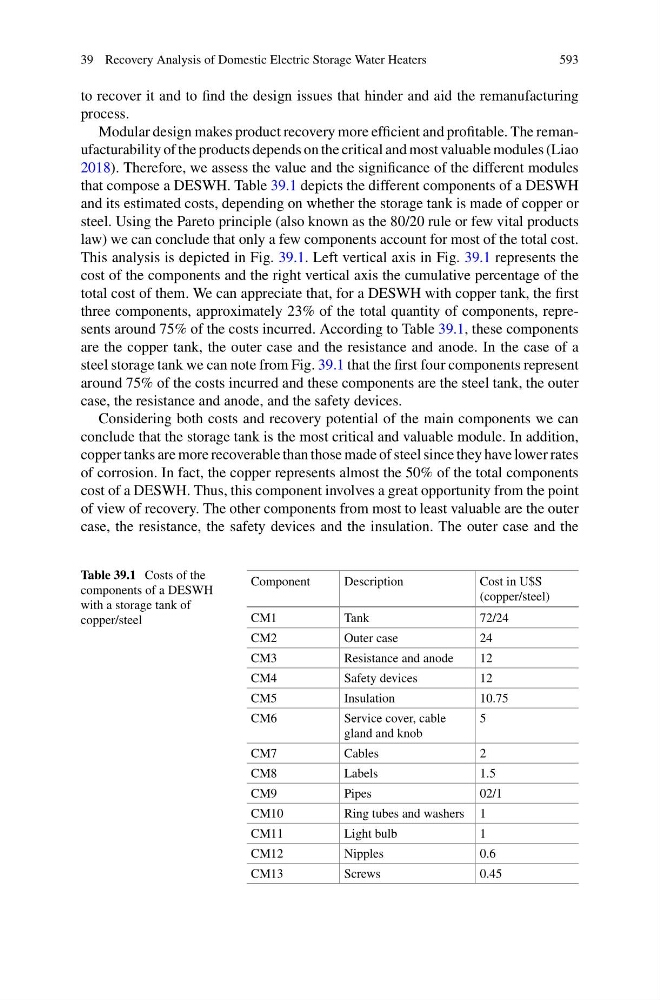
that compose a DESWH. Table 39.1 depicts the different components of a DESWH
and its estimated costs, depending on whether the storage tank is made of copper or
steel. Using the Pareto principle (also known as the 80/20 rule or few vital products
law) we can conclude that only a few components account for most of the total cost.
This analysis is depicted in Fig. 39.1. Left vertical axis in Fig. 39.1 represents the
cost of the components and the right vertical axis the cumulative percentage of the
total cost of them. We can appreciate that, for a DESWH with copper tank, the first
three components, approximately 23% of the total quantity of components, represents around 75% of the costs incurred. According to Table 39.1, these components
are the copper tank, the outer case and the resistance and anode. In the case of a
steel storage tank we can note from Fig. 39.1 that the first four components represent
around 75% of the costs incurred and these components are the steel tank, the outer
case, the resistance and anode, and the safety devices.
Considering both costs and recovery potential of the main components we can
conclude that the storage tank is the most critical and valuable module. In addition,
copper tanks are more recoverable than those made of steel since they have lower rates
of corrosion. In fact, the copper represents almost the 50% of the total components
cost of a DESWH. Thus, this component involves a great opportunity from the point
of view of recovery. The other components from most to least valuable are the outer
case, the resistance, the safety devices and the insulation. The outer case and the
Table 39.1 Costs of the
components of a DESWH
with a storage tank of
copper/steel
Component
Description
Cost in U$S
(copper/steel)
CM1
Tank
72/24
CM2
Outer case
24
CM3
Resistance and anode
12
CM4
Safety devices
12
CM5
Insulation
10.75
CM6
Service cover, cable
gland and knob
5
CM7
Cables
2
CM8
Labels
1.5
CM9
Pipes
02/1
CM10
Ring tubes and washers 1
CM11
Light bulb
1
CM12
Nipples
0.6
CM13
Screws
0.45