

490
N. Takatsu and H. Farzaneh
32.3.4 Electrolyzer
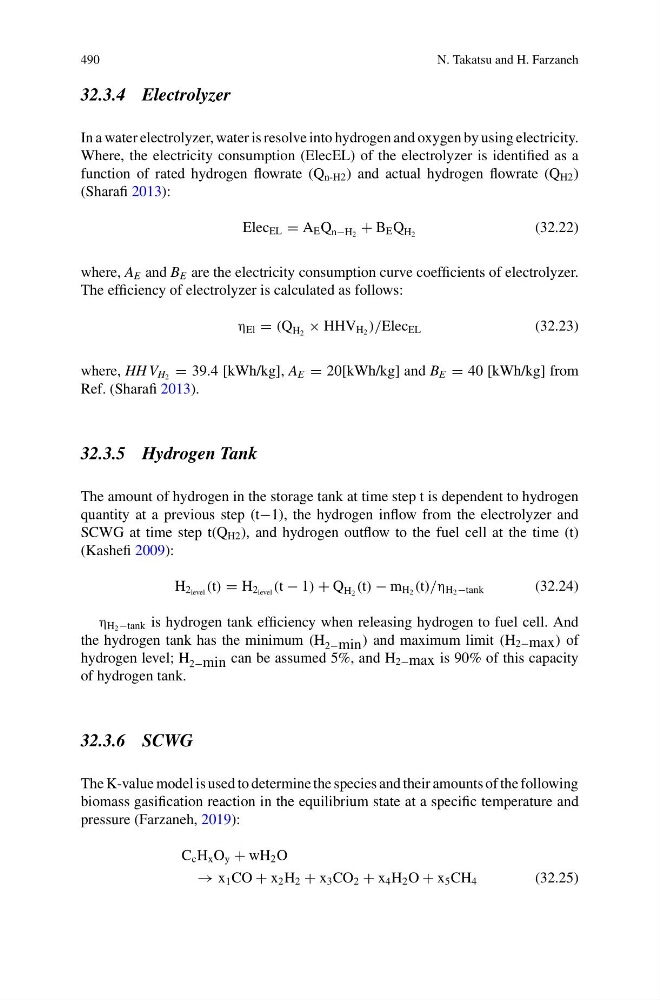
In a water electrolyzer, water is resolve into hydrogen and oxygen by using electricity.
Where, the electricity consumption (ElecEL) of the electrolyzer is identified as a
function of rated hydrogen flowrate (Q n-H2 ) and actual hydrogen flowrate (Q H2 )
(Sharafi 2013):
Elec EL = A E Q n−H 2 + B E Q H 2
(32.22)
where, A E and B E are the electricity consumption curve coefficients of electrolyzer.
The efficiency of electrolyzer is calculated as follows:
η El = (Q H 2 × HHV H 2 )/Elec EL
(32.23)
where, HH V H 2 = 39.4 [kWh/kg], A E = 20[kWh/kg] and B E = 40 [kWh/kg] from
Ref. (Sharafi 2013).
32.3.5 Hydrogen Tank
The amount of hydrogen in the storage tank at time step t is dependent to hydrogen
quantity at a previous step (t−1), the hydrogen inflow from the electrolyzer and
SCWG at time step t(Q H2 ), and hydrogen outflow to the fuel cell at the time (t)
(Kashefi 2009):
H 2 level (t) = H 2 level (t − 1) + Q H 2 (t) − m H 2 (t)/η H 2 −tank
(32.24)
η H 2 −tank is hydrogen tank efficiency when releasing hydrogen to fuel cell. And
the hydrogen tank has the minimum (H 2−min ) and maximum limit (H 2−max ) of
hydrogen level; H 2−min can be assumed 5%, and H 2−max is 90% of this capacity
of hydrogen tank.
32.3.6 SCWG
The K-value model is used to determine the species and their amounts of the following
biomass gasification reaction in the equilibrium state at a specific temperature and
pressure (Farzaneh, 2019):
C c H x O y + wH 2 O
→ x 1 CO + x 2 H 2 + x 3 CO 2 + x 4 H 2 O + x 5 CH 4
(32.25)
N. Takatsu and H. Farzaneh
32.3.4 Electrolyzer
In a water electrolyzer, water is resolve into hydrogen and oxygen by using electricity.
Where, the electricity consumption (ElecEL) of the electrolyzer is identified as a
function of rated hydrogen flowrate (Q n-H2 ) and actual hydrogen flowrate (Q H2 )
(Sharafi 2013):
Elec EL = A E Q n−H 2 + B E Q H 2
(32.22)
where, A E and B E are the electricity consumption curve coefficients of electrolyzer.
The efficiency of electrolyzer is calculated as follows:
η El = (Q H 2 × HHV H 2 )/Elec EL
(32.23)
where, HH V H 2 = 39.4 [kWh/kg], A E = 20[kWh/kg] and B E = 40 [kWh/kg] from
Ref. (Sharafi 2013).
32.3.5 Hydrogen Tank
The amount of hydrogen in the storage tank at time step t is dependent to hydrogen
quantity at a previous step (t−1), the hydrogen inflow from the electrolyzer and
SCWG at time step t(Q H2 ), and hydrogen outflow to the fuel cell at the time (t)
(Kashefi 2009):
H 2 level (t) = H 2 level (t − 1) + Q H 2 (t) − m H 2 (t)/η H 2 −tank
(32.24)
η H 2 −tank is hydrogen tank efficiency when releasing hydrogen to fuel cell. And
the hydrogen tank has the minimum (H 2−min ) and maximum limit (H 2−max ) of
hydrogen level; H 2−min can be assumed 5%, and H 2−max is 90% of this capacity
of hydrogen tank.
32.3.6 SCWG
The K-value model is used to determine the species and their amounts of the following
biomass gasification reaction in the equilibrium state at a specific temperature and
pressure (Farzaneh, 2019):
C c H x O y + wH 2 O
→ x 1 CO + x 2 H 2 + x 3 CO 2 + x 4 H 2 O + x 5 CH 4
(32.25)