

430
H. Michino and T. Koji
is no clear way to generate energy for catching these changes of demands up. On
the other hand, these economic development are only happened in the city areas.
For example, the difference of mean monthly gross household income between city
area and rural area is getting bigger in Malaysia. Increased amount of the difference
between 2002 and 2012 was 739 MYR, the one in city areas was 43% bigger than
the one in rural areas (Chamhuri et al. 2016).
For these two issues in south east, a rapid increase of energy demands and the
difference between city area and rural area, biomass energy can be one of solutions
since it contributes energy shift as a renewable and sustainable energy. Moreover,
there is high potential resource of biomass energy in rural areas especially in south
east Asia. However, regarding biomass energy gathering stable amount of biomass
resources is one of problems when we apply biomass energy as a baseline energy
resource as biomass resources from forest is depending on season and climate. About
this problem, it can be soleved if we can utilize waste from industries as biomass fuel
because waste can generate stably and not depend on nature. Moreover, it contributes
to make additional sales for industries that has high potential in rural areas.
Our research focused on waste from palm oil industries in Malaysia. Malaysia is
the 2nd biggest country of palm oil production only after Indonesia.
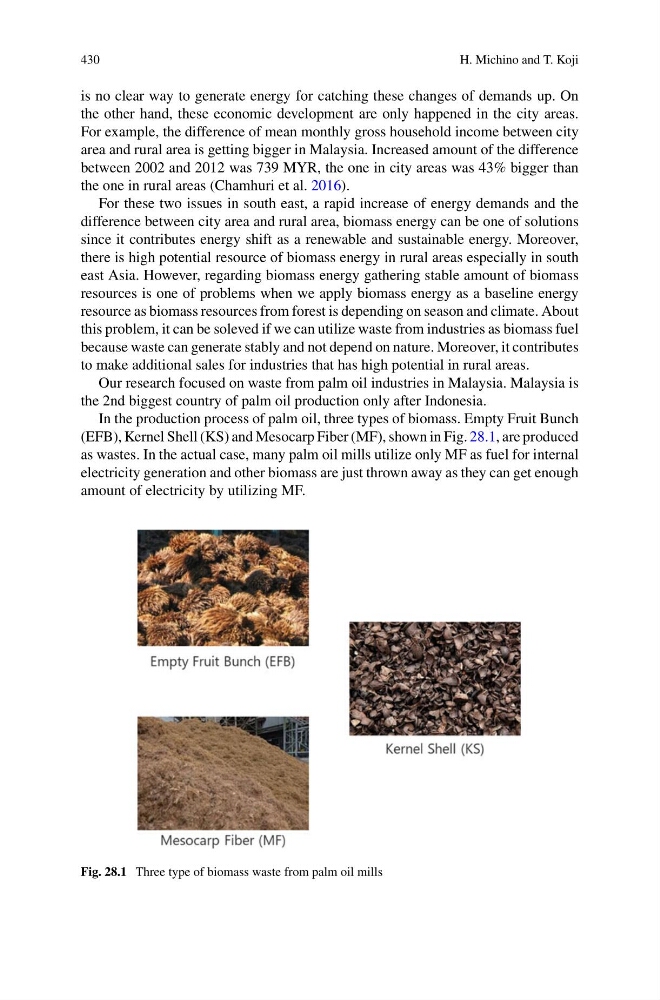
In the production process of palm oil, three types of biomass. Empty Fruit Bunch
(EFB), Kernel Shell (KS) and Mesocarp Fiber (MF), shown in Fig. 28.1, are produced
as wastes. In the actual case, many palm oil mills utilize only MF as fuel for internal
electricity generation and other biomass are just thrown away as they can get enough
amount of electricity by utilizing MF.
Fig. 28.1 Three type of biomass waste from palm oil mills
H. Michino and T. Koji
is no clear way to generate energy for catching these changes of demands up. On
the other hand, these economic development are only happened in the city areas.
For example, the difference of mean monthly gross household income between city
area and rural area is getting bigger in Malaysia. Increased amount of the difference
between 2002 and 2012 was 739 MYR, the one in city areas was 43% bigger than
the one in rural areas (Chamhuri et al. 2016).
For these two issues in south east, a rapid increase of energy demands and the
difference between city area and rural area, biomass energy can be one of solutions
since it contributes energy shift as a renewable and sustainable energy. Moreover,
there is high potential resource of biomass energy in rural areas especially in south
east Asia. However, regarding biomass energy gathering stable amount of biomass
resources is one of problems when we apply biomass energy as a baseline energy
resource as biomass resources from forest is depending on season and climate. About
this problem, it can be soleved if we can utilize waste from industries as biomass fuel
because waste can generate stably and not depend on nature. Moreover, it contributes
to make additional sales for industries that has high potential in rural areas.
Our research focused on waste from palm oil industries in Malaysia. Malaysia is
the 2nd biggest country of palm oil production only after Indonesia.
In the production process of palm oil, three types of biomass. Empty Fruit Bunch
(EFB), Kernel Shell (KS) and Mesocarp Fiber (MF), shown in Fig. 28.1, are produced
as wastes. In the actual case, many palm oil mills utilize only MF as fuel for internal
electricity generation and other biomass are just thrown away as they can get enough
amount of electricity by utilizing MF.
Fig. 28.1 Three type of biomass waste from palm oil mills