

27 Scenario Analysis of Environmental Impact of Paddy Rice …
417
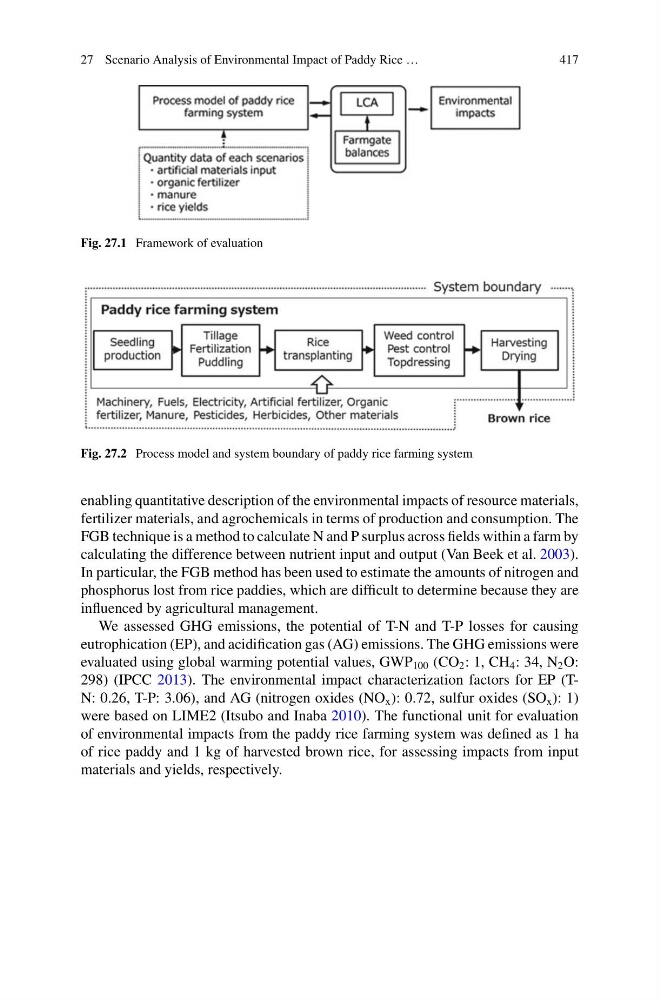
Fig. 27.1 Framework of evaluation
Fig. 27.2 Process model and system boundary of paddy rice farming system
enabling quantitative description of the environmental impacts of resource materials,
fertilizer materials, and agrochemicals in terms of production and consumption. The
FGB technique is a method to calculate N and P surplus across fields within a farm by
calculating the difference between nutrient input and output (Van Beek et al. 2003).
In particular, the FGB method has been used to estimate the amounts of nitrogen and
phosphorus lost from rice paddies, which are difficult to determine because they are
influenced by agricultural management.
We assessed GHG emissions, the potential of T-N and T-P losses for causing
eutrophication (EP), and acidification gas (AG) emissions. The GHG emissions were
evaluated using global warming potential values, GWP 100 (CO 2 : 1, CH 4 : 34, N 2 O:
298) (IPCC 2013). The environmental impact characterization factors for EP (TN: 0.26, T-P: 3.06), and AG (nitrogen oxides (NO x ): 0.72, sulfur oxides (SO x ): 1)
were based on LIME2 (Itsubo and Inaba 2010). The functional unit for evaluation
of environmental impacts from the paddy rice farming system was defined as 1 ha
of rice paddy and 1 kg of harvested brown rice, for assessing impacts from input
materials and yields, respectively.
417
Fig. 27.1 Framework of evaluation
Fig. 27.2 Process model and system boundary of paddy rice farming system
enabling quantitative description of the environmental impacts of resource materials,
fertilizer materials, and agrochemicals in terms of production and consumption. The
FGB technique is a method to calculate N and P surplus across fields within a farm by
calculating the difference between nutrient input and output (Van Beek et al. 2003).
In particular, the FGB method has been used to estimate the amounts of nitrogen and
phosphorus lost from rice paddies, which are difficult to determine because they are
influenced by agricultural management.
We assessed GHG emissions, the potential of T-N and T-P losses for causing
eutrophication (EP), and acidification gas (AG) emissions. The GHG emissions were
evaluated using global warming potential values, GWP 100 (CO 2 : 1, CH 4 : 34, N 2 O:
298) (IPCC 2013). The environmental impact characterization factors for EP (TN: 0.26, T-P: 3.06), and AG (nitrogen oxides (NO x ): 0.72, sulfur oxides (SO x ): 1)
were based on LIME2 (Itsubo and Inaba 2010). The functional unit for evaluation
of environmental impacts from the paddy rice farming system was defined as 1 ha
of rice paddy and 1 kg of harvested brown rice, for assessing impacts from input
materials and yields, respectively.