

26 Ecological Cost-Benefit Analysis of a Sensor-Based Parking …
403
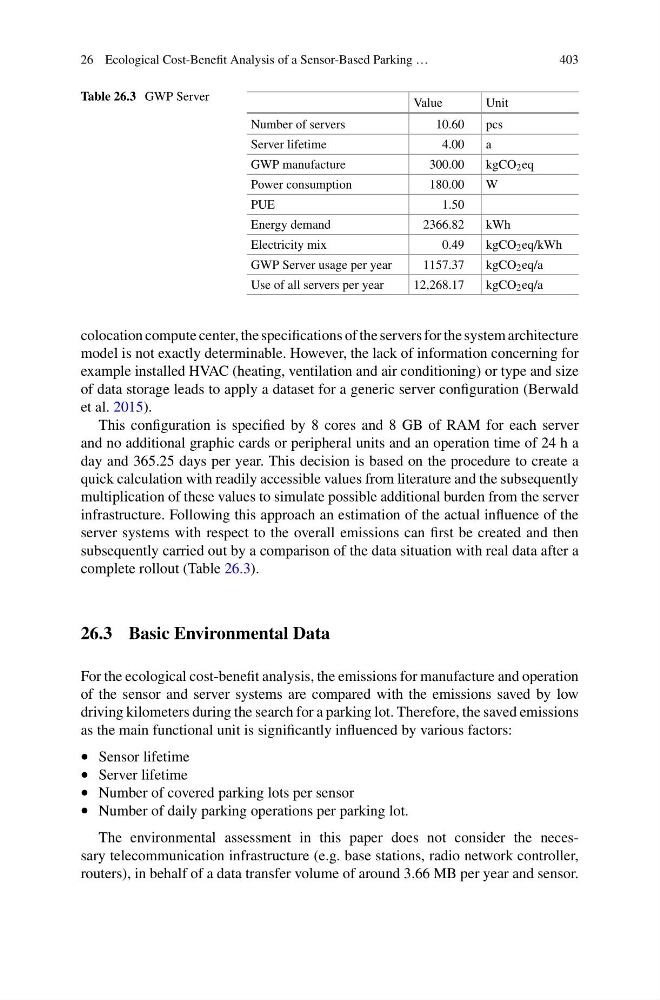
Table 26.3 GWP Server
Value
Unit
Number of servers
10.60
pcs
Server lifetime
4.00
a
GWP manufacture
300.00
kgCO 2 eq
Power consumption
180.00
W
PUE
1.50
Energy demand
2366.82
kWh
Electricity mix
0.49
kgCO 2 eq/kWh
GWP Server usage per year
1157.37
kgCO 2 eq/a
Use of all servers per year
12,268.17
kgCO 2 eq/a
colocation compute center, the specifications of the servers for the system architecture
model is not exactly determinable. However, the lack of information concerning for
example installed HVAC (heating, ventilation and air conditioning) or type and size
of data storage leads to apply a dataset for a generic server configuration (Berwald
et al. 2015).
This configuration is specified by 8 cores and 8 GB of RAM for each server
and no additional graphic cards or peripheral units and an operation time of 24 h a
day and 365.25 days per year. This decision is based on the procedure to create a
quick calculation with readily accessible values from literature and the subsequently
multiplication of these values to simulate possible additional burden from the server
infrastructure. Following this approach an estimation of the actual influence of the
server systems with respect to the overall emissions can first be created and then
subsequently carried out by a comparison of the data situation with real data after a
complete rollout (Table 26.3).
26.3 Basic Environmental Data
For the ecological cost-benefit analysis, the emissions for manufacture and operation
of the sensor and server systems are compared with the emissions saved by low
driving kilometers during the search for a parking lot. Therefore, the saved emissions
as the main functional unit is significantly influenced by various factors:
• Sensor lifetime
• Server lifetime
• Number of covered parking lots per sensor
• Number of daily parking operations per parking lot.
The environmental assessment in this paper does not consider the necessary telecommunication infrastructure (e.g. base stations, radio network controller,
routers), in behalf of a data transfer volume of around 3.66 MB per year and sensor.
403
Table 26.3 GWP Server
Value
Unit
Number of servers
10.60
pcs
Server lifetime
4.00
a
GWP manufacture
300.00
kgCO 2 eq
Power consumption
180.00
W
PUE
1.50
Energy demand
2366.82
kWh
Electricity mix
0.49
kgCO 2 eq/kWh
GWP Server usage per year
1157.37
kgCO 2 eq/a
Use of all servers per year
12,268.17
kgCO 2 eq/a
colocation compute center, the specifications of the servers for the system architecture
model is not exactly determinable. However, the lack of information concerning for
example installed HVAC (heating, ventilation and air conditioning) or type and size
of data storage leads to apply a dataset for a generic server configuration (Berwald
et al. 2015).
This configuration is specified by 8 cores and 8 GB of RAM for each server
and no additional graphic cards or peripheral units and an operation time of 24 h a
day and 365.25 days per year. This decision is based on the procedure to create a
quick calculation with readily accessible values from literature and the subsequently
multiplication of these values to simulate possible additional burden from the server
infrastructure. Following this approach an estimation of the actual influence of the
server systems with respect to the overall emissions can first be created and then
subsequently carried out by a comparison of the data situation with real data after a
complete rollout (Table 26.3).
26.3 Basic Environmental Data
For the ecological cost-benefit analysis, the emissions for manufacture and operation
of the sensor and server systems are compared with the emissions saved by low
driving kilometers during the search for a parking lot. Therefore, the saved emissions
as the main functional unit is significantly influenced by various factors:
• Sensor lifetime
• Server lifetime
• Number of covered parking lots per sensor
• Number of daily parking operations per parking lot.
The environmental assessment in this paper does not consider the necessary telecommunication infrastructure (e.g. base stations, radio network controller,
routers), in behalf of a data transfer volume of around 3.66 MB per year and sensor.