

26 Ecological Cost-Benefit Analysis of a Sensor-Based Parking …
401
Table 26.1 Sensor
components including weight
Component
Weight (g)
Battery
96.36
Foam pads
3.59
Copper coil
0.69
Battery holder
27.06
Cable
0.97
Plastic seperator
26.75
Secondary board
9.82
Primary board
16.63
Outer shell
106.15
SIM card
0.08
Total
288.10
900 MHz and band 20 at 800 MHz), as well as all active and passive components to
ensure all sensor functions (U-blox Holding 2018). All sensor elements are enclosed
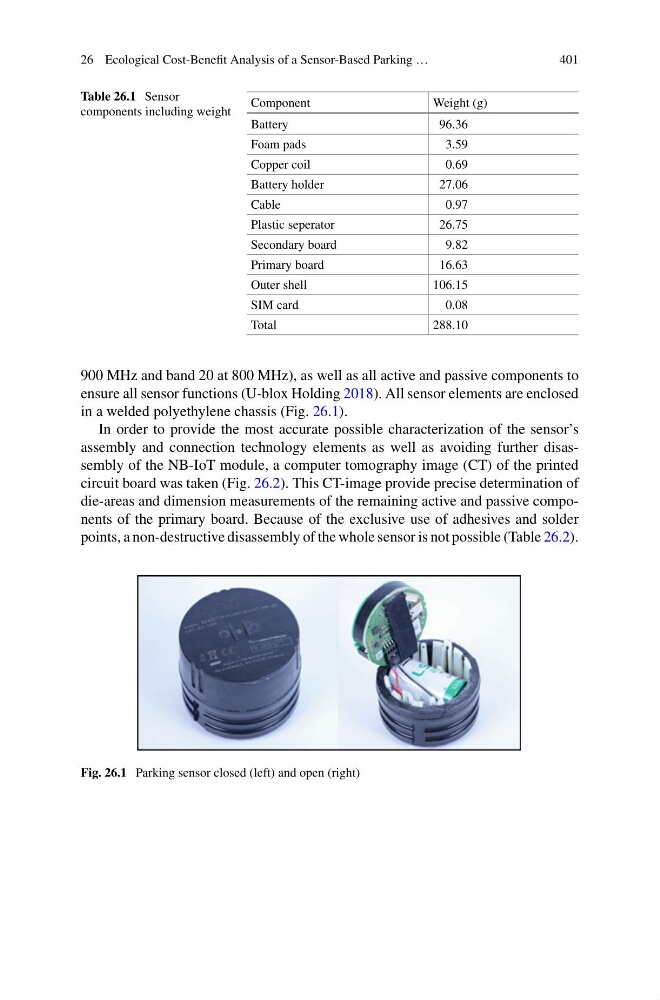
in a welded polyethylene chassis (Fig. 26.1).
In order to provide the most accurate possible characterization of the sensor’s
assembly and connection technology elements as well as avoiding further disassembly of the NB-IoT module, a computer tomography image (CT) of the printed
circuit board was taken (Fig. 26.2). This CT-image provide precise determination of
die-areas and dimension measurements of the remaining active and passive components of the primary board. Because of the exclusive use of adhesives and solder
points, a non-destructive disassembly of the whole sensor is not possible (Table 26.2).
Fig. 26.1 Parking sensor closed (left) and open (right)
401
Table 26.1 Sensor
components including weight
Component
Weight (g)
Battery
96.36
Foam pads
3.59
Copper coil
0.69
Battery holder
27.06
Cable
0.97
Plastic seperator
26.75
Secondary board
9.82
Primary board
16.63
Outer shell
106.15
SIM card
0.08
Total
288.10
900 MHz and band 20 at 800 MHz), as well as all active and passive components to
ensure all sensor functions (U-blox Holding 2018). All sensor elements are enclosed
in a welded polyethylene chassis (Fig. 26.1).
In order to provide the most accurate possible characterization of the sensor’s
assembly and connection technology elements as well as avoiding further disassembly of the NB-IoT module, a computer tomography image (CT) of the printed
circuit board was taken (Fig. 26.2). This CT-image provide precise determination of
die-areas and dimension measurements of the remaining active and passive components of the primary board. Because of the exclusive use of adhesives and solder
points, a non-destructive disassembly of the whole sensor is not possible (Table 26.2).
Fig. 26.1 Parking sensor closed (left) and open (right)