

24 CO 2 Removal Using the Sun and Forest: An Environmental Life …
381
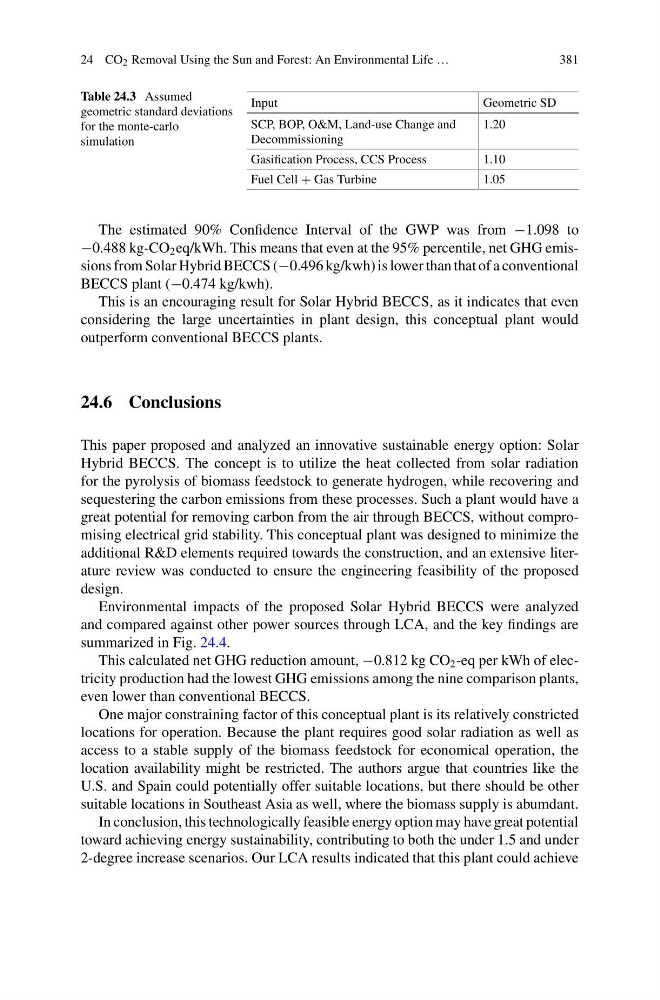
Table 24.3 Assumed
geometric standard deviations
for the monte-carlo
simulation
Input
Geometric SD
SCP, BOP, O&M, Land-use Change and
Decommissioning
1.20
Gasification Process, CCS Process
1.10
Fuel Cell + Gas Turbine
1.05
The estimated 90% Confidence Interval of the GWP was from −1.098 to
−0.488 kg-CO 2 eq/kWh. This means that even at the 95% percentile, net GHG emissions from Solar Hybrid BECCS (−0.496 kg/kwh) is lower than that of a conventional
BECCS plant (−0.474 kg/kwh).
This is an encouraging result for Solar Hybrid BECCS, as it indicates that even
considering the large uncertainties in plant design, this conceptual plant would
outperform conventional BECCS plants.
24.6 Conclusions
This paper proposed and analyzed an innovative sustainable energy option: Solar
Hybrid BECCS. The concept is to utilize the heat collected from solar radiation
for the pyrolysis of biomass feedstock to generate hydrogen, while recovering and
sequestering the carbon emissions from these processes. Such a plant would have a
great potential for removing carbon from the air through BECCS, without compromising electrical grid stability. This conceptual plant was designed to minimize the
additional R&D elements required towards the construction, and an extensive literature review was conducted to ensure the engineering feasibility of the proposed
design.
Environmental impacts of the proposed Solar Hybrid BECCS were analyzed
and compared against other power sources through LCA, and the key findings are
summarized in Fig. 24.4.
This calculated net GHG reduction amount, −0.812 kg CO 2 -eq per kWh of electricity production had the lowest GHG emissions among the nine comparison plants,
even lower than conventional BECCS.
One major constraining factor of this conceptual plant is its relatively constricted
locations for operation. Because the plant requires good solar radiation as well as
access to a stable supply of the biomass feedstock for economical operation, the
location availability might be restricted. The authors argue that countries like the
U.S. and Spain could potentially offer suitable locations, but there should be other
suitable locations in Southeast Asia as well, where the biomass supply is abumdant.
In conclusion, this technologically feasible energy option may have great potential
toward achieving energy sustainability, contributing to both the under 1.5 and under
2-degree increase scenarios. Our LCA results indicated that this plant could achieve
381
Table 24.3 Assumed
geometric standard deviations
for the monte-carlo
simulation
Input
Geometric SD
SCP, BOP, O&M, Land-use Change and
Decommissioning
1.20
Gasification Process, CCS Process
1.10
Fuel Cell + Gas Turbine
1.05
The estimated 90% Confidence Interval of the GWP was from −1.098 to
−0.488 kg-CO 2 eq/kWh. This means that even at the 95% percentile, net GHG emissions from Solar Hybrid BECCS (−0.496 kg/kwh) is lower than that of a conventional
BECCS plant (−0.474 kg/kwh).
This is an encouraging result for Solar Hybrid BECCS, as it indicates that even
considering the large uncertainties in plant design, this conceptual plant would
outperform conventional BECCS plants.
24.6 Conclusions
This paper proposed and analyzed an innovative sustainable energy option: Solar
Hybrid BECCS. The concept is to utilize the heat collected from solar radiation
for the pyrolysis of biomass feedstock to generate hydrogen, while recovering and
sequestering the carbon emissions from these processes. Such a plant would have a
great potential for removing carbon from the air through BECCS, without compromising electrical grid stability. This conceptual plant was designed to minimize the
additional R&D elements required towards the construction, and an extensive literature review was conducted to ensure the engineering feasibility of the proposed
design.
Environmental impacts of the proposed Solar Hybrid BECCS were analyzed
and compared against other power sources through LCA, and the key findings are
summarized in Fig. 24.4.
This calculated net GHG reduction amount, −0.812 kg CO 2 -eq per kWh of electricity production had the lowest GHG emissions among the nine comparison plants,
even lower than conventional BECCS.
One major constraining factor of this conceptual plant is its relatively constricted
locations for operation. Because the plant requires good solar radiation as well as
access to a stable supply of the biomass feedstock for economical operation, the
location availability might be restricted. The authors argue that countries like the
U.S. and Spain could potentially offer suitable locations, but there should be other
suitable locations in Southeast Asia as well, where the biomass supply is abumdant.
In conclusion, this technologically feasible energy option may have great potential
toward achieving energy sustainability, contributing to both the under 1.5 and under
2-degree increase scenarios. Our LCA results indicated that this plant could achieve