

24 CO 2 Removal Using the Sun and Forest: An Environmental Life …
379
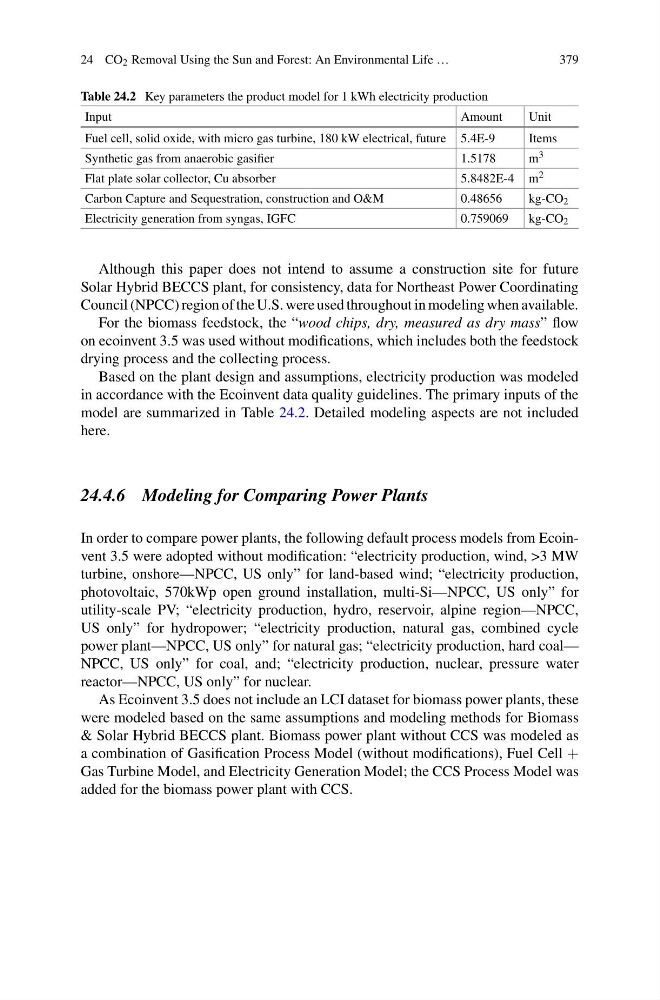
Table 24.2 Key parameters the product model for 1 kWh electricity production
Input
Amount
Unit
Fuel cell, solid oxide, with micro gas turbine, 180 kW electrical, future 5.4E-9
Items
Synthetic gas from anaerobic gasifier
1.5178
m 3
Flat plate solar collector, Cu absorber
5.8482E-4 m 2
Carbon Capture and Sequestration, construction and O&M
0.48656
kg-CO 2
Electricity generation from syngas, IGFC
0.759069
kg-CO 2
Although this paper does not intend to assume a construction site for future
Solar Hybrid BECCS plant, for consistency, data for Northeast Power Coordinating
Council (NPCC) region of the U.S. were used throughout in modeling when available.
For the biomass feedstock, the “wood chips, dry, measured as dry mass” flow
on ecoinvent 3.5 was used without modifications, which includes both the feedstock
drying process and the collecting process.
Based on the plant design and assumptions, electricity production was modeled
in accordance with the Ecoinvent data quality guidelines. The primary inputs of the
model are summarized in Table 24.2. Detailed modeling aspects are not included
here.
24.4.6 Modeling for Comparing Power Plants
In order to compare power plants, the following default process models from Ecoinvent 3.5 were adopted without modification: “electricity production, wind, >3 MW
turbine, onshore—NPCC, US only” for land-based wind; “electricity production,
photovoltaic, 570kWp open ground installation, multi-Si—NPCC, US only” for
utility-scale PV; “electricity production, hydro, reservoir, alpine region—NPCC,
US only” for hydropower; “electricity production, natural gas, combined cycle
power plant—NPCC, US only” for natural gas; “electricity production, hard coal—
NPCC, US only” for coal, and; “electricity production, nuclear, pressure water
reactor—NPCC, US only” for nuclear.
As Ecoinvent 3.5 does not include an LCI dataset for biomass power plants, these
were modeled based on the same assumptions and modeling methods for Biomass
& Solar Hybrid BECCS plant. Biomass power plant without CCS was modeled as
a combination of Gasification Process Model (without modifications), Fuel Cell +
Gas Turbine Model, and Electricity Generation Model; the CCS Process Model was
added for the biomass power plant with CCS.
379
Table 24.2 Key parameters the product model for 1 kWh electricity production
Input
Amount
Unit
Fuel cell, solid oxide, with micro gas turbine, 180 kW electrical, future 5.4E-9
Items
Synthetic gas from anaerobic gasifier
1.5178
m 3
Flat plate solar collector, Cu absorber
5.8482E-4 m 2
Carbon Capture and Sequestration, construction and O&M
0.48656
kg-CO 2
Electricity generation from syngas, IGFC
0.759069
kg-CO 2
Although this paper does not intend to assume a construction site for future
Solar Hybrid BECCS plant, for consistency, data for Northeast Power Coordinating
Council (NPCC) region of the U.S. were used throughout in modeling when available.
For the biomass feedstock, the “wood chips, dry, measured as dry mass” flow
on ecoinvent 3.5 was used without modifications, which includes both the feedstock
drying process and the collecting process.
Based on the plant design and assumptions, electricity production was modeled
in accordance with the Ecoinvent data quality guidelines. The primary inputs of the
model are summarized in Table 24.2. Detailed modeling aspects are not included
here.
24.4.6 Modeling for Comparing Power Plants
In order to compare power plants, the following default process models from Ecoinvent 3.5 were adopted without modification: “electricity production, wind, >3 MW
turbine, onshore—NPCC, US only” for land-based wind; “electricity production,
photovoltaic, 570kWp open ground installation, multi-Si—NPCC, US only” for
utility-scale PV; “electricity production, hydro, reservoir, alpine region—NPCC,
US only” for hydropower; “electricity production, natural gas, combined cycle
power plant—NPCC, US only” for natural gas; “electricity production, hard coal—
NPCC, US only” for coal, and; “electricity production, nuclear, pressure water
reactor—NPCC, US only” for nuclear.
As Ecoinvent 3.5 does not include an LCI dataset for biomass power plants, these
were modeled based on the same assumptions and modeling methods for Biomass
& Solar Hybrid BECCS plant. Biomass power plant without CCS was modeled as
a combination of Gasification Process Model (without modifications), Fuel Cell +
Gas Turbine Model, and Electricity Generation Model; the CCS Process Model was
added for the biomass power plant with CCS.