

352
A. Evangelista et al.
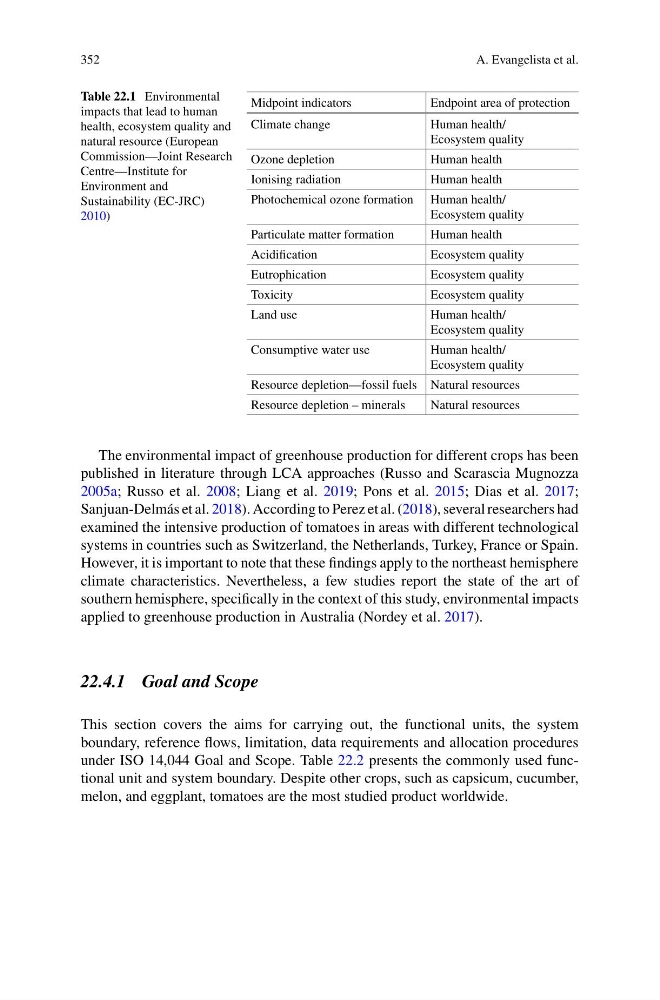
Table 22.1 Environmental
impacts that lead to human
health, ecosystem quality and
natural resource (European
Commission—Joint Research
Centre—Institute for
Environment and
Sustainability (EC-JRC)
2010)
Midpoint indicators
Endpoint area of protection
Climate change
Human health/
Ecosystem quality
Ozone depletion
Human health
Ionising radiation
Human health
Photochemical ozone formation Human health/
Ecosystem quality
Particulate matter formation
Human health
Acidification
Ecosystem quality
Eutrophication
Ecosystem quality
Toxicity
Ecosystem quality
Land use
Human health/
Ecosystem quality
Consumptive water use
Human health/
Ecosystem quality
Resource depletion—fossil fuels Natural resources
Resource depletion – minerals
Natural resources
The environmental impact of greenhouse production for different crops has been
published in literature through LCA approaches (Russo and Scarascia Mugnozza
2005a; Russo et al. 2008; Liang et al. 2019; Pons et al. 2015; Dias et al. 2017;
Sanjuan-Delmás et al. 2018). According to Perez et al. (2018), several researchers had
examined the intensive production of tomatoes in areas with different technological
systems in countries such as Switzerland, the Netherlands, Turkey, France or Spain.
However, it is important to note that these findings apply to the northeast hemisphere
climate characteristics. Nevertheless, a few studies report the state of the art of
southern hemisphere, specifically in the context of this study, environmental impacts
applied to greenhouse production in Australia (Nordey et al. 2017).
22.4.1 Goal and Scope
This section covers the aims for carrying out, the functional units, the system
boundary, reference flows, limitation, data requirements and allocation procedures
under ISO 14,044 Goal and Scope. Table 22.2 presents the commonly used functional unit and system boundary. Despite other crops, such as capsicum, cucumber,
melon, and eggplant, tomatoes are the most studied product worldwide.
A. Evangelista et al.
Table 22.1 Environmental
impacts that lead to human
health, ecosystem quality and
natural resource (European
Commission—Joint Research
Centre—Institute for
Environment and
Sustainability (EC-JRC)
2010)
Midpoint indicators
Endpoint area of protection
Climate change
Human health/
Ecosystem quality
Ozone depletion
Human health
Ionising radiation
Human health
Photochemical ozone formation Human health/
Ecosystem quality
Particulate matter formation
Human health
Acidification
Ecosystem quality
Eutrophication
Ecosystem quality
Toxicity
Ecosystem quality
Land use
Human health/
Ecosystem quality
Consumptive water use
Human health/
Ecosystem quality
Resource depletion—fossil fuels Natural resources
Resource depletion – minerals
Natural resources
The environmental impact of greenhouse production for different crops has been
published in literature through LCA approaches (Russo and Scarascia Mugnozza
2005a; Russo et al. 2008; Liang et al. 2019; Pons et al. 2015; Dias et al. 2017;
Sanjuan-Delmás et al. 2018). According to Perez et al. (2018), several researchers had
examined the intensive production of tomatoes in areas with different technological
systems in countries such as Switzerland, the Netherlands, Turkey, France or Spain.
However, it is important to note that these findings apply to the northeast hemisphere
climate characteristics. Nevertheless, a few studies report the state of the art of
southern hemisphere, specifically in the context of this study, environmental impacts
applied to greenhouse production in Australia (Nordey et al. 2017).
22.4.1 Goal and Scope
This section covers the aims for carrying out, the functional units, the system
boundary, reference flows, limitation, data requirements and allocation procedures
under ISO 14,044 Goal and Scope. Table 22.2 presents the commonly used functional unit and system boundary. Despite other crops, such as capsicum, cucumber,
melon, and eggplant, tomatoes are the most studied product worldwide.