

20 Consideration of Communication Methods with the Next …
315
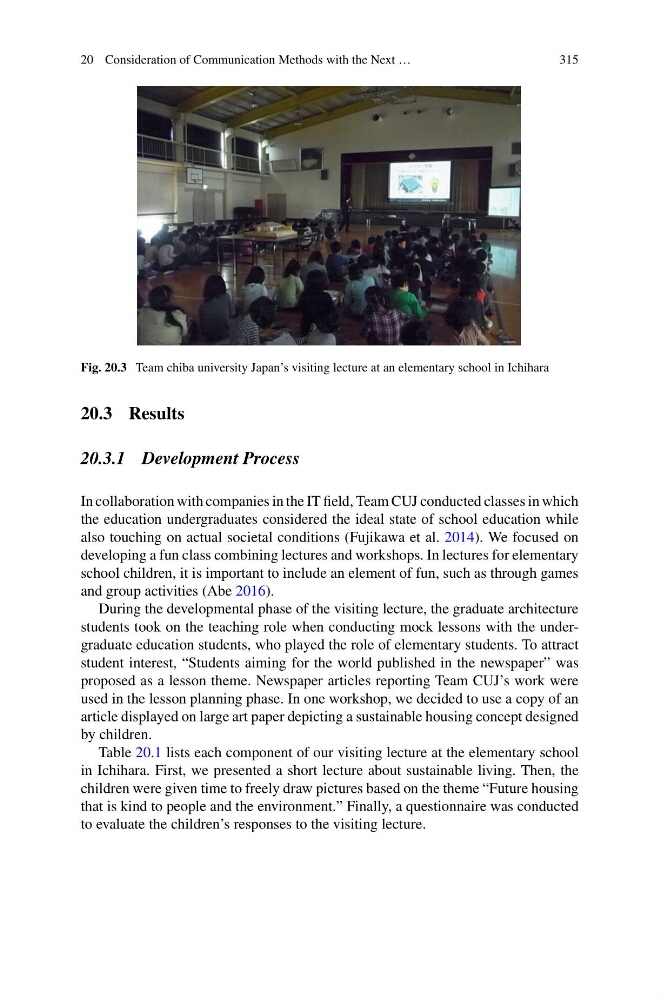
Fig. 20.3 Team chiba university Japan’s visiting lecture at an elementary school in Ichihara
20.3 Results
20.3.1 Development Process
In collaboration with companies in the IT field, Team CUJ conducted classes in which
the education undergraduates considered the ideal state of school education while
also touching on actual societal conditions (Fujikawa et al. 2014). We focused on
developing a fun class combining lectures and workshops. In lectures for elementary
school children, it is important to include an element of fun, such as through games
and group activities (Abe 2016).
During the developmental phase of the visiting lecture, the graduate architecture
students took on the teaching role when conducting mock lessons with the undergraduate education students, who played the role of elementary students. To attract
student interest, “Students aiming for the world published in the newspaper” was
proposed as a lesson theme. Newspaper articles reporting Team CUJ’s work were
used in the lesson planning phase. In one workshop, we decided to use a copy of an
article displayed on large art paper depicting a sustainable housing concept designed
by children.
Table 20.1 lists each component of our visiting lecture at the elementary school
in Ichihara. First, we presented a short lecture about sustainable living. Then, the
children were given time to freely draw pictures based on the theme “Future housing
that is kind to people and the environment.” Finally, a questionnaire was conducted
to evaluate the children’s responses to the visiting lecture.
315
Fig. 20.3 Team chiba university Japan’s visiting lecture at an elementary school in Ichihara
20.3 Results
20.3.1 Development Process
In collaboration with companies in the IT field, Team CUJ conducted classes in which
the education undergraduates considered the ideal state of school education while
also touching on actual societal conditions (Fujikawa et al. 2014). We focused on
developing a fun class combining lectures and workshops. In lectures for elementary
school children, it is important to include an element of fun, such as through games
and group activities (Abe 2016).
During the developmental phase of the visiting lecture, the graduate architecture
students took on the teaching role when conducting mock lessons with the undergraduate education students, who played the role of elementary students. To attract
student interest, “Students aiming for the world published in the newspaper” was
proposed as a lesson theme. Newspaper articles reporting Team CUJ’s work were
used in the lesson planning phase. In one workshop, we decided to use a copy of an
article displayed on large art paper depicting a sustainable housing concept designed
by children.
Table 20.1 lists each component of our visiting lecture at the elementary school
in Ichihara. First, we presented a short lecture about sustainable living. Then, the
children were given time to freely draw pictures based on the theme “Future housing
that is kind to people and the environment.” Finally, a questionnaire was conducted
to evaluate the children’s responses to the visiting lecture.