

19 Gamifying Sustainable Design to Enhance Environmental …
293
is defined as a physical activity that often uses objects and prompts player interaction (Oberprieler et al. 2017), whereas game-based learning is described as the use of
games to support learning as well as gathering knowledge and skills (Oberprieler et al.
2017; Wiggins and Khosrow-Pour 2018). Despite its distinct interpretation, the application of gamification is intended to change human behavior (Landers et al. 2018;
Oberprieler et al. 2017; Morganti et al. 2017) and, in particular, to develop games
for serious purpose (Morganti et al. 2017). Considering recent developments on
design educational landscape, gamification offers an innovative approach to produce
improved learning outcomes and student collaboration and enable design educators
to expand design curriculum and create innovative teaching methods (Oberprieler
et al. 2017; Boks and McAloone 2009).
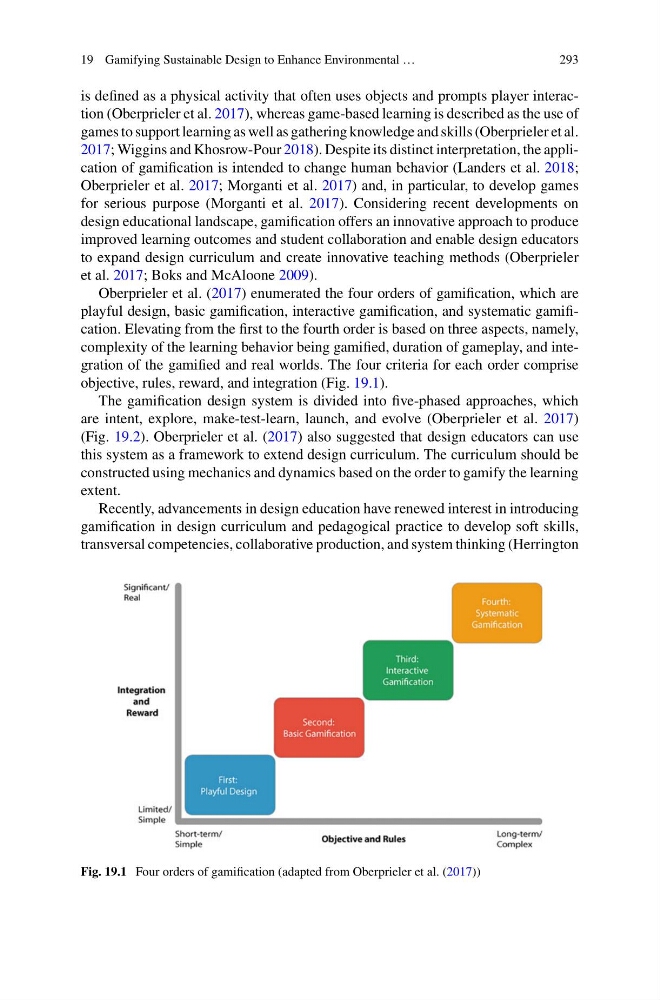
Oberprieler et al. (2017) enumerated the four orders of gamification, which are
playful design, basic gamification, interactive gamification, and systematic gamification. Elevating from the first to the fourth order is based on three aspects, namely,
complexity of the learning behavior being gamified, duration of gameplay, and integration of the gamified and real worlds. The four criteria for each order comprise
objective, rules, reward, and integration (Fig. 19.1).
The gamification design system is divided into five-phased approaches, which
are intent, explore, make-test-learn, launch, and evolve (Oberprieler et al. 2017)
(Fig. 19.2). Oberprieler et al. (2017) also suggested that design educators can use
this system as a framework to extend design curriculum. The curriculum should be
constructed using mechanics and dynamics based on the order to gamify the learning
extent.
Recently, advancements in design education have renewed interest in introducing
gamification in design curriculum and pedagogical practice to develop soft skills,
transversal competencies, collaborative production, and system thinking (Herrington
Fig. 19.1 Four orders of gamification (adapted from Oberprieler et al. (2017))
293
is defined as a physical activity that often uses objects and prompts player interaction (Oberprieler et al. 2017), whereas game-based learning is described as the use of
games to support learning as well as gathering knowledge and skills (Oberprieler et al.
2017; Wiggins and Khosrow-Pour 2018). Despite its distinct interpretation, the application of gamification is intended to change human behavior (Landers et al. 2018;
Oberprieler et al. 2017; Morganti et al. 2017) and, in particular, to develop games
for serious purpose (Morganti et al. 2017). Considering recent developments on
design educational landscape, gamification offers an innovative approach to produce
improved learning outcomes and student collaboration and enable design educators
to expand design curriculum and create innovative teaching methods (Oberprieler
et al. 2017; Boks and McAloone 2009).
Oberprieler et al. (2017) enumerated the four orders of gamification, which are
playful design, basic gamification, interactive gamification, and systematic gamification. Elevating from the first to the fourth order is based on three aspects, namely,
complexity of the learning behavior being gamified, duration of gameplay, and integration of the gamified and real worlds. The four criteria for each order comprise
objective, rules, reward, and integration (Fig. 19.1).
The gamification design system is divided into five-phased approaches, which
are intent, explore, make-test-learn, launch, and evolve (Oberprieler et al. 2017)
(Fig. 19.2). Oberprieler et al. (2017) also suggested that design educators can use
this system as a framework to extend design curriculum. The curriculum should be
constructed using mechanics and dynamics based on the order to gamify the learning
extent.
Recently, advancements in design education have renewed interest in introducing
gamification in design curriculum and pedagogical practice to develop soft skills,
transversal competencies, collaborative production, and system thinking (Herrington
Fig. 19.1 Four orders of gamification (adapted from Oberprieler et al. (2017))