

18 Study on the Quantitative Evaluation of Greenhouse Gas (GHG) …
277
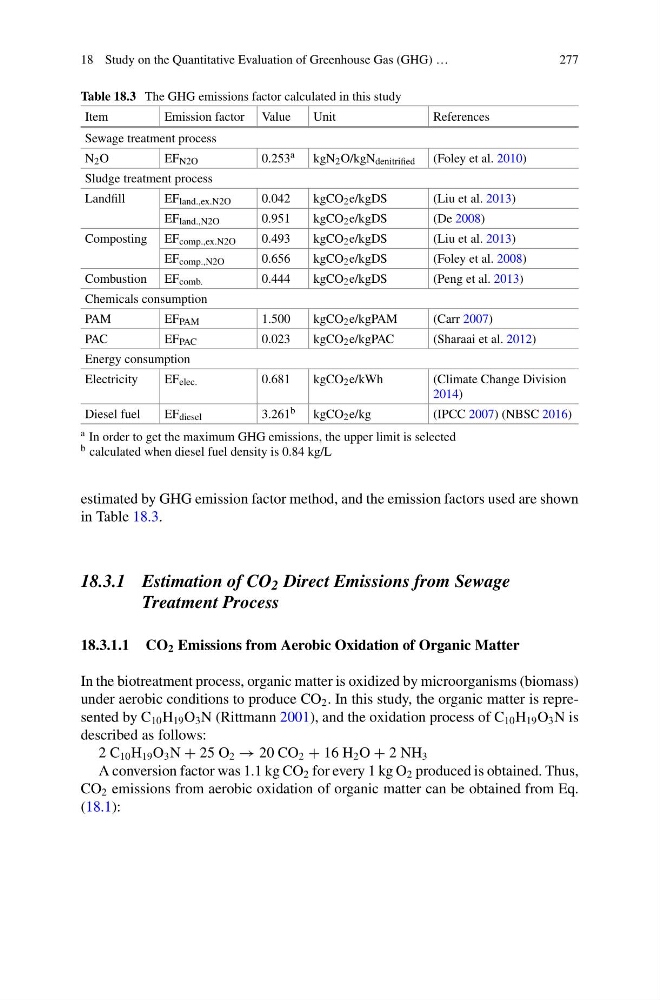
Table 18.3 The GHG emissions factor calculated in this study
Item
Emission factor Value
Unit
References
Sewage treatment process
N 2 O
EF N2O
0.253 a kgN 2 O/kgN denitrified (Foley et al. 2010)
Sludge treatment process
Landfill
EF land.,ex.N2O
0.042
kgCO 2 e/kgDS
(Liu et al. 2013)
EF land.,N2O
0.951
kgCO 2 e/kgDS
(De 2008)
Composting EF comp.,ex.N2O
0.493
kgCO 2 e/kgDS
(Liu et al. 2013)
EF comp.,N2O
0.656
kgCO 2 e/kgDS
(Foley et al. 2008)
Combustion EF comb.
0.444
kgCO 2 e/kgDS
(Peng et al. 2013)
Chemicals consumption
PAM
EF PAM
1.500
kgCO 2 e/kgPAM
(Carr 2007)
PAC
EF PAC
0.023
kgCO 2 e/kgPAC
(Sharaai et al. 2012)
Energy consumption
Electricity
EF elec.
0.681
kgCO 2 e/kWh
(Climate Change Division
2014)
Diesel fuel
EF diesel
3.261 b kgCO 2 e/kg
(IPCC 2007) (NBSC 2016)
a In order to get the maximum GHG emissions, the upper limit is selected
b calculated when diesel fuel density is 0.84 kg/L
estimated by GHG emission factor method, and the emission factors used are shown
in Table 18.3.
18.3.1 Estimation of CO 2 Direct Emissions from Sewage
Treatment Process
18.3.1.1 CO 2 Emissions from Aerobic Oxidation of Organic Matter
In the biotreatment process, organic matter is oxidized by microorganisms (biomass)
under aerobic conditions to produce CO 2 . In this study, the organic matter is represented by C 10 H 19 O 3 N (Rittmann 2001), and the oxidation process of C 10 H 19 O 3 N is
described as follows:
2 C 10 H 19 O 3 N + 25 O 2 → 20 CO 2 + 16 H 2 O + 2 NH 3
A conversion factor was 1.1 kg CO 2 for every 1 kg O 2 produced is obtained. Thus,
CO 2 emissions from aerobic oxidation of organic matter can be obtained from Eq.
(18.1):
277
Table 18.3 The GHG emissions factor calculated in this study
Item
Emission factor Value
Unit
References
Sewage treatment process
N 2 O
EF N2O
0.253 a kgN 2 O/kgN denitrified (Foley et al. 2010)
Sludge treatment process
Landfill
EF land.,ex.N2O
0.042
kgCO 2 e/kgDS
(Liu et al. 2013)
EF land.,N2O
0.951
kgCO 2 e/kgDS
(De 2008)
Composting EF comp.,ex.N2O
0.493
kgCO 2 e/kgDS
(Liu et al. 2013)
EF comp.,N2O
0.656
kgCO 2 e/kgDS
(Foley et al. 2008)
Combustion EF comb.
0.444
kgCO 2 e/kgDS
(Peng et al. 2013)
Chemicals consumption
PAM
EF PAM
1.500
kgCO 2 e/kgPAM
(Carr 2007)
PAC
EF PAC
0.023
kgCO 2 e/kgPAC
(Sharaai et al. 2012)
Energy consumption
Electricity
EF elec.
0.681
kgCO 2 e/kWh
(Climate Change Division
2014)
Diesel fuel
EF diesel
3.261 b kgCO 2 e/kg
(IPCC 2007) (NBSC 2016)
a In order to get the maximum GHG emissions, the upper limit is selected
b calculated when diesel fuel density is 0.84 kg/L
estimated by GHG emission factor method, and the emission factors used are shown
in Table 18.3.
18.3.1 Estimation of CO 2 Direct Emissions from Sewage
Treatment Process
18.3.1.1 CO 2 Emissions from Aerobic Oxidation of Organic Matter
In the biotreatment process, organic matter is oxidized by microorganisms (biomass)
under aerobic conditions to produce CO 2 . In this study, the organic matter is represented by C 10 H 19 O 3 N (Rittmann 2001), and the oxidation process of C 10 H 19 O 3 N is
described as follows:
2 C 10 H 19 O 3 N + 25 O 2 → 20 CO 2 + 16 H 2 O + 2 NH 3
A conversion factor was 1.1 kg CO 2 for every 1 kg O 2 produced is obtained. Thus,
CO 2 emissions from aerobic oxidation of organic matter can be obtained from Eq.
(18.1):