

16 Towards Intercity Cooperation: Comparison of Spatial Transport …
243
16.2.3 Computation of Spatial Transport Energy Intensity
One of the common indicators for evaluating transport energy efficiency is transport
energy intensity (Chung et al. 2013; Lipscy and Schipper 2013). Transport energy
intensity is represented by energy consumption per mass volume per travel distance.
First, energy consumption for the production of material used in the vehicle body
is computed based on the weight and rate of composition of the transportation means
and the energy consumption rate of composition by using the following equation.
Q material =
(Mc i e i )
(16.1)
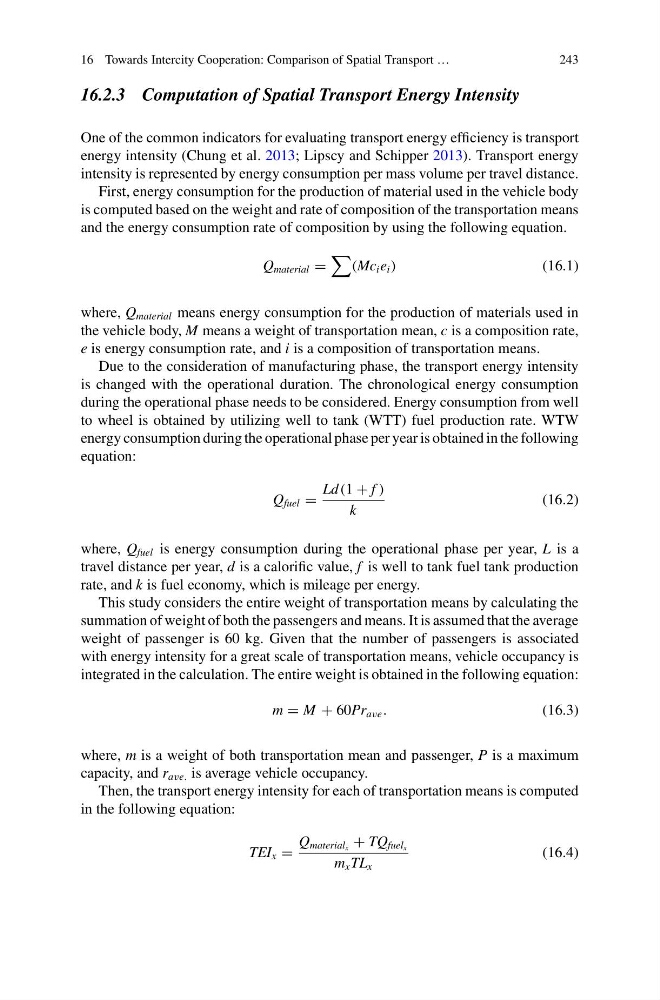
where, Q material means energy consumption for the production of materials used in
the vehicle body, M means a weight of transportation mean, c is a composition rate,
e is energy consumption rate, and i is a composition of transportation means.
Due to the consideration of manufacturing phase, the transport energy intensity
is changed with the operational duration. The chronological energy consumption
during the operational phase needs to be considered. Energy consumption from well
to wheel is obtained by utilizing well to tank (WTT) fuel production rate. WTW
energy consumption during the operational phase per year is obtained in the following
equation:
Q fuel =
Ld (1 + f )
k
(16.2)
where, Q fuel is energy consumption during the operational phase per year, L is a
travel distance per year, d is a calorific value, f is well to tank fuel tank production
rate, and k is fuel economy, which is mileage per energy.
This study considers the entire weight of transportation means by calculating the
summation of weight of both the passengers and means. It is assumed that the average
weight of passenger is 60 kg. Given that the number of passengers is associated
with energy intensity for a great scale of transportation means, vehicle occupancy is
integrated in the calculation. The entire weight is obtained in the following equation:
m = M + 60Pr ave .
(16.3)
where, m is a weight of both transportation mean and passenger, P is a maximum
capacity, and r ave. is average vehicle occupancy.
Then, the transport energy intensity for each of transportation means is computed
in the following equation:
TEI x =
Q material x + TQ fuel x
m x TL x
(16.4)
243
16.2.3 Computation of Spatial Transport Energy Intensity
One of the common indicators for evaluating transport energy efficiency is transport
energy intensity (Chung et al. 2013; Lipscy and Schipper 2013). Transport energy
intensity is represented by energy consumption per mass volume per travel distance.
First, energy consumption for the production of material used in the vehicle body
is computed based on the weight and rate of composition of the transportation means
and the energy consumption rate of composition by using the following equation.
Q material =
(Mc i e i )
(16.1)
where, Q material means energy consumption for the production of materials used in
the vehicle body, M means a weight of transportation mean, c is a composition rate,
e is energy consumption rate, and i is a composition of transportation means.
Due to the consideration of manufacturing phase, the transport energy intensity
is changed with the operational duration. The chronological energy consumption
during the operational phase needs to be considered. Energy consumption from well
to wheel is obtained by utilizing well to tank (WTT) fuel production rate. WTW
energy consumption during the operational phase per year is obtained in the following
equation:
Q fuel =
Ld (1 + f )
k
(16.2)
where, Q fuel is energy consumption during the operational phase per year, L is a
travel distance per year, d is a calorific value, f is well to tank fuel tank production
rate, and k is fuel economy, which is mileage per energy.
This study considers the entire weight of transportation means by calculating the
summation of weight of both the passengers and means. It is assumed that the average
weight of passenger is 60 kg. Given that the number of passengers is associated
with energy intensity for a great scale of transportation means, vehicle occupancy is
integrated in the calculation. The entire weight is obtained in the following equation:
m = M + 60Pr ave .
(16.3)
where, m is a weight of both transportation mean and passenger, P is a maximum
capacity, and r ave. is average vehicle occupancy.
Then, the transport energy intensity for each of transportation means is computed
in the following equation:
TEI x =
Q material x + TQ fuel x
m x TL x
(16.4)