

242
S. Kosai and E. Yamasue
16.2.1 Boundary of Transport Energy Consumption
In the transport energy efficiency narratives, interest in the lifecycle fuel consumption
during the transport operational phase has increasingly been growing as a research
topic. One of the major lifecycle approaches focuses on the entire fuel consumption
during the operational phase from well to wheel (WTW) beyond tank to wheel
(TTW) (Fiori et al. 2016). In particular, the WTW assessment has been applied
to automobiles (Kosai et al. 2018), electric trains (Washing and Pulugurtha 2015)
and bicycles (Melo and Baptista 2017). The other lifecycle approach focuses on the
energy consumption during all lifecycle phases including not only operation but also
manufacture, maintenance, recycle, and end-of-life (Facanha and Horvath 2007).
This study focuses on the WTW fuel consumption during the operational phase
and energy input for the production materials used for body structure during
the manufacturing phase. Various studies pointed out the significance of energy
consumption at the manufacturing phase among the lifecycle transport stages
(Sullivan et al. 2013). Meanwhile, energy input for other life cycle stages including
maintenance, recycling and end-of-life, and for the development of transport
infrastructure is out of focus.
16.2.2 Transportation Modes
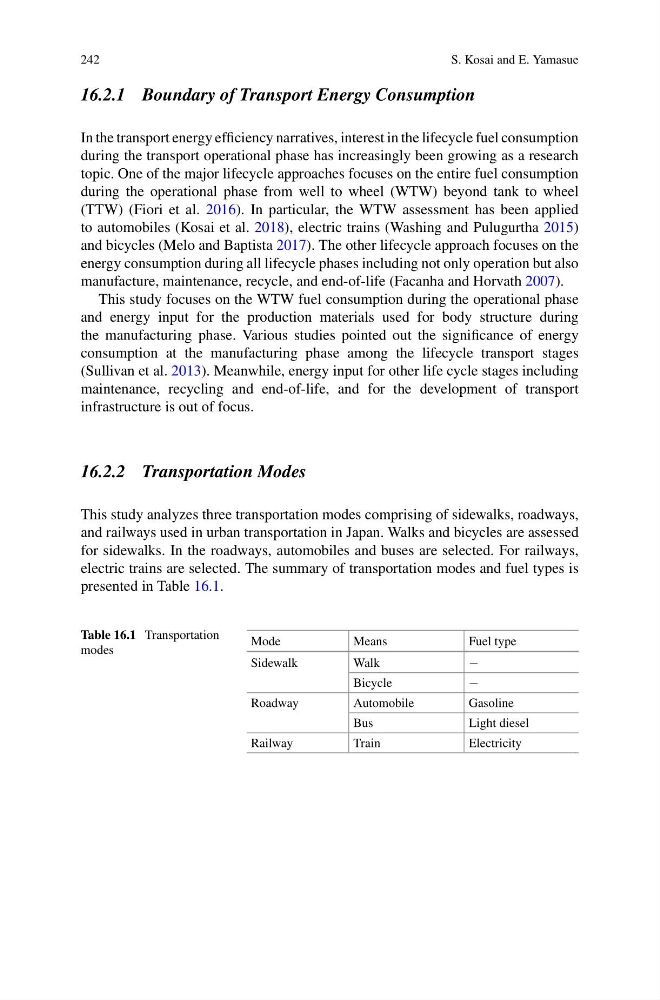
This study analyzes three transportation modes comprising of sidewalks, roadways,
and railways used in urban transportation in Japan. Walks and bicycles are assessed
for sidewalks. In the roadways, automobiles and buses are selected. For railways,
electric trains are selected. The summary of transportation modes and fuel types is
presented in Table 16.1.
Table 16.1 Transportation
modes
Mode
Means
Fuel type
Sidewalk
Walk
−
Bicycle
−
Roadway
Automobile
Gasoline
Bus
Light diesel
Railway
Train
Electricity
S. Kosai and E. Yamasue
16.2.1 Boundary of Transport Energy Consumption
In the transport energy efficiency narratives, interest in the lifecycle fuel consumption
during the transport operational phase has increasingly been growing as a research
topic. One of the major lifecycle approaches focuses on the entire fuel consumption
during the operational phase from well to wheel (WTW) beyond tank to wheel
(TTW) (Fiori et al. 2016). In particular, the WTW assessment has been applied
to automobiles (Kosai et al. 2018), electric trains (Washing and Pulugurtha 2015)
and bicycles (Melo and Baptista 2017). The other lifecycle approach focuses on the
energy consumption during all lifecycle phases including not only operation but also
manufacture, maintenance, recycle, and end-of-life (Facanha and Horvath 2007).
This study focuses on the WTW fuel consumption during the operational phase
and energy input for the production materials used for body structure during
the manufacturing phase. Various studies pointed out the significance of energy
consumption at the manufacturing phase among the lifecycle transport stages
(Sullivan et al. 2013). Meanwhile, energy input for other life cycle stages including
maintenance, recycling and end-of-life, and for the development of transport
infrastructure is out of focus.
16.2.2 Transportation Modes
This study analyzes three transportation modes comprising of sidewalks, roadways,
and railways used in urban transportation in Japan. Walks and bicycles are assessed
for sidewalks. In the roadways, automobiles and buses are selected. For railways,
electric trains are selected. The summary of transportation modes and fuel types is
presented in Table 16.1.
Table 16.1 Transportation
modes
Mode
Means
Fuel type
Sidewalk
Walk
−
Bicycle
−
Roadway
Automobile
Gasoline
Bus
Light diesel
Railway
Train
Electricity