

13 Information Flow System for Chemicals in Products (CiP) …
199
13.4.3 The US and EU
In the US and EU, waste management systems are similar in some respects, even
though they are very different in the overall architecture. In both systems, the classification of waste into hazardous versus non-hazardous is crucial and should be
considered at the beginning of the process.
In the US, there are two general categories of hazardous waste. One is “Listed
wastes”, including waste from industrial processes or sources (on F & K lists)
and unused chemicals (on P & U lists) according to the type of industry. The
other is “Characteristic wastes” consisting of four more specific classifications of
characteristics.
Landfill facilities are used as the final disposal sites for a large portion of hazardous
wastes (EPA 2005) and included under “land disposal” in the RCRA
*12 (Directive
2008). The HSWA
*13 to the RCRA prohibits the land disposal of hazardous wastes
included in the table of “Treatment Standards for Hazardous Wastes” if they do
not meet the requirements of the RCRA (European Commission 2018). This means
that there are other criteria for a landfill in addition to the categories for hazardous
wastes mentioned above. The table encompasses pesticides, organic substances and
ten inorganic substances. The number of organic substances and pesticides is so large
in comparison with Japanese regulations that we only consider inorganic substances
in this paper.
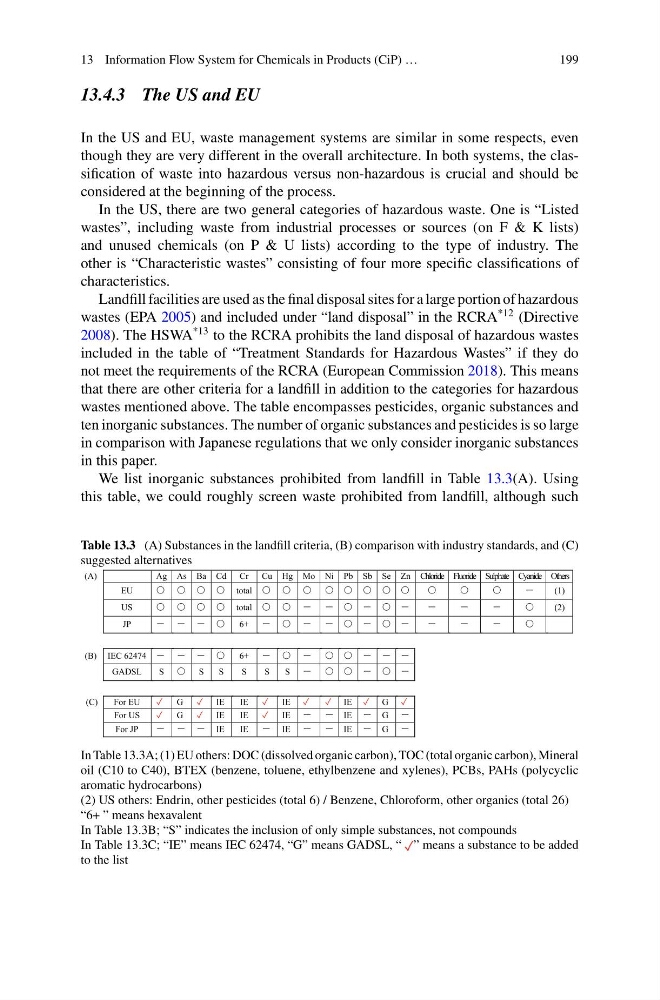
We list inorganic substances prohibited from landfill in Table 13.3(A). Using
this table, we could roughly screen waste prohibited from landfill, although such
Table 13.3 (A) Substances in the landfill criteria, (B) comparison with industry standards, and (C)
suggested alternatives
In Table 13.3A; (1) EU others: DOC (dissolved organic carbon), TOC (total organic carbon), Mineral
oil (C10 to C40), BTEX (benzene, toluene, ethylbenzene and xylenes), PCBs, PAHs (polycyclic
aromatic hydrocarbons)
(2) US others: Endrin, other pesticides (total 6) / Benzene, Chloroform, other organics (total 26)
“6+ ” means hexavalent
In Table 13.3B; “S” indicates the inclusion of only simple substances, not compounds
In Table 13.3C; “IE” means IEC 62474, “G” means GADSL, “ ” means a substance to be added
to the list
199
13.4.3 The US and EU
In the US and EU, waste management systems are similar in some respects, even
though they are very different in the overall architecture. In both systems, the classification of waste into hazardous versus non-hazardous is crucial and should be
considered at the beginning of the process.
In the US, there are two general categories of hazardous waste. One is “Listed
wastes”, including waste from industrial processes or sources (on F & K lists)
and unused chemicals (on P & U lists) according to the type of industry. The
other is “Characteristic wastes” consisting of four more specific classifications of
characteristics.
Landfill facilities are used as the final disposal sites for a large portion of hazardous
wastes (EPA 2005) and included under “land disposal” in the RCRA
*12 (Directive
2008). The HSWA
*13 to the RCRA prohibits the land disposal of hazardous wastes
included in the table of “Treatment Standards for Hazardous Wastes” if they do
not meet the requirements of the RCRA (European Commission 2018). This means
that there are other criteria for a landfill in addition to the categories for hazardous
wastes mentioned above. The table encompasses pesticides, organic substances and
ten inorganic substances. The number of organic substances and pesticides is so large
in comparison with Japanese regulations that we only consider inorganic substances
in this paper.
We list inorganic substances prohibited from landfill in Table 13.3(A). Using
this table, we could roughly screen waste prohibited from landfill, although such
Table 13.3 (A) Substances in the landfill criteria, (B) comparison with industry standards, and (C)
suggested alternatives
In Table 13.3A; (1) EU others: DOC (dissolved organic carbon), TOC (total organic carbon), Mineral
oil (C10 to C40), BTEX (benzene, toluene, ethylbenzene and xylenes), PCBs, PAHs (polycyclic
aromatic hydrocarbons)
(2) US others: Endrin, other pesticides (total 6) / Benzene, Chloroform, other organics (total 26)
“6+ ” means hexavalent
In Table 13.3B; “S” indicates the inclusion of only simple substances, not compounds
In Table 13.3C; “IE” means IEC 62474, “G” means GADSL, “ ” means a substance to be added
to the list