

8
K. Chinen et al.
1.3.3 Statistical Analysis
1.3.3.1 Hypotheses H1a, b, c
We accept the ordinal response model to examine the influence of a respondent’s
quality image toward CBEVs made in country c (PQ c ), perceived benefits of buying
EVs (PB), and perceived risks toward EVs on his/her purchase intention toward
country c’s CBEVs (PI c ). “c” includes China, the US, Sweden, Mexico, South Korea,
and Japan.
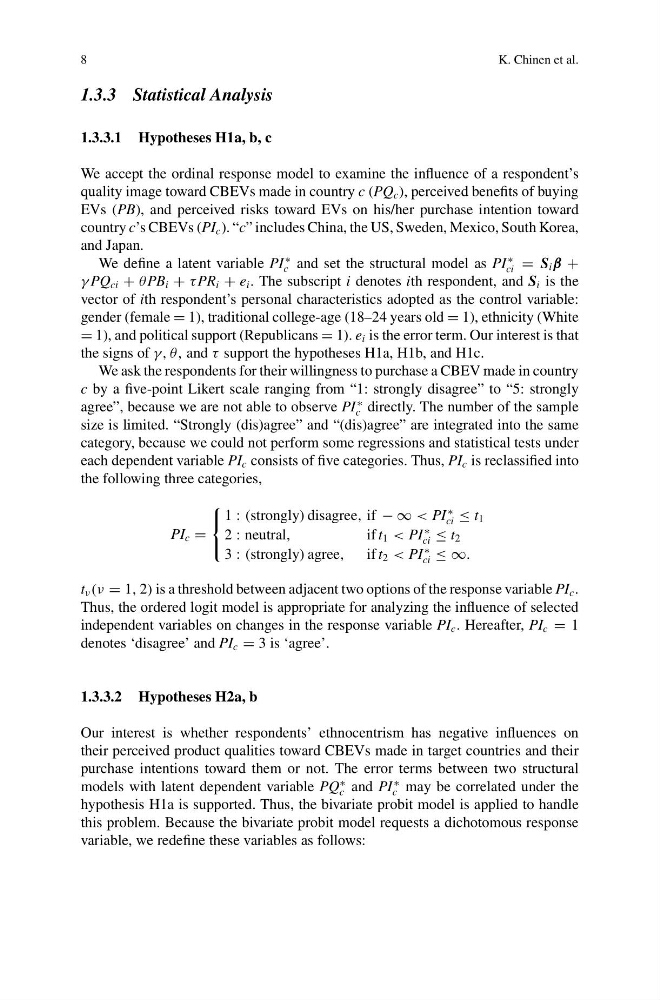
We define a latent variable PI
∗
c and set the structural model as PI
∗
ci = S i β +
γ PQ ci + θ PB i + τ PR i + e i . The subscript i denotes ith respondent, and S i is the
vector of ith respondent’s personal characteristics adopted as the control variable:
gender (female = 1), traditional college-age (18–24 years old = 1), ethnicity (White
= 1), and political support (Republicans = 1). e i is the error term. Our interest is that
the signs of γ, θ, and τ support the hypotheses H1a, H1b, and H1c.
We ask the respondents for their willingness to purchase a CBEV made in country
c by a five-point Likert scale ranging from “1: strongly disagree” to “5: strongly
agree”, because we are not able to observe PI
∗
c directly. The number of the sample
size is limited. “Strongly (dis)agree” and “(dis)agree” are integrated into the same
category, because we could not perform some regressions and statistical tests under
each dependent variable PI c consists of five categories. Thus, PI c is reclassified into
the following three categories,
PI c =
⎧
⎨
⎩
1 : (strongly) disagree, if − ∞ < PI
∗
ci ≤ t 1
2 : neutral,
if t 1 < PI
∗
ci ≤ t 2
3 : (strongly) agree, if t 2 < PI
∗
ci ≤ ∞.
t ν (ν = 1, 2) is a threshold between adjacent two options of the response variable PI c .
Thus, the ordered logit model is appropriate for analyzing the influence of selected
independent variables on changes in the response variable PI c . Hereafter, PI c = 1
denotes ‘disagree’ and PI c = 3 is ‘agree’.
1.3.3.2 Hypotheses H2a, b
Our interest is whether respondents’ ethnocentrism has negative influences on
their perceived product qualities toward CBEVs made in target countries and their
purchase intentions toward them or not. The error terms between two structural
models with latent dependent variable PQ
∗
c and PI
∗
c may be correlated under the
hypothesis H1a is supported. Thus, the bivariate probit model is applied to handle
this problem. Because the bivariate probit model requests a dichotomous response
variable, we redefine these variables as follows:
K. Chinen et al.
1.3.3 Statistical Analysis
1.3.3.1 Hypotheses H1a, b, c
We accept the ordinal response model to examine the influence of a respondent’s
quality image toward CBEVs made in country c (PQ c ), perceived benefits of buying
EVs (PB), and perceived risks toward EVs on his/her purchase intention toward
country c’s CBEVs (PI c ). “c” includes China, the US, Sweden, Mexico, South Korea,
and Japan.
We define a latent variable PI
∗
c and set the structural model as PI
∗
ci = S i β +
γ PQ ci + θ PB i + τ PR i + e i . The subscript i denotes ith respondent, and S i is the
vector of ith respondent’s personal characteristics adopted as the control variable:
gender (female = 1), traditional college-age (18–24 years old = 1), ethnicity (White
= 1), and political support (Republicans = 1). e i is the error term. Our interest is that
the signs of γ, θ, and τ support the hypotheses H1a, H1b, and H1c.
We ask the respondents for their willingness to purchase a CBEV made in country
c by a five-point Likert scale ranging from “1: strongly disagree” to “5: strongly
agree”, because we are not able to observe PI
∗
c directly. The number of the sample
size is limited. “Strongly (dis)agree” and “(dis)agree” are integrated into the same
category, because we could not perform some regressions and statistical tests under
each dependent variable PI c consists of five categories. Thus, PI c is reclassified into
the following three categories,
PI c =
⎧
⎨
⎩
1 : (strongly) disagree, if − ∞ < PI
∗
ci ≤ t 1
2 : neutral,
if t 1 < PI
∗
ci ≤ t 2
3 : (strongly) agree, if t 2 < PI
∗
ci ≤ ∞.
t ν (ν = 1, 2) is a threshold between adjacent two options of the response variable PI c .
Thus, the ordered logit model is appropriate for analyzing the influence of selected
independent variables on changes in the response variable PI c . Hereafter, PI c = 1
denotes ‘disagree’ and PI c = 3 is ‘agree’.
1.3.3.2 Hypotheses H2a, b
Our interest is whether respondents’ ethnocentrism has negative influences on
their perceived product qualities toward CBEVs made in target countries and their
purchase intentions toward them or not. The error terms between two structural
models with latent dependent variable PQ
∗
c and PI
∗
c may be correlated under the
hypothesis H1a is supported. Thus, the bivariate probit model is applied to handle
this problem. Because the bivariate probit model requests a dichotomous response
variable, we redefine these variables as follows: