

10 Understanding of Individuals’ Intention Toward Car Sharing …
153
10.3.4 Conceptual Model Structure Among Potential Factors
and Individuals’ Car Travel Behavior
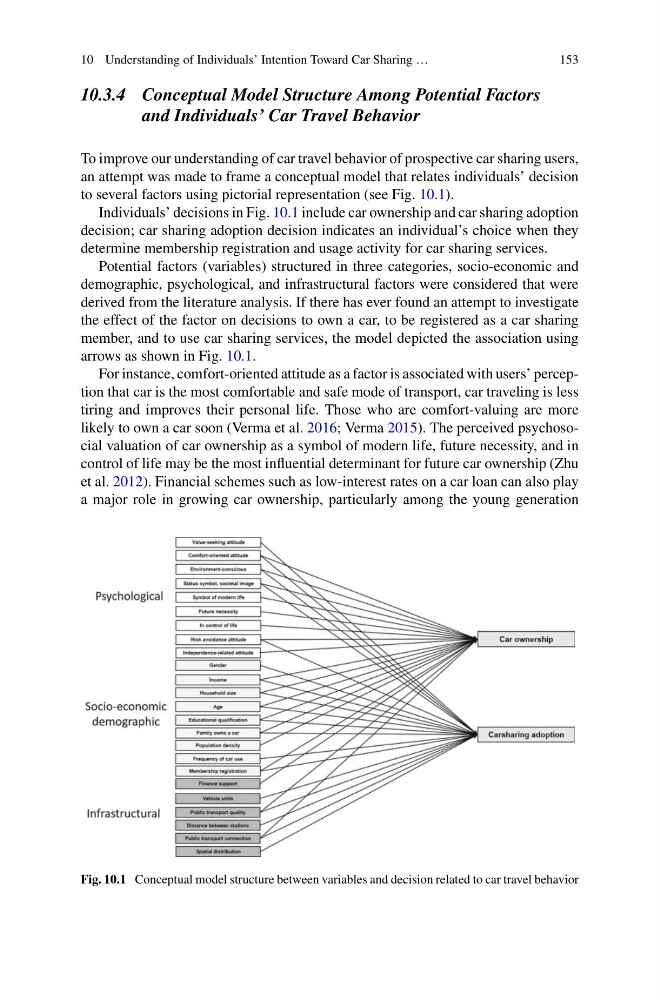
To improve our understanding of car travel behavior of prospective car sharing users,
an attempt was made to frame a conceptual model that relates individuals’ decision
to several factors using pictorial representation (see Fig. 10.1).
Individuals’ decisions in Fig. 10.1 include car ownership and car sharing adoption
decision; car sharing adoption decision indicates an individual’s choice when they
determine membership registration and usage activity for car sharing services.
Potential factors (variables) structured in three categories, socio-economic and
demographic, psychological, and infrastructural factors were considered that were
derived from the literature analysis. If there has ever found an attempt to investigate
the effect of the factor on decisions to own a car, to be registered as a car sharing
member, and to use car sharing services, the model depicted the association using
arrows as shown in Fig. 10.1.
For instance, comfort-oriented attitude as a factor is associated with users’ perception that car is the most comfortable and safe mode of transport, car traveling is less
tiring and improves their personal life. Those who are comfort-valuing are more
likely to own a car soon (Verma et al. 2016; Verma 2015). The perceived psychosocial valuation of car ownership as a symbol of modern life, future necessity, and in
control of life may be the most influential determinant for future car ownership (Zhu
et al. 2012). Financial schemes such as low-interest rates on a car loan can also play
a major role in growing car ownership, particularly among the young generation
Fig. 10.1 Conceptual model structure between variables and decision related to car travel behavior
153
10.3.4 Conceptual Model Structure Among Potential Factors
and Individuals’ Car Travel Behavior
To improve our understanding of car travel behavior of prospective car sharing users,
an attempt was made to frame a conceptual model that relates individuals’ decision
to several factors using pictorial representation (see Fig. 10.1).
Individuals’ decisions in Fig. 10.1 include car ownership and car sharing adoption
decision; car sharing adoption decision indicates an individual’s choice when they
determine membership registration and usage activity for car sharing services.
Potential factors (variables) structured in three categories, socio-economic and
demographic, psychological, and infrastructural factors were considered that were
derived from the literature analysis. If there has ever found an attempt to investigate
the effect of the factor on decisions to own a car, to be registered as a car sharing
member, and to use car sharing services, the model depicted the association using
arrows as shown in Fig. 10.1.
For instance, comfort-oriented attitude as a factor is associated with users’ perception that car is the most comfortable and safe mode of transport, car traveling is less
tiring and improves their personal life. Those who are comfort-valuing are more
likely to own a car soon (Verma et al. 2016; Verma 2015). The perceived psychosocial valuation of car ownership as a symbol of modern life, future necessity, and in
control of life may be the most influential determinant for future car ownership (Zhu
et al. 2012). Financial schemes such as low-interest rates on a car loan can also play
a major role in growing car ownership, particularly among the young generation
Fig. 10.1 Conceptual model structure between variables and decision related to car travel behavior