

7 Strengthening Aesthetic Individualization in Product Design …
109
customer-specific mass production is possible. However, it is not possible to
derive a standardized ideal procedure for a process that allows a greater degree
of individualization for every conceivable product.
7.4 Discussion and Conclusion
Overall it could be proven that an extension of individualization is possible and
more sustainable than mass produced goods. It could be found out that customers
not only use stronger individualized goods longer but also build up a higher product
attachment and thus build a stronger loyalty towards the brand. This means that the
product can be more sustainable, by encouraging the costumer to use the product for
a longer period of time, which means a costumer rebuys the product less often.
A greater degree of individualization must be formulated for each product, since
consumer needs as well as design and manufacturing processes for individual products differ greatly from one another. A basic guideline for the implementation of
individualization strategies, as proposed by Kaneko et al., is possible and its structure is also reflected in the process diagrams of both workshop groups. Kaneko et al.
describes the procedure for designing an individualization process of a product in the
process steps readout, goal setting, solution development, production and realization
(Kaneko et al. 2018).
In the case of an especially strong degree of individualization a more user centered
description model was chosen. It was possible to identify drivers that are important
for the success of such a process. The most important drivers that were identified
in the investigation of the paper and possible implementation strategies that derive
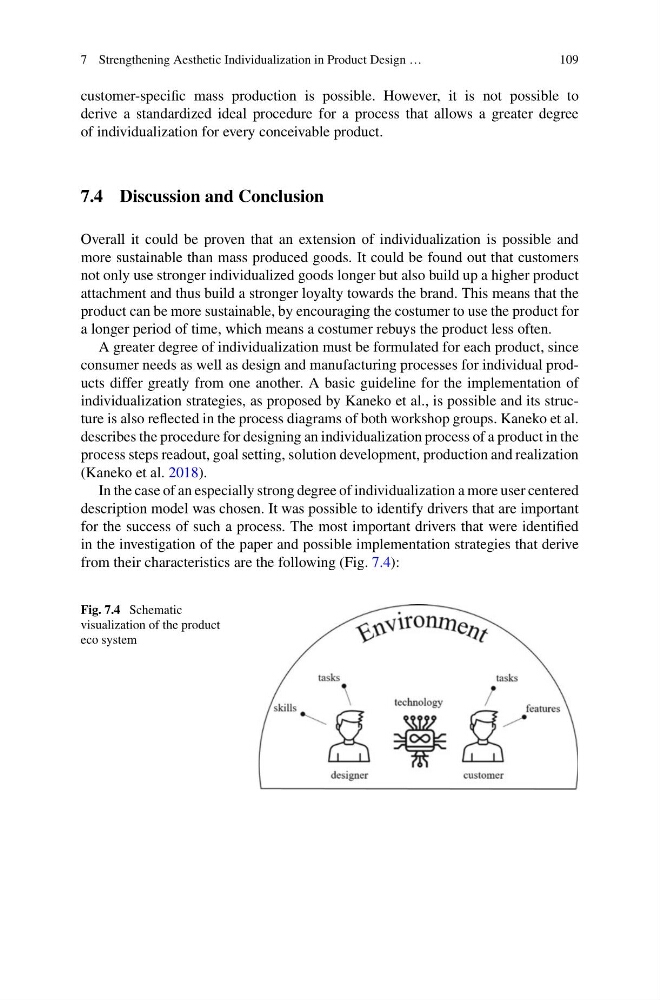
from their characteristics are the following (Fig. 7.4):
Fig. 7.4 Schematic
visualization of the product
eco system
109
customer-specific mass production is possible. However, it is not possible to
derive a standardized ideal procedure for a process that allows a greater degree
of individualization for every conceivable product.
7.4 Discussion and Conclusion
Overall it could be proven that an extension of individualization is possible and
more sustainable than mass produced goods. It could be found out that customers
not only use stronger individualized goods longer but also build up a higher product
attachment and thus build a stronger loyalty towards the brand. This means that the
product can be more sustainable, by encouraging the costumer to use the product for
a longer period of time, which means a costumer rebuys the product less often.
A greater degree of individualization must be formulated for each product, since
consumer needs as well as design and manufacturing processes for individual products differ greatly from one another. A basic guideline for the implementation of
individualization strategies, as proposed by Kaneko et al., is possible and its structure is also reflected in the process diagrams of both workshop groups. Kaneko et al.
describes the procedure for designing an individualization process of a product in the
process steps readout, goal setting, solution development, production and realization
(Kaneko et al. 2018).
In the case of an especially strong degree of individualization a more user centered
description model was chosen. It was possible to identify drivers that are important
for the success of such a process. The most important drivers that were identified
in the investigation of the paper and possible implementation strategies that derive
from their characteristics are the following (Fig. 7.4):
Fig. 7.4 Schematic
visualization of the product
eco system